
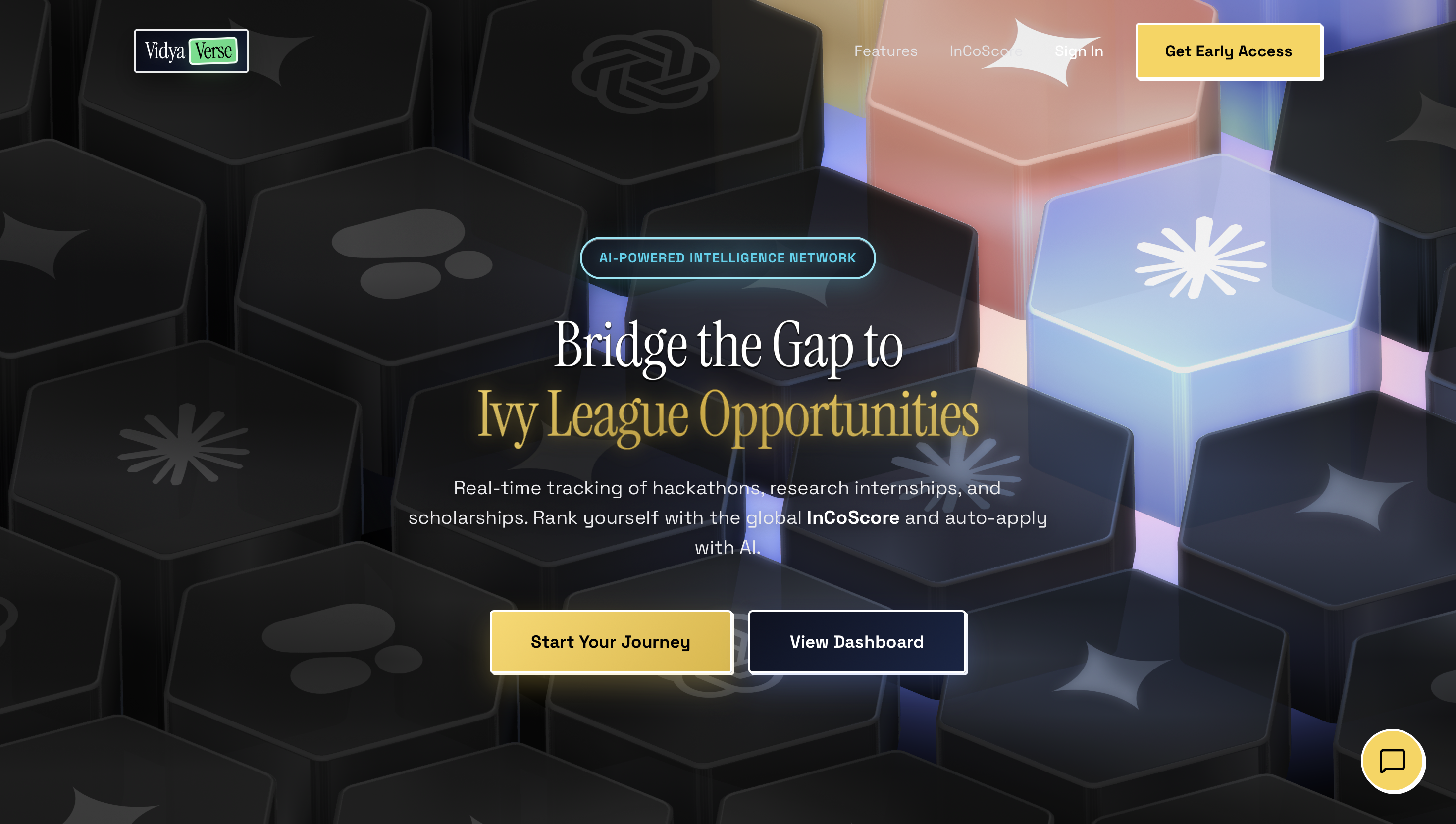
An internship posts once, then it's everywhere: the company's own careers page, three placement WhatsApp groups, a Telegram channel, a LinkedIn repost from someone who screenshotted it. By the time it reaches your feed, the slots are already gone. That's the problem Ankan Ghosh, a student at Lovely Professional University, decided to actually fix instead of just complaining about — and this is Campus Radar, GenZTech's new weekly spotlight on real student projects. First one up: his.
The problem: opportunities die in transit
"I kept losing opportunities before I even saw them," Ankan told us. "A company posts an internship, it lands on ten different portals and WhatsApp groups, and by the time it reaches your feed the slots are already gone." That's not a niche complaint — it's how most campus hiring actually moves in India: a single posting fans out across placement cells, WhatsApp broadcast lists, and Telegram channels faster than any one student can track, and the version that reaches you last is often the one with the fewest slots left. His fix wasn't another aggregator that dumps everything into one feed and calls it done — that just relocates the noise problem instead of solving it. Instead he built VidyaVerse, a portal that pulls opportunities from verified sources and ranks them against your actual CV and profile, so what you see is filtered before it reaches you, not after.
RelatedKimi K3 Needed 10x the Tokens to Tie Fable 5 on SWE
What he actually built
This is the part that separates VidyaVerse from a weekend scraper project. Under the hood it's semantic and vector-based retrieval, a behavior-informed learned ranking model, and a RAG panel that explains why a given opportunity was surfaced instead of just listing it. The system runs a closed learning loop — impressions feed clicks, saves, and applies back into the model, which retrains and only promotes a new version once it clears a quality gate. There's also a self-growing source network: new sources get discovered, then have to pass qualification, extraction, a probation period, and trust scoring before they're allowed into production, which is the part most scrapers skip entirely in exchange for volume. That's the same shape of engineering discipline you'd expect from a funded startup's data pipeline, not a student side project.
- Stack: FastAPI, Next.js, MongoDB, Redis, Playwright, NLP, vector search, RAG
- Security posture: Redis-backed cookie sessions, CSRF double-submit, CSP/Trusted Types, abuse locks, audit logs
- Operations: CI release gates, incident artifacts, scheduled scorecards, synthetic checks
How it's different from a normal listings site
| Trait | VidyaVerse | Typical listings aggregator |
|---|---|---|
| Source handling | New sources pass qualification, extraction, a probation period, and trust scoring before going live | Scrapes and republishes whatever it finds, no vetting |
| Ranking | Learned model, retrained against real click/save/apply behavior | Reverse-chronological or unranked |
| Explainability | RAG panel states why a result was surfaced | None — you get a list, not a reason |
| Personalization | Ranked against your uploaded CV and profile | Same feed for every visitor |
| Security posture | CSRF, CSP/Trusted Types, audit logs, abuse locks | Rarely a stated concern for a listings site |
The hardest part wasn't the scraping
"The hardest part wasn't the scraping," Ankan said. "It was training the ranking model to only surface real, verified opportunities instead of random noise, while still understanding what's actually relevant to you." Getting there took 130 model versions, A/B tested against 15,700+ real student interactions before the ranking started meaningfully moving the numbers that matter: a 58% lift in click-through rate and a 153% lift in apply rate versus the baseline. Those aren't vanity metrics from a demo — they're the kind of before/after a real product team tracks, applied to a system built and measured by one student, on a problem he was living through himself.
Our take
Most "AI for students" side projects stop at a slick landing page and a demo GIF. What makes VidyaVerse worth a closer look isn't the RAG panel or the vector search — plenty of student projects bolt those on for the resume line. It's the unglamorous half: rate limiting, CSRF protection, audit logs, a gated model-promotion pipeline that won't ship a retrained ranker until it clears a quality bar. That's the stuff that never shows up in a hackathon demo because judges don't ask for it, and it's exactly the stuff that separates a project built to be used from one built to be shown once and forgotten. Most student portfolios optimize for breadth — five different projects, none load-tested, all impressive for ninety seconds. Ankan went the other way: one system, measured against real usage, hardened like it might actually need to survive contact with real users. That's the bar Campus Radar is looking for.
Related29 Countries Sign China-Led AI Governance Body in Shanghai
VidyaVerse isn't publicly deployed yet — it's still active, in-progress work, browsable on GitHub rather than live. Ankan is also a Google Gemini Student Ambassador and builds independently alongside coursework and an SDE internship. Follow the project or reach out: GitHub · LinkedIn · portfolio.
- Built something? Doesn't need to be finished or fancy — a side project, a hackathon build, or a class project you're proud of counts.
- Email [email protected] with what you built, why you built it, a link, and your name + college.
- See every spotlight so far at genztech.blog/campus-radar.
Reporting based on a direct interview with Ankan Ghosh. Project details, stack, and metrics as described by the builder; GenZTech has not independently audited VidyaVerse's production claims.