
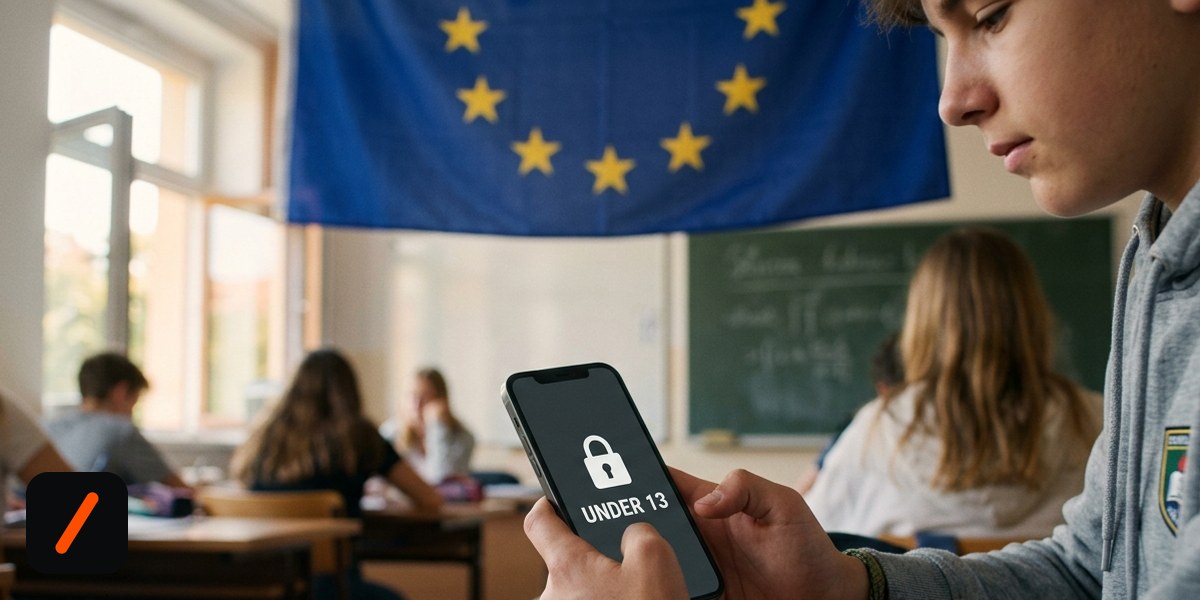
The European Commission wants to bar anyone under 13 from having a social media account anywhere in the EU, and to limit accounts for 13 to 15 year olds to supervised "mini accounts" that require a parent's consent. Commission President Ursula von der Leyen laid out the plan, called the Kids Act, in her State of the European Union speech in Strasbourg on Wednesday, September 16, 2026. The full legislative text follows a day later, on Thursday, September 17. Her framing was blunt: "No social media under the age of 13. No personal account under the age of 15." She added: "Europe has the power to act. It is us who decide the rules, not big tech."
- Under 13: no access to social media, online games or AI chatbots without parental supervision, in practice a ban.
- Ages 13 to 15: only supervised "mini accounts," with parental consent, controls, feature limits and time limits.
- Ages 15 to 18: platforms must build "safe by design" products rather than bolt on safety later.
- Fines reach 6% of global annual revenue, and platforms, not regulators, must prove their products are safe for minors.
What exactly does the Kids Act ban?
Three age lines, three obligations. Under 13 is a de facto ban: no access to social media, online games or AI chatbots without a parent supervising directly. From 13 to 15, only supervised "mini accounts" with upfront parental consent, controls, feature limits and time limits. From 15 to 18 the outright restrictions lift, but platforms must provide "safe design," products built to reduce harm by default rather than a settings menu a teenager can switch off.
RelatedEU Finds Instagram, Facebook Addictive Design Breaks DSA
Why are online games and AI chatbots included, not just social apps?
The text names two categories beyond the social media headline. Online games are flagged as posing "specific design risks for minors." AI powered chatbots and companions get their own callout as "virtual tools that can give mental health and personal development advice to minors." Companies in all three categories must add safeguards against abusive design and addictive behaviour, and for AI companions, against unhealthy emotional attachments and harmful interactions. That clause has no real precedent: social media age limits exist elsewhere, but a chatbot age line in primary law does not.
How would Brussels actually enforce an age limit like this?
Two mechanisms matter more than the age numbers. Companies would confirm a user's age through an official EU age verification app, not birthdate fields and self-attestation checkboxes. More consequential: the burden of proof flips. Today a regulator has to show a platform caused harm; under the Kids Act, platforms must prove their product is safe for minors before serving them. Non-compliance carries fines up to 6% of global annual revenue, not just EU revenue.
What's the path from speech to enforceable law?
Wednesday's speech and Thursday's text are the starting gun, not the finish line. The proposal still needs debate and a vote by the European Parliament and by the Council, representing the 27 member states, a process officials say could take years.
- September 15, 2026Euronews reports a leaked draft floating restrictions for under-15s ahead of the official announcement
- September 16, 2026Von der Leyen announces the Kids Act State of the European Union speech, Strasbourg
- September 17, 2026Full legislative text published the version this article is based on
- 2026 to 2028 (expected)Parliament and Council debate and vote officials describe a process that could take years
How does this compare with what Australia and France have tried?
The EU is not writing on a blank page. Australia has already enacted a national age restriction that keeps under-16s off social media accounts. New Zealand, Spain and Portugal have pursued comparable measures. France tried a narrower version and lost: its constitutional court struck down a national ban on social media accounts for under-15s in August 2026, citing infringement of fundamental freedoms, one reason Brussels is moving at bloc level rather than leaving this to national capitals.
| EU Kids Act | Australia | France | |
|---|---|---|---|
| Status | Text published September 17, 2026, debate ahead | Enacted and in force | Struck down, August 2026 |
| Age line | No access under 13, mini accounts only from 13 to 15 | No social media accounts under 16 | Proposed ban for under 15, blocked |
| Scope | Social and video platforms, online games, AI chatbots | Social media platforms | Social media platforms |
| Legal challenge | None yet, pending Parliament and Council | None named in our sources | Constitutional court cited infringement of fundamental freedoms |
The Kids Act arrives days after Meta agreed to an $18 billion settlement with US state attorneys general over child safety, as reported by the Associated Press, a reminder that youth safety pressure is not an EU-only story right now.
RelatedFrance's top court kills the under-15 social media ban
Not everyone is convinced age lines are the right lever. Simeon de Brouwer of the digital rights group EDRi argues the approach treats symptoms, not the "business model and extractive practices" that make these platforms addictive in the first place.
What it means for the market
The platforms with the most exposure to EU users under 16 are the obvious names: Meta (META), which runs Instagram and Facebook; Snap (SNAP), whose Snapchat skews younger than most social apps; Alphabet (GOOGL), through YouTube; and Roblox (RBLX), whose core audience is younger still. None has disclosed EU user counts by age band, so we are not putting a number on the exposure. The signal for investors is regulatory, not immediate: a multi year legislative process buys time to build age verification infrastructure, but the reversed burden of proof turns that into a standing compliance cost, not a one time build.
- The EU age verification app. Whether Brussels can ship and get adoption of a centralized tool, the hardest engineering problem in the proposal.
- Parliament and Council positioning. Whether states with struck down national laws, like France, push for a version that survives constitutional review.
- Platform response to reversed burden of proof. Expect compliance filings and safety audits before the law even takes effect.
- Whether other jurisdictions copy the chatbot provision. No other major market legislates an age line for AI companions yet.
Our take
The headline number, 6%, is the same top fine that already exists under the Digital Services Act. This is not a new regulator, it is the DSA's enforcement machinery extended to a new category of harm. The bigger structural change is the reversed burden of proof: platforms must now prove they are safe before serving minors, instead of waiting to be proven unsafe. That flips the default from permissive to restrictive. France's ruling is the clearest signal for why Brussels chose the EU route over national parliaments, since a bloc-wide instrument carries different legal standing than a domestic ban. The genuinely novel piece is AI companions sitting in the same bill as social media: chatbots giving "mental health and personal development advice" to a 12 year old are a real product category now, and the EU just became the first major jurisdiction to write an age line for them into primary legislation.
- ReportAP: EU chief proposes bloc-wide social media ban for kids under 13 primary report on the announcement and quotes
- ReportMacRumors: EU's Kids Act to ban social media for under-13s, curb chatbot access coverage of the AI chatbot provisions
- ReportBloomberg: EU unveils social media curbs for kids and ban on users under 13 market and enforcement detail
- ReportEuronews: leaked draft of the Commission's under-15 social media restrictions the September 15 leak that preceded the announcement
- OfficialEuropean Commission press corner, State of the Union 2026 official Commission communications hub
Original analysis by GenZTech, drawing on the primary source and the sources listed above.