
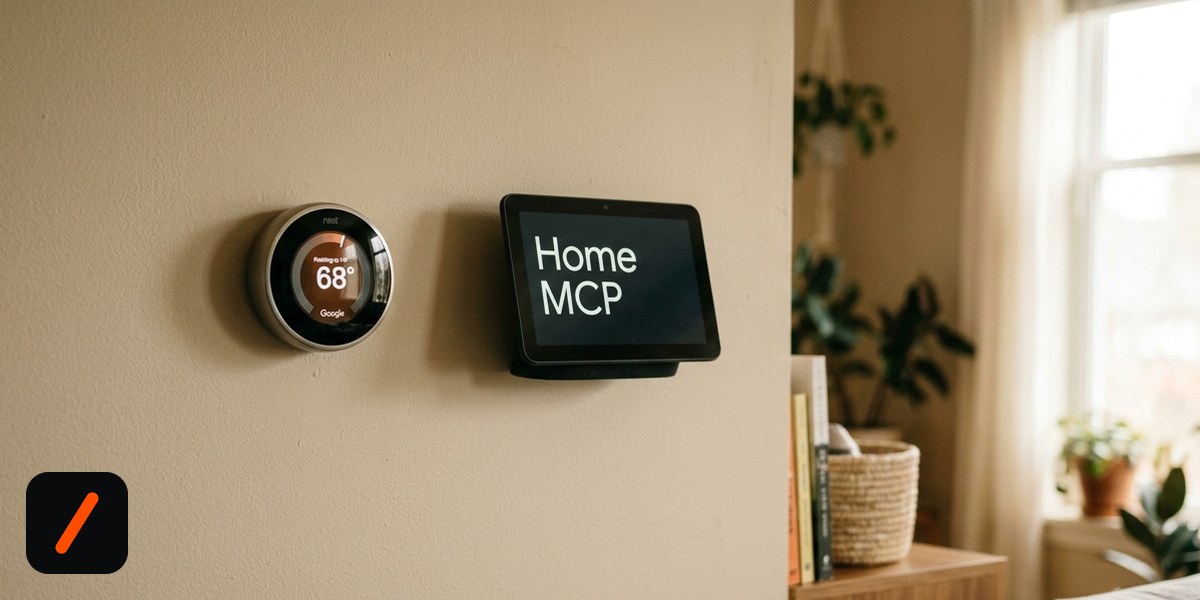
Google opened early access on September 16, 2026 to Home MCP, a Model Context Protocol server that lets outside AI agents, including Claude and ChatGPT, read and control every device sitting inside a user's Google Home setup: Nest cameras, Nest thermostats, Matter light bulbs, anything already working with Google Home. It is not a Google-only feature. It is gated behind a $20 a month Google Home Premium Advanced subscription, a Google Cloud project, and it stops well short of full control: no automations yet, no unlocking doors, ever.
- Home MCP is an open Model Context Protocol server at
home.googleapis.com/mcpthat any MCP-capable agent can connect to over Server-Sent Events. - Google names Google Antigravity, Claude, Hermes and OpenClaw as example agents; coverage also lists ChatGPT as a compatible MCP client.
- Five tools are exposed: listing homes, listing devices and their command schemas, reading live states, pulling history, and running device commands. Automations and door unlocks are explicitly off the table for now.
- Early access requires a US-based Google Home Premium Advanced subscription, a Google Cloud project with the Home API enabled, and arrives "in the coming weeks."
How does an outside agent like Claude actually reach a thermostat?
The mechanism is plain HTTP once it is set up. The Home MCP server lives at home.googleapis.com/mcp and talks over Server-Sent Events, the same transport pattern MCP servers use elsewhere. A developer creates a Google Cloud project, enables the Home API, and generates a Client ID and Client Secret, then feeds those into the agent's MCP configuration alongside the OAuth 2.0 scope https://www.googleapis.com/auth/home.platform.v2. From there the agent prompts the actual homeowner to sign in with their Google account and grant permission through the normal OAuth consent screen. Nothing happens until a real person clicks allow.
RelatedClaude Fable 5.1 and Mythos 5.1: Anthropic Splits the Safeguards
Once connected, the agent can call list_homes to see which structures exist, list_home_resources to enumerate devices and command schemas, list_home_states for live connectivity and trait data, list_home_history for past state changes, and run_home_actions to send a command. That is the entire surface area, documented in full at developers.home.google.com/mcp/home.
Why only five tools, and why no automations or door locks?
The count is small on purpose. Four of the five tools are read-only: discover, enumerate, read state, read history. Only run_home_actions writes anything, and it is parameterized, meaning the agent names a device and a specific command rather than issuing free-form instructions. Google's documentation is explicit that creating or managing automations is not supported through Home MCP yet, with that planned for a future release. Sensitive actions such as unlocking doors are prohibited outright, and Google says rate limits and other safety protections apply on top of that. It reads like a design built for an agent still being tested against real hardware, not one trusted to rewrite how the house runs.
| Tool | What it does | Read or write |
|---|---|---|
| list_homes | Discovers which home structures the user has | Read |
| list_home_resources | Enumerates devices, areas, traits and command schemas | Read |
| list_home_states | Returns real-time connectivity and trait states | Read |
| list_home_history | Returns historical state changes and event logs | Read |
| run_home_actions | Executes a parameterized command on a named device | Write |
Who can actually use Home MCP right now?
Not many people, yet, and only in the US. The early access build needs a Google Home Premium Advanced subscription, the $20 a month tier, plus enough comfort with Google Cloud to spin up a project and wire an API key into an agent's MCP settings. That is a developer-shaped bar, not a consumer one. Google frames the use cases as answering questions about home activity, summarizing camera footage across rooms, managing devices on someone's behalf, and building smart-home dashboards from plain language, all things a Premium Advanced subscriber already gets through Gemini, now reachable from whichever agent they prefer instead. Worth one line: a separate Home Developer MCP targets coding tools like the Antigravity CLI, Claude Code, Cursor and GitHub Copilot in VS Code, authenticated with trial paths or project API keys rather than a homeowner's OAuth login, for building against the Home API rather than controlling a real house.
What about the camera footage and familiar faces data?
This is the part worth sitting with. Letting a third-party agent summarize footage across rooms means Nest camera history is now something Claude or ChatGPT can be asked to read, not just Google's own assistant. Familiar-faces recognition data requires a separate, explicit consent on top of the base OAuth grant, and access can be revoked at any time from the Google Home app or the user's Google Account. Known issues so far: experimental device traits can behave unexpectedly, and Google is still tuning latency. None of that is unusual for an early access program, but handing a home's event history to whichever agent a user trusts is a meaningfully bigger blast radius than the closed system it replaces.
RelatedClaude Fable 5 Returns and Retakes the Coding Crown
- Late 2024Model Context Protocol introduced. Anthropic's open standard for connecting AI agents to tools and data becomes the common connector format across coding tools and enterprise apps.
- Sep 16, 2026Home MCP opens in early access. Google exposes the Home graph to Claude, ChatGPT, Antigravity, Hermes and OpenClaw via an open protocol for the first time.
- Coming weeksEarly access build ships. US-only, requires Google Home Premium Advanced and a Google Cloud project.
- Future releaseAutomations support planned. Google says creating and managing automations through Home MCP is not supported yet.
- Does the tool list grow past five. Automations are the obvious next addition; watch whether door locks ever join the allowed list.
- How far past the US it spreads. Early access is US-only and tied to Premium Advanced; international rollout is the next signal.
- Whether ChatGPT gets a documented integration. Google's docs list Antigravity, Claude Cowork and OpenClaw; ChatGPT appears in coverage but not yet in the docs.
- Adoption beyond the named agents. A five-tool, read-heavy API is easy to wrap; the test is how many builders beyond those four ship a connector.
Our take
Google did not have to do this. Gemini already sits inside Google Home, and keeping the graph exclusive to it would have been the obvious lock-in play. Opening an MCP endpoint that Claude and ChatGPT can use instead is a bet that Premium Advanced subscription revenue matters more than steering every home query to Gemini. The five-tool design backs that reading up: generous with information, four read tools plus full history, stingy with control, one write tool, no automations, no locks. That is a sensible place to start an early access program, and a tell that Google is not yet confident letting an outside model make consequential decisions in someone's house, which is the right instinct to have in September 2026.
What it means for the market
For Alphabet, this is a subscription upsell dressed up as openness: Home MCP only works for people already paying $20 a month, so every developer wiring up a Claude or ChatGPT connection is a walking advertisement for the tier. It also positions Google Home as the smart-home platform most willing to let rival AI ecosystems in, while Amazon's Alexa+ and Apple Home have kept their device graphs largely closed to outside agents. If adoption is real rather than a developer curiosity, watch whether Amazon or Apple answer with anything similarly open, or keep betting that owning the assistant end to end beats the platform fees an open protocol could generate.
- Officialdevelopers.home.google.com/mcp/home endpoint, auth scope, and the five-tool reference
- CoverageEngadget early access announcement and use cases
- CoverageAndroid Authority pricing and setup requirements
- CoverageAndroid Police agent compatibility, including ChatGPT
Original analysis by GenZTech. Source: Google Home MCP developer documentation.