
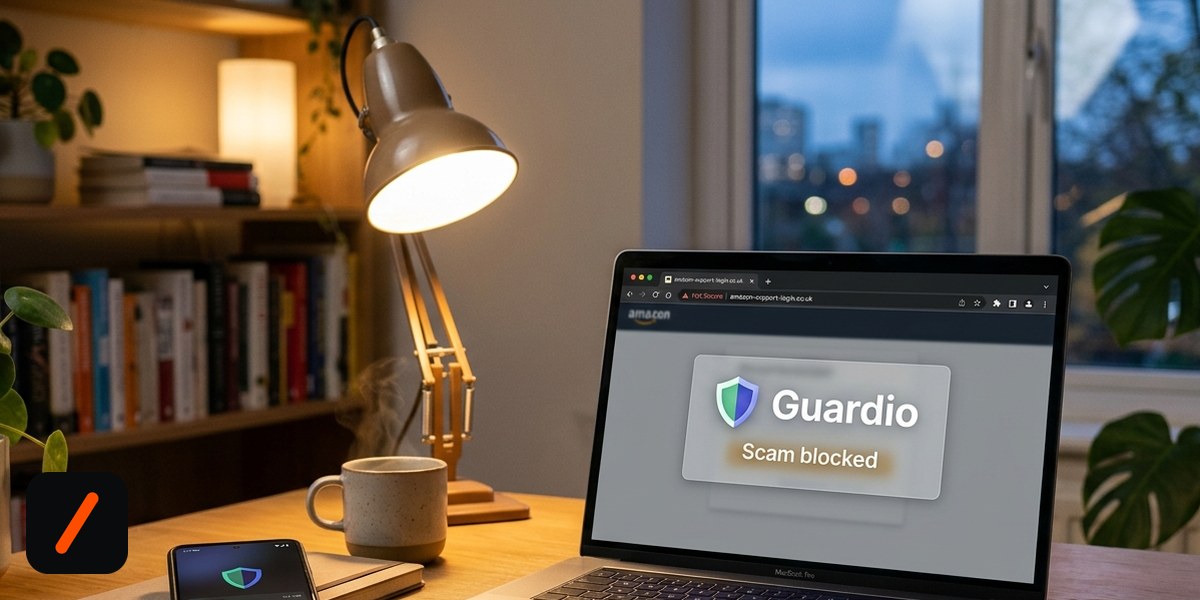
Guardio, a Tel Aviv-based consumer cybersecurity startup, has raised $40 million at a $1.1 billion valuation in a round joined by Assaf Rappaport, the Wiz co-founder and CEO who personally invested less than six months after Google parent Alphabet bought Wiz for $32 billion. The deal puts a company that protects ordinary people's browsers, inboxes and phones in valuation territory investors once reserved almost exclusively for enterprise security vendors.
- Guardio closed a $40 million round at a $1.1 billion valuation, announced around September 3, 2026, bringing its total funding to $167 million.
- Assaf Rappaport, who sold Wiz to Google/Alphabet for $32 billion in March 2026, personally joined the round, one of his first public personal bets since that exit.
- Existing backers ION Crossover Partners, Union Tech Ventures, Vintage Investment Partners, Cerca Partners and Emerge Ventures also returned for the round.
- Guardio has passed 1 million paying customers and $150 million in annual recurring revenue after four straight years of triple-digit growth.
What exactly did Guardio just raise?
On September 3, 2026, Guardio announced a $40 million funding round that values the company at $1.1 billion, officially making it a unicorn. The round adds to Guardio's capital base rather than replacing it: the company's Series B, an $80 million raise led by ION Crossover Partners, closed just ten months earlier in November 2025. Combined with earlier funding, Guardio has now taken in $167 million since founding. ION Crossover Partners returned for this round alongside Union Tech Ventures, Vintage Investment Partners, Cerca Partners and Emerge Ventures, all previous backers reinvesting rather than a fresh syndicate discovering the company for the first time. That pattern, insiders doubling down instead of new names being sold on faith, tends to signal confidence in the underlying numbers.
RelatedTemporal Raises $550M Series E at $12.55B, 2.5x in 7 Months
Why did a Wiz billionaire personally back a consumer security startup?
The headline name in the round is Assaf Rappaport, co-founder and chief executive of Wiz, the cloud security company Google's parent Alphabet acquired for $32 billion in March 2026. Rappaport personally invested in Guardio, making this one of the first major personal bets he has made public since that exit closed. The connection is not incidental. Wiz built its reputation, and its price tag, by convincing enterprises that cloud infrastructure needed dedicated, AI-aware security tooling rather than legacy products bolted onto old assumptions. Guardio is pitching the same logic at consumers: browsing, email and text messaging are now attack surfaces sophisticated enough to need purpose-built defense, not an antivirus suite treating phishing as an afterthought. A founder who just proved that thesis at enterprise scale putting his own money into the consumer version of it is the kind of signal other investors read closely, whether or not they say so out loud.
What does Guardio actually do?
Guardio sells a browser extension and companion apps built to sit between ordinary people and the scams, phishing pages, malicious sites and identity theft attempts that increasingly show up in their browsing, email and text messages. Unlike enterprise tools built for IT departments and security operations centers, Guardio is built for consumers who have no SOC, no IT admin and no time to evaluate whether a link, attachment or text message is safe. The company uses AI to flag and block threats in real time across those channels, positioning itself as enterprise-grade cybersecurity built for regular people. That framing matters commercially: it lets Guardio charge a subscription price closer to a security product than a free utility, which is part of how the company reports $150 million in ARR from a subscriber base north of 1 million paying customers, after four consecutive years of triple-digit growth.
Why is AI-era scam volume a real market now?
Guardio's growth story only makes sense against a broader shift: generative AI has collapsed the cost of producing convincing scam content. Cloned voices, personalized phishing emails referencing real details about a target, and deepfake audio or video impersonating a trusted contact used to require skill and time to fake credibly. Now they can be produced cheaply and at volume, which changes the economics of scamming from a craft into something closer to manufacturing. That shift is what turns a browser extension into a category with a plausible path to a billion-dollar valuation: the addressable population isn't security-conscious enterprises, it's every person with an inbox, a phone number and a browser, and the threats aimed at them are getting harder to spot on sight. Guardio's bet, and its investors' bet, is that AI-generated scam volume keeps climbing faster than most people's ability to recognize it, which keeps demand for automated, always-on defense growing too.
RelatedWonderful's $550M Series C Doubles Valuation to $5B
What it means for the market
A $1.1 billion valuation on $150 million in ARR works out to roughly 7.3 times revenue, a multiple that would have looked unremarkable during the 2021 software boom but stands out in 2026, when growth-stage investors have generally pulled multiples down and demanded profitability or a clear path to it. That Guardio commanded it anyway, with existing investors leading rather than a fresh syndicate discovering the story, suggests real appetite for AI-scam-defense as its own category, not a feature bolted onto existing antivirus suites. It also raises the standard follow-on questions for a newly minted unicorn: whether Guardio pursues an IPO once the category matures, or becomes an acquisition target for a larger security or consumer-tech player looking to absorb its user base and detection technology the way Google absorbed Wiz. Watch too for whether incumbents in consumer security respond with dedicated AI-scam products instead of folding the capability into existing suites, and whether more Wiz-adjacent capital keeps flowing into consumer-facing security given how thin that category has historically been relative to enterprise cybersecurity funding. Readers can track how this raise stacks up against other deals in GenZTech's Funding Tracker and against the largest AI-related rounds in our Biggest AI Funding Rounds tracker. None of this is a signal to trade on. It's a read on where growth capital thinks the next defensible security category sits.
| Product | Primary angle | Target user | AI-scam focus |
|---|---|---|---|
| Guardio | AI-native scam and phishing defense across browsing, email and text | Individual consumers, no IT support assumed | Core product thesis, built around AI-generated scam volume |
| McAfee+ | Broad consumer security suite: antivirus, VPN, identity monitoring | Individual consumers and families | Offered as a feature within a wider suite |
| Norton (Gen Digital) | Device protection plus identity and dark web monitoring | Individual consumers and families | Offered as a feature within a wider suite |
| Aura | Identity theft and financial fraud protection bundle | Families, often marketed around identity and credit monitoring | Positioned around identity fraud more than real-time browsing threats |
- Follow-on funding pace. Whether other consumer-security startups attract growth-stage rounds at similar ARR multiples, or whether Guardio's raise turns out to be an outlier tied specifically to Rappaport's involvement.
- Incumbent response. Whether McAfee, Norton/Gen Digital and Aura ship dedicated AI-scam-detection features positioned as aggressively as Guardio's, rather than treating it as a suite add-on.
- Exit path. Whether Guardio heads toward an IPO once ARR growth proves durable past the $150 million mark, or becomes an acquisition target for a larger security or consumer-tech platform.
- Rappaport's next moves. Whether this round is a one-off personal investment or the first of several bets he makes in consumer-facing security after the Wiz exit.
Our take
The interesting part of this raise isn't the dollar figure, it's who wrote a personal check. Rappaport didn't need to diversify into consumer security to prove anything after the Wiz sale; he could have taken a long vacation instead. That he chose to personally back a company solving a version of the same problem, purpose-built AI-era defense rather than generic tooling, but for consumers instead of cloud infrastructure, suggests the thesis he built a $32 billion company on travels further than enterprise IT. We would treat Guardio's $150 million ARR and its 1 million-plus paying customers as more meaningful than the valuation multiple itself: consumers rarely pay recurring subscriptions for security unless they have personally been burned or scared, and building that habit at this scale is harder than it looks. The real test is whether Guardio's growth curve holds once AI scam detection stops being a differentiator and becomes table stakes that every consumer security vendor claims to offer.
- News SiliconANGLE: Guardio raises $40M at $1.1B valuation - round details and investor list
- News CTech/Calcalist coverage of the raise - Israeli tech press context on Rappaport's involvement
- Official PR Newswire: Guardio reaches $1.1 billion valuation - official release with traction figures
- News fintech.global: Guardio raises $40M as scammers turn to AI at scale - market framing on AI-driven scam growth
Original analysis by GenZTech. Sources: SiliconANGLE, CTech, PR Newswire.