
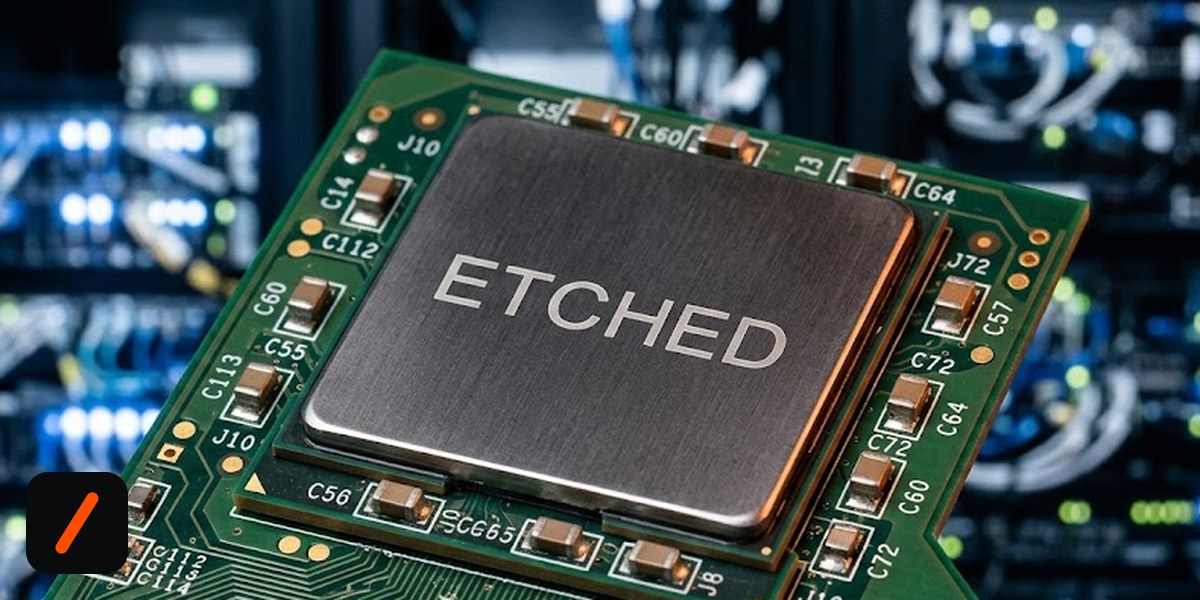
Etched, a four-year-old startup building chips that run only transformer AI models, has raised $300 million at a $10.3 billion valuation, roughly doubling its worth in about seven months and turning one of Silicon Valley's riskiest hardware bets into one of its most expensive. Sequoia Capital led the round, announced July 23, with memory maker SK Hynix among the backers. It is a wager that the AI industry will pay for silicon that does one thing extremely well instead of everything adequately.
- The round: $300M Series C at a $10.3B valuation, led by Sequoia Capital, up from roughly half that just seven months earlier.
- The bet: Etched's Sohu chip is an ASIC hard-wired for the transformer architecture behind GPT, Claude and Llama, trading a GPU's flexibility for far higher throughput on that single job.
- Why now: inference, the cost of running models rather than training them, is becoming the bulk of AI compute spend, and buyers want cheaper alternatives to Nvidia.
- The catch: an architecture-specific chip is a gamble that transformers stay dominant; a shift in model design could strand the silicon.
What did Etched raise, and from whom?
Etched closed a $300 million Series C at a $10.3 billion valuation, according to reporting from TechCrunch and Reuters. Sequoia Capital led, and SK Hynix, one of the world's largest makers of the high-bandwidth memory that AI chips depend on, is among the backers. The valuation is the headline: it roughly doubled in about seven months, a striking mark-up for a company that has yet to ship its flagship chip at scale. Etched was founded in 2022 by three Harvard dropouts and has spent its short life on a single, contrarian idea.
RelatedGimlet Labs Raises $300M at $3B to Bet Against Nvidia Lock-In
What is a transformer ASIC, and why build one?
Nearly every large AI model in use today, from GPT to Claude to Llama, is built on the transformer architecture. GPUs, the chips Nvidia sells by the billion, can run transformers, but they can also run almost anything else, and that generality costs silicon area and power. Etched's pitch is to throw the generality away. Its Sohu chip is an application-specific integrated circuit, or ASIC, with the transformer's core operations, attention and the feed-forward layers, etched directly into hardware. The claim is that a chip built for one architecture can push far more tokens per second per watt than a general GPU running the same model.
That is a powerful pitch precisely because the market has tilted toward inference. Training a frontier model is a one-time, capital-intensive event; serving it to millions of users is a continuous, growing cost. If inference is where the money now goes, a chip that makes inference dramatically cheaper is worth a great deal, which is the case Sequoia is buying.
How does Sohu compare to Nvidia, Groq and Cerebras?
Etched is not alone in attacking Nvidia from the inference side, but its approach is the most specialized of the challengers.
| Approach | Etched Sohu | Nvidia GPU | Groq / Cerebras |
|---|---|---|---|
| Chip type | Transformer-only ASIC | General-purpose GPU | Inference-tuned accelerators |
| Flexibility | Very low, by design | Very high | Medium |
| Pitch | Max throughput per watt on transformers | Runs everything, huge ecosystem | Fast inference, more general than an ASIC |
| Main risk | Architecture lock-in | Cost and supply | Standing out from both ends |
The trade is stark. Nvidia wins on flexibility, software and an entrenched ecosystem. Etched wins, if it wins, only on the narrow axis of running transformers cheaply, and only for as long as transformers dominate.
What does it mean for the market?
The signal for investors is that specialized inference silicon is now a fundable category with real conviction behind it, not a fringe science project. Nvidia (NASDAQ: NVDA) still owns training and most inference, but the challenge is clearly organizing around the cost of serving models, which is where its margins are most exposed. SK Hynix's involvement is its own tell: a top memory supplier backing Etched signals confidence in demand for the high-bandwidth memory these chips need, and gives Etched a friendlier path to supply. For Sequoia, the doubling valuation is a bet that Etched ships Sohu at volume before the model landscape moves. The thing to watch is not the valuation but the silicon: whether Sohu reaches customers in production, at the throughput Etched claims, on a real manufacturing schedule.
RelatedClay's Sales AI Startup Hits a $7 Billion Valuation
What could go wrong?
The same specialization that makes Sohu fast makes it fragile. An ASIC cannot be reprogrammed for a new architecture; if the field moves decisively past the transformer, the way it once moved past earlier designs, Etched's chip becomes expensive scrap. Manufacturing risk is real too: designing an ambitious ASIC is one thing, yielding it at volume on a leading process node is another, and hardware startups routinely stumble on exactly that step. A $10.3 billion valuation leaves little room for either failure mode.
- Production Sohu. Real customers running real workloads, the only proof that beats a benchmark slide.
- Architecture drift. Any serious move away from transformers is an existential risk to a transformer-only chip.
- Nvidia's response. Whether Nvidia leans harder into inference-optimized parts to close the price gap Etched is attacking.
Our take
Etched is a clean, high-conviction bet on a single idea: that transformers are here to stay and that generality is a tax worth cutting. If both halves hold, a transformer-only chip is exactly the kind of company that can carve a durable slice out of Nvidia's inference business. If either half breaks, the same design that makes it fast makes it a liability. A $10.3 billion valuation prices in the optimistic case; the next year of production and model trends will decide whether that price was vision or hubris. Either way, the round confirms investors now see specialized inference silicon as a real front in the war on Nvidia, not a sideshow.
- ReportingReuters: Etched raises $300M at $10.3B valuation — round terms and investors
- FundingGENZ TECH Funding Tracker — our running record of AI-era rounds
- ReferenceBiggest AI funding rounds — ranked by size
Original analysis by GenZTech. Source: Reuters.