
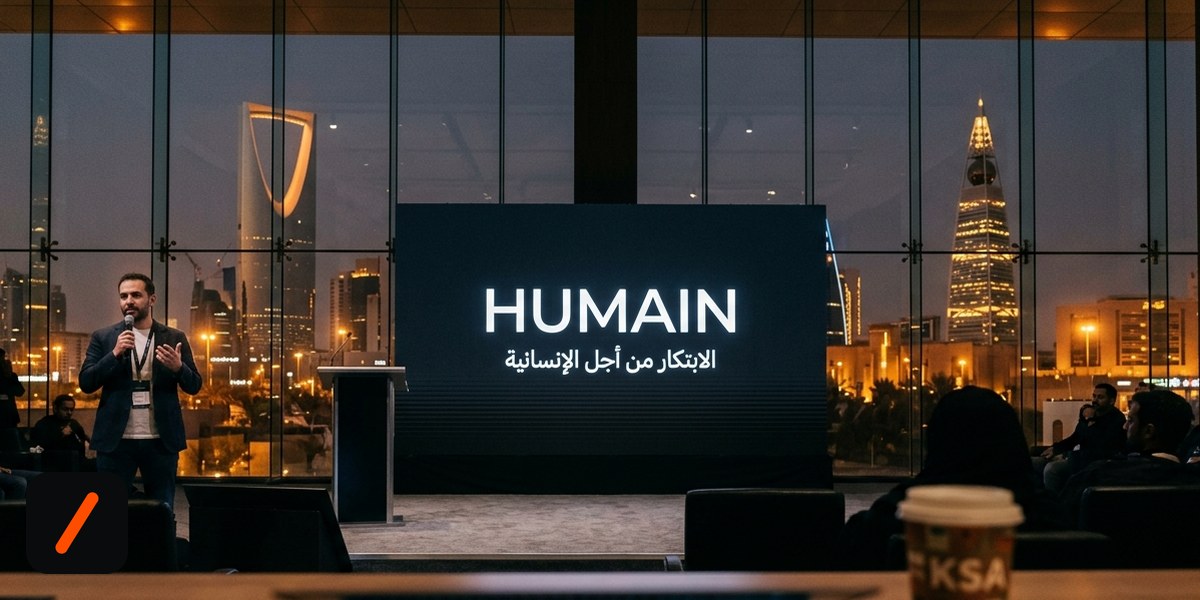
HUMAIN, Saudi Arabia's state-backed AI company, used the LEAP conference stage in Riyadh on September 3, 2026 to unveil humain-m3, a 428-billion-parameter Arabic language model. The headline number isn't really the parameter count. It's that HUMAIN built the model on top of MiniMax-M3, an open-weight base model from a Chinese lab, instead of training from a blank slate or wiring its national AI platform to a US provider's API.
- 428B total, roughly 23B active parameters. humain-m3 is a Mixture-of-Experts model, so each token only routes through about 23 billion of its 428 billion parameters, which keeps inference cheaper than a dense model of the same size would be.
- Trained on more than 1 trillion Arabic tokens. HUMAIN layered additional pre-training and post-training on top of MiniMax-M3 using upwards of a trillion tokens of Arabic-native text.
- 89.37% average across seven Arabic benchmarks. That figure comes from HUMAIN itself. Nobody outside the company has reproduced it yet.
- Live now, not just announced. Developers can already try humain-m3 through a research preview called HUMAIN Node.
What exactly did HUMAIN announce at LEAP?
HUMAIN is Saudi Arabia's national AI company, funded through the Public Investment Fund and positioned as the kingdom's main vehicle for building AI infrastructure, data centers, and models under one roof. At LEAP 2026 in Riyadh, the company introduced humain-m3 as a frontier Arabic language model rather than a general-purpose chatbot bolted onto an existing product. The base architecture comes from MiniMax-M3, a Mixture-of-Experts model released by the Chinese AI lab MiniMax. HUMAIN then trained on top of that foundation with more than a trillion tokens of Arabic-native content, tuning it for the dialects, script direction, and cultural context that most multilingual models treat as an afterthought. The result ships today as a research preview inside HUMAIN Node, not as a distant roadmap item.
RelatedZhipu's GLM-5.2 Tops the Open-Weight Model Rankings
Why build on Chinese weights instead of starting from scratch?
Training a 428-billion-parameter model from nothing costs hundreds of millions of dollars in compute and takes a research team years to get right, even before you touch the Arabic-specific tuning. Open weights let you skip that step entirely. MiniMax already spent the money and the engineering hours; HUMAIN downloaded the result and adapted it. That's the practical case: it's cheaper, faster, and lower risk than a from-scratch build.
There's a control argument too. Open weights mean HUMAIN can inspect the model, modify it, and run it entirely on hardware it owns, with no dependency on a foreign company's servers staying online or a contract staying favorable. Compare that to leaning on a closed API from OpenAI, Anthropic, or Google, where the weights never leave the vendor's infrastructure and the terms of access can shift with US policy. For a government building what it calls sovereign AI, owning the weights is the entire point. Renting inference from a US lab would defeat that goal just as thoroughly as building nothing at all.
What does this mean for US AI export controls?
Washington's export control regime was built mostly around hardware: restricting which countries can buy advanced Nvidia chips and under what conditions. The implicit bet behind that policy was that even if a country got the chips, it would still need American models and American APIs to do anything useful with them, and that dependency would keep leverage in US hands. humain-m3 is a quiet counterexample. MiniMax, DeepSeek, and Qwen all publish open weights, and a government with enough GPUs, including the Nvidia chips it may have already bought under license, can fine-tune one of those models into a national platform without asking Washington or Beijing for anything further. That doesn't break export controls on paper, but it chips away at the assumption that controlling chips is enough to control outcomes. It also deepens a Gulf-China tech relationship that the US has been trying to slow down through diplomacy rather than law.
RelatedCognition's SWE-2 Nearly Matches GPT-6 Astra for a Quarter the Price
How good is humain-m3, really?
The 89.37% average across seven Arabic-language benchmarks is HUMAIN's own number, and TechTimes flagged it as unverified in its analysis. Vendor-reported benchmarks tend to be selected and framed favorably, so treat that figure as a starting claim rather than an established fact until outside researchers run their own evaluations. What's more defensible is the architectural logic: MoE models like this one trade a bit of raw quality, relative to a dense model with the same active parameter count, for a large efficiency win at inference time. The bigger differentiator is probably the Arabic-native training data. General-purpose models, whatever their overall benchmark scores, routinely struggle with Arabic because of script handling, dialectal variation across the Gulf, Levant, and North Africa, and a smaller share of Arabic text in most training corpora. A model built specifically to close that gap has a real shot at outperforming bigger, more famous models on Arabic tasks specifically, even if it can't touch them on English reasoning benchmarks.
How does humain-m3 stack up against other regional efforts?
| humain-m3 | MiniMax-M3 (base) | Falcon (UAE / TII) | GPT-5 / Gemini (Arabic use) | |
|---|---|---|---|---|
| Total / active params | 428B / ~23B, MoE | 428B / ~23B, MoE | Up to ~180B, dense | Undisclosed |
| Base weights origin | Chinese base, Saudi fine-tune | Chinese, built in-house | Emirati, built in-house | US, closed |
| Arabic-native training | 1T+ tokens, targeted | General multilingual mix | Arabic included from day one | Multilingual, Arabic a small slice |
| Access today | Research preview, HUMAIN Node | Open weights, downloadable | Open weights, several sizes | API only |
| Self-hostable | Yes, open lineage | Yes | Yes | No |
- Independent benchmarking. Watch for third-party researchers to run humain-m3 against the same seven benchmarks, or against harder Arabic-specific test sets, to see if 89.37% holds up.
- Washington's response. Whether US officials treat open-weight Chinese foundation models as a policy gap worth closing, or continue focusing export control energy on chips alone.
- Copycat announcements. If humain-m3 performs well in production, expect other sovereign wealth funds to fork the same playbook: take an open Chinese base, fine-tune for a local language, ship fast.
- HUMAIN's next moves. This model is one piece of a much larger PIF-backed AI buildout; watch for data center and chip procurement news tied to it.
Our take
The interesting part of this story isn't whether humain-m3 is a great model. It's that a government spending billions to build "sovereign" AI decided the fastest route to sovereignty ran through someone else's weights, and that someone else was Chinese rather than American. That's not hypocrisy so much as a rational response to the options on the table: train from zero and burn years and a fortune, rent a closed US API and stay permanently dependent, or fork open weights and own the result outright. Two of those three options currently point away from Washington. If more Gulf and Asian states run the same math, the leverage the US assumed it held through chip export controls looks a lot less solid than it did a year ago. We'd also push back gently on treating the 89.37% figure as settled. Vendor benchmarks are marketing documents first and technical documents second, and this blog will treat any unverified number the same way regardless of who published it.
- Official HUMAIN's PR Newswire announcement the vendor release with full specs and benchmark claims
- Reporting Bloomberg's coverage of the LEAP unveiling context on the Saudi-China angle
- Analysis TechTimes' breakdown of the launch flags the unverified benchmark scores
Original analysis by GenZTech, based on Bloomberg's reporting.