
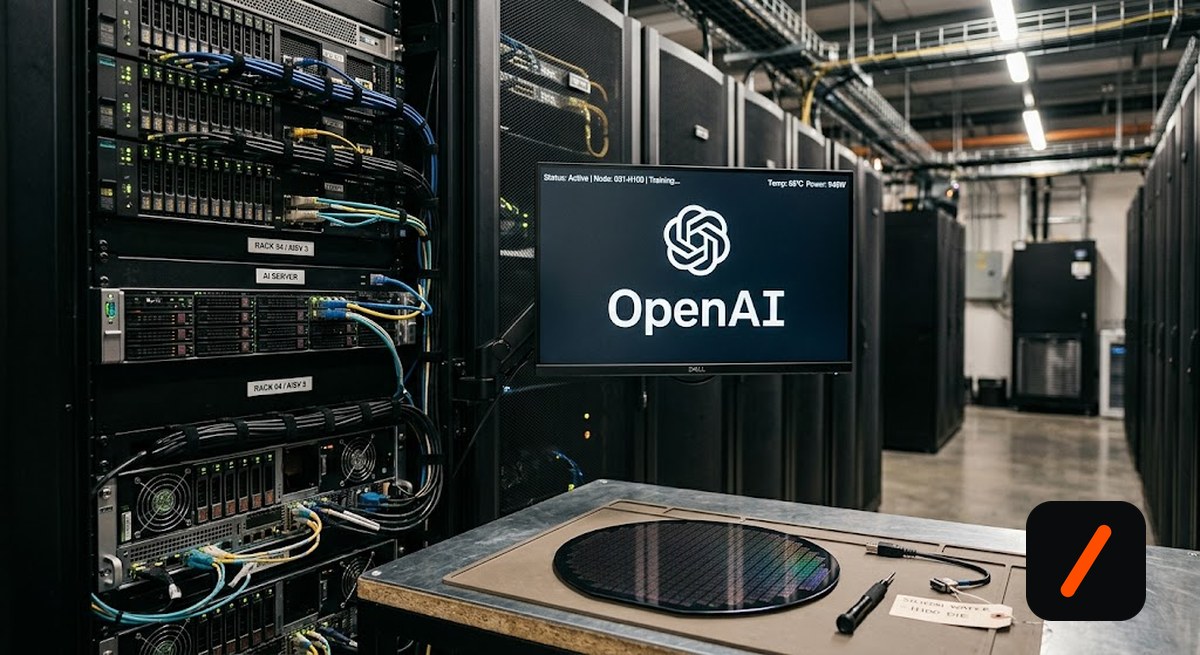
OpenAI is serving GPT-5.6 Sol, the strongest model in its new July lineup, on Cerebras wafer-scale hardware for select customers at up to 750 tokens per second. That is roughly 15x the speed most frontier models manage on clustered GPUs, and it is the clearest signal yet that the inference bottleneck, not training, is where the next round of AI competition gets decided.
- GPT-5.6 Sol runs on Cerebras CS-series wafer-scale engines for a limited customer set, hitting ~750 tokens/sec versus the tens-to-low-hundreds typical of GPU serving.
- Sol is OpenAI’s biology, chemistry and cybersecurity model, and also its heaviest to run, so the speed deal targets exactly the workloads where slow output hurts most.
- The move splits inference away from Nvidia’s default stack for a flagship model, the first time OpenAI has done so publicly at this tier.
- For users, the payoff is latency: agentic loops, long tool chains and reasoning traces feel interactive instead of stalling on every step.
What actually happened?
When OpenAI shipped the GPT-5.6 series publicly this week, the headline was the models themselves: Sol as the frontier reasoning model, Terra as the cost-tuned middle tier, and Luna as the fast, cheap option. Buried in the rollout was the serving detail. Sol, the most capable and most expensive model to run, is being offered on Cerebras wafer-scale engines for a select group of customers at throughput no GPU deployment currently matches. Cerebras builds a single chip the size of a dinner plate, keeping an entire model resident on one piece of silicon instead of sharding it across dozens of GPUs wired together.
RelatedGPT-6.1 Sol: OpenAI's Cheap Model Nears Astra's Power
The number that matters is 750 tokens per second. Most GPU-served frontier models land somewhere between 30 and 120 tokens per second per stream once you account for large context windows and reasoning overhead. Pushing an order of magnitude past that changes what the model feels like to use.
Why does token speed matter this much now?
A year ago, raw quality was the whole game. In 2026 the frontier models are close enough on benchmarks that experience is the differentiator, and experience is dominated by latency. Reasoning models emit long internal traces before they answer. Agentic systems chain dozens of model calls, each one blocking the next. When every call runs at 50 tokens per second, a ten-step agent takes minutes; at 750, it takes seconds. Sol is tuned for biology, chemistry and cybersecurity work, precisely the domains where users run long, multi-step investigations rather than one-shot prompts, so the speed compounds.
Who does this pressure?
The obvious target is the default assumption that serious inference has to run on Nvidia. Nvidia still owns roughly 70 to 80 percent of AI accelerators, and its moat is as much software (CUDA) as silicon. A flagship OpenAI model publicly served on a rival architecture is a crack in that assumption, even if it is limited to select customers for now. It also validates the wafer-scale bet that Cerebras has been making for years against skeptics who argued the yield economics of dinner-plate chips would never work at scale.
RelatedSakana AI Ditches the Frontier Model for Fugu Ultra v2
- Does Sol-on-Cerebras leave the select tier? The tell is whether OpenAI opens wafer-scale serving to general API traffic or keeps it as a premium lane.
- Cost per token, not just speed. 750 tokens/sec is meaningless if the price per token is 10x GPU. Watch for published pricing.
- Nvidia’s response. Faster interconnect and Rubin-era parts are the counter; the question is whether they close the single-stream latency gap wafer-scale exploits.
What it means for the market
The signal for investors is that inference silicon is becoming a real, contested category rather than a footnote to training. Nvidia (NVDA) remains the dominant exposure and is not threatened near-term, but a publicly disclosed OpenAI-on-Cerebras deployment gives credibility to the challenger thesis and to inference specialists broadly. Cerebras has pursued a public listing, so a marquee OpenAI workload is exactly the reference customer that reprices that story. The broader read: as models converge on quality, spending shifts toward whoever serves tokens fastest and cheapest, and that is a different competitive map than the training-cluster arms race that made Nvidia. This is analysis, not investment advice.
Our take
The model names got the attention, but the serving footnote is the more durable story. Training scale made the last two years; serving economics will make the next two. OpenAI putting its heaviest model on wafer-scale silicon is a bet that users will pay for models that think out loud without making them wait. If that bet pays off, expect every frontier lab to shop its flagship across more than one kind of chip, and the era of one-vendor inference ends quietly.
- OfficialOpenAI blog GPT-5.6 series launch notes
- ReferenceCerebras wafer-scale engine and inference throughput
- BenchmarkGenZTech AI Coding Leaderboard where GPT-5.6 Sol ranks on verified evals
Original analysis by GenZTech. Figures current as of July 2026. Source: Nextgov/FCW.