
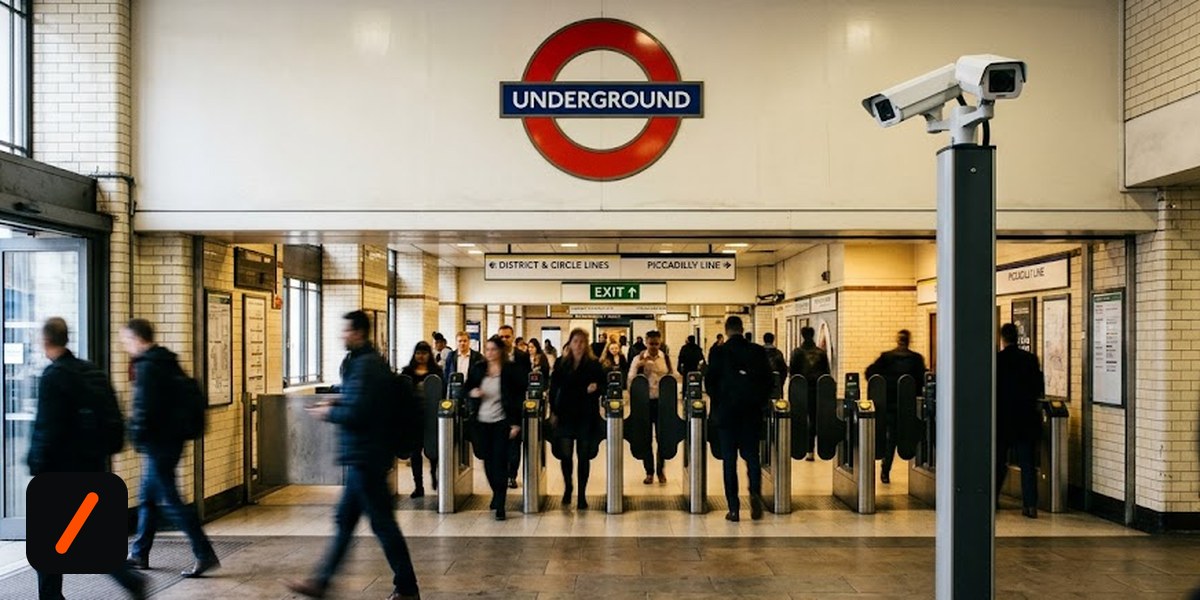
British Transport Police turned on live facial recognition inside a London Underground station for the first time on Tuesday morning, at Victoria. The cameras scan faces as passengers move through the station, convert each one into a numeric biometric template, and compare it against a watchlist of people wanted by police or the courts. Anyone who does not match is supposed to be discarded within a second or so, without a human ever seeing the frame.
The deployment is an extension, not a new programme. BTP opened its pilot on 11 February at London Bridge, a Network Rail station, and had spent six months on mainline concourses. Moving inside the Tube changes something the trial had not yet tested: what happens when the camera sits on a gateline that a million-odd people a day have no practical way around.
RelatedAnthropic Runs a 'Person-of-Interest' System to Track Activists
- Victoria is the first Transport for London station to host a BTP live facial recognition deployment, and it happened on 11 August 2026.
- The pilot has been extended to November, with deployments rotating between Underground and Network Rail stations rather than sitting permanently in one place.
- The matching engine is NEC NeoFace M40, the same algorithm family the Metropolitan Police uses, benchmarked by the National Physical Laboratory.
- Every alert is reviewed by an officer before anyone is approached, and BTP says templates that do not match the watchlist are deleted automatically.
What actually happens when you walk past the camera?
The pipeline is short and mostly automated. A camera pointed at a busy walkway feeds live video into a detector that finds faces. Each face becomes a template, a string of numbers describing geometry, not a stored photograph. That template is compared against a watchlist assembled specifically for that deployment. Below the similarity threshold, nothing happens and the template is dropped. Above it, an alert lands on an officer's device, and a person decides whether to walk over.
That human step matters more than the technology marketing suggests. In the Metropolitan Police's own accounting, false alerts do occur and are usually resolved at the point of the stop, which is exactly where the experience stops being abstract. Shaun Thompson, a community worker, was pulled aside near London Bridge in 2024 after the system confused him with someone else on a watchlist. He is now one of two claimants who took the Met to court over the practice.
Why does a Tube gateline change the argument?
Every legal defence of live facial recognition in the UK leans on the idea that deployments are overt, limited and avoidable. Signs go up. Officers hand out leaflets. The camera van sits on one corner of one street for a few hours, and if you would rather not be scanned you can cross the road. Whether that choice is meaningful has always been contested, but it existed.
A Tube station is built to remove exactly that kind of choice. Passengers are funnelled through a fixed number of gates, at a fixed pace, with no parallel route. Victoria is one of the busiest interchanges in the country. Declining to be scanned there means declining to travel, which is a different proposition from walking down a different street in Croydon. That is the substantive thing that changed on Tuesday, and most of the coverage has treated it as a routine site expansion.
| Deployment setting | Street LFR van | Mainline concourse | Underground gateline |
|---|---|---|---|
| Realistic way to avoid it | Cross the road | Use another entrance | Do not travel |
| Notice before you are scanned | Signs, leaflets, officers | Signs at entrances | Signs, but past the point of commitment |
| Faces per hour | Hundreds to low thousands | Tens of thousands | Tens of thousands, tightly channelled |
| Who chose the location | Local force operation | BTP with Network Rail | BTP with Transport for London |
What has the trial produced so far?
BTP has not published deployment-level figures for the six months since London Bridge, and has promised a full assessment once the pilot closes. The force describes deployments as intelligence-led, aimed at people wanted for serious offences and those breaching bail conditions or court orders, rather than a standing scan of the network.
The Metropolitan Police numbers are the useful benchmark, because the Met has run the technology at scale for longer. It reported 962 arrests from live facial recognition deployments between September 2024 and September 2025, and more than 2,000 since the start of 2024. A separate fixed-camera pilot in Croydon ran 24 operations from October 2025 to March 2026 and produced 173 arrests. Those are real numbers, and they are the reason the Home Office keeps funding the expansion.
Is any of this settled law?
Partly. On 21 April 2026 the High Court dismissed a judicial review brought by Shaun Thompson and Silkie Carlo, director of Big Brother Watch, ruling in R (Thompson and Carlo) v Commissioner of Police of the Metropolis that the Met's live facial recognition policy was lawful and compatible with human rights law. Lord Justice Holgate and Mrs Justice Farbey found the policy contained clear, interlocking and cumulative constraints. Both claimants said they would appeal.
Read closely, that judgment is a ruling about a specific written policy and the safeguards inside it, not a blanket authorisation of biometric scanning wherever a force fancies. There is still no dedicated statute governing police use of live facial recognition in England and Wales. The government opened a ten-week consultation on a legal framework in December 2025, and it has not landed yet. Forces are scaling in the gap.
RelatedCognition's SWE-2 Nearly Matches GPT-6 Astra for a Quarter the Price
- 11 Feb 2026BTP opens its pilot at London Bridge six months, planned with Network Rail, DfT and the Rail Delivery Group
- 21 Apr 2026High Court upholds the Met's LFR policy Thompson and Carlo lose on both grounds, confirm they will appeal
- 11 Aug 2026First Underground deployment, at Victoria the trial moves from mainline concourses to a TfL gateline
- to Nov 2026Extended pilot rotates between Tube and rail stations no fixed permanent site announced
- After the pilotBTP publishes a full assessment the first chance to judge the trial on its own numbers
Who should be paying attention?
Commuters, obviously, though the practical advice is thin: there is no opt-out at a gateline, and covering your face invites the attention you were avoiding. The more consequential audience is anyone building or buying biometric systems in the UK. A police force running NEC's algorithm through a transport operator's estate, under a policy the High Court has blessed but Parliament has not codified, is now the working template. Retailers, stadiums and airports watch these deployments closely because the legal reasoning transfers.
Civil liberties groups are treating it as the obvious escalation. Big Brother Watch has called subjecting law-abiding passengers to mass biometric surveillance disproportionate. Zoe Garbett, a Green member of the London Assembly, has argued the rollout has outpaced any evaluation of its effectiveness or cost, and that deployments have skewed toward areas with more Black, Asian and mixed-ethnicity residents than the London average. Neither criticism is answered by the arrest totals, because the arrest totals were never the contested part.
- The BTP assessment. Whether it publishes false-alert rates per deployment, not just arrests. Arrests alone cannot tell you what the system costs the people it stops by mistake.
- Which stations come next. A rotation that stays on major interchanges reads as intelligence-led. Quiet suburban stations would suggest the trial has drifted into general patrol.
- The appeal. Thompson and Carlo are heading to the Court of Appeal. A narrower reading of what counts as a sufficient safeguard would land directly on deployments like this one.
- The legal framework. The consultation that opened in December 2025 still has not produced a statute. Until it does, every expansion is governed by force policy and case law rather than by legislation.
Our take
The technology question here is close to boring. Face matching at this accuracy is a solved engineering problem, the pipeline deletes what it says it deletes, and a human still makes the final call. The interesting question is architectural, and it is about where you put the camera. Putting it on a street corner produces a system people can route around. Putting it on a gateline produces a system that everyone entering the network passes through by design, which is a checkpoint whether or not anyone calls it one.
BTP is running a time-boxed trial and has promised to show its working, and that deserves to be judged on the assessment rather than on a first-day reaction. But the trial is establishing a precedent faster than the law governing it is being written, and once biometric checks are normal infrastructure at the Tube gateline, no assessment published in November is going to remove them.
- OfficialBTP expands Live Facial Recognition trial into London Underground stations the announcement of the Victoria deployment
- PolicyBritish Transport Police: use of Live Facial Recognition Technology watchlist criteria, deletion policy and oversight
- JudgmentSummary of judgment, Thompson and Carlo v Metropolitan Police Commissioner the 21 April 2026 High Court ruling
- GovernmentLive facial recognition technology to catch high-harm offenders the ten-van rollout across seven forces
- Met dataMetropolitan Police, live facial recognition pilot results arrest figures from the Croydon fixed-camera pilot
Reporting and analysis by GenZTech, written from the British Transport Police announcement and the primary documents listed above.