
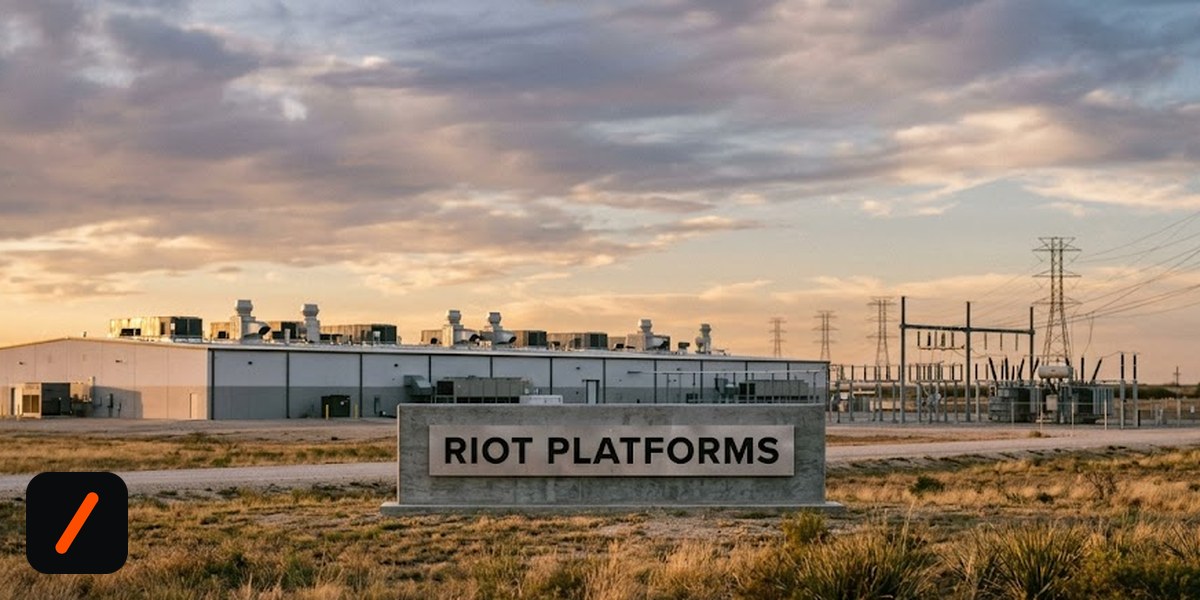
Riot Platforms has agreed to lease 191 megawatts of data center capacity at its Rockdale, Texas campus to a single artificial intelligence customer for 20 years, a contract the company expects to generate $9.1 billion in revenue. Riot disclosed the agreement in an SEC filing late Monday and identified the tenant only as a leading frontier AI lab. Bloomberg reported hours afterward that the customer is Anthropic. Neither company has confirmed that publicly. The stock had closed down 5.46% on Monday, then climbed more than 25% in after-hours trading to roughly $24.30, and it was still running about 20% higher in Tuesday pre-market.
- The lease covers 191 MW of critical IT capacity and runs through June 2048, with two five-year extension options that would lift total contract revenue to about $16.1 billion.
- Delivery is phased: the first 96 MW is targeted for December 2027, the remaining capacity by June 2028. Riot collects almost nothing from this contract for the next 16 months.
- Morgan Stanley is providing a $573 million interim financing facility to fund the initial buildout, which tells you the capital intensity here is front-loaded.
- Riot's entire data center segment booked $23.2 million last quarter. This one contract averages roughly $455 million a year once capacity is live.
What exactly did Riot agree to?
The structure is a long-term colocation lease, not a cloud contract and not an equity investment. Riot supplies powered shell, cooling and 191 MW of critical IT capacity at Rockdale. The tenant supplies the chips. The term runs to June 2048, and Riot has priced expected revenue over that window at $9.1 billion. Two five-year extensions sit on top, and if the tenant exercises both, Riot puts the ceiling at roughly $16.1 billion across 30 years.
RelatedGemini 3.5 Pro Is Months Late and DeepMind Is Rattled
Rockdale is the useful detail. That campus was built as a bitcoin mining site, which means the interconnect, the substation and the land were already permitted and energized years ago. Getting 191 MW of new grid capacity in Texas from a standing start would take longer than the entire delivery schedule Riot just committed to. The miners are not selling compute here. They are selling a queue position.
Riot also disclosed a letter of intent for a roughly 1 gigawatt site at Corsicana, so Rockdale is being positioned as the proof point rather than the finish line.
Why won't Riot name the customer?
Riot's Monday filing called the counterparty a leading frontier AI lab and stopped there. Bloomberg then reported the tenant is Anthropic, and every outlet that has run the story since is sourcing that identification rather than a confirmation. As of Tuesday morning neither Riot nor Anthropic has said so on the record.
That reticence is normal for deals of this shape. Large tenants routinely negotiate confidentiality on site announcements, partly to avoid telegraphing capacity plans to competitors bidding on the same substations, partly because naming a landlord invites questions about power sourcing and local politics. Read the identification as well-sourced reporting, not as a signed press release, and weight it accordingly.
What does $9.1 billion actually buy per megawatt?
This is the number nobody in the coverage has worked out, and it is the one that tells you whether Riot negotiated well. Take the $9.1 billion base case, treat it as 20 years of the full 191 MW, and the arithmetic lands at about $455 million a year, or roughly $2.38 million per megawatt per year. Convert to the unit the colocation industry actually quotes and that is approximately $198 per kilowatt per month.
For context, conventional hyperscale wholesale colocation in low-cost US markets has historically cleared closer to $100 to $150 per kW per month, and Texas is not an expensive power market. Riot is capturing a premium of roughly 30% to 90% over that older band. Two caveats keep this honest: the calculation flattens the phase-in ramp, and lease revenue in these contracts often bundles power pass-through, which inflates the headline rate relative to a pure space-and-power quote. Even after haircutting for both, the direction is unambiguous. AI tenants are paying up for energized capacity because energized capacity is the scarce good, not the building.
Set that against Riot's actual operating results. The company reported $174.2 million of total revenue for the June quarter, up 14% year over year, of which data center hosting contributed just $23.2 million against $113.7 million from bitcoin mining. A contract averaging $455 million a year is roughly five times Riot's current annualized data center run rate, arriving at a company that just posted a $237.2 million quarterly net loss.
How does this fit the broader AI compute scramble?
If the Bloomberg identification holds, this is the latest in a run of Anthropic capacity agreements that have gotten steadily larger and steadily stranger in their counterparties.
RelatedMeta Wants to Rent Anthropic $10B of Compute
| Counterparty | Riot Platforms | Volta Infra | xAI | AMD |
|---|---|---|---|---|
| Reported value | $9.1B | $10B | ~$45B | $5B investment |
| What is bought | 191 MW colocation | Cloud capacity | Compute purchase | 2 GW MI450 silicon |
| Term | 20 years, to 2048 | Multi-year | Multi-year | Multi-year |
| Counterparty's day job | Bitcoin mining | Data centers | Frontier AI rival | Chipmaker |
| Confirmed by both sides | No | Yes | Yes | Yes |
The pattern is a lab that has concluded it cannot buy enough capacity from the three big clouds alone and is now contracting directly with anyone holding energized megawatts, including a competitor's infrastructure and a bitcoin miner's retired mining hall. That is a statement about scarcity, and it is a more reliable signal than any individual deal value.
What it means for the stock
RIOT re-rated on this instantly, and the mechanical reason is that a 20-year contracted revenue stream is valued very differently from bitcoin mining revenue, which is unhedged exposure to hash price. Investors will now try to capitalize $455 million of eventual annual revenue at data center multiples rather than miner multiples, and that spread is most of the 25% move.
The signal to watch is execution risk, not deal quality. Riot has to build out 191 MW on a schedule it does not control end to end, funded partly by a $573 million interim facility, while burning cash on the mining side. The first 96 MW lands in December 2027. Between now and then the contract contributes no revenue and considerable capex, and the financing mix, whether Riot funds this with more debt, equity dilution or by selling into its 11,380 bitcoin position, will matter more to shareholders than the headline number. This is analysis, not investment advice.
- Aug 10, 2026Riot files 8-K disclosing a 20-year, 191 MW lease with an unnamed frontier AI lab alongside Q2 results
- Aug 10, eveningBloomberg reports the tenant is Anthropic; RIOT jumps 25% after hours unconfirmed by either party
- Aug 11, pre-marketStock holds roughly 20% of the gain into Tuesday trading still no on-record confirmation
- Dec 2027First 96 MW targeted for delivery first material lease revenue
- Jun 2028Full 191 MW online run rate reaches roughly $455M/yr
- Jun 2048Base term expires; two five-year options could extend to 2058 $16.1B ceiling
- An on-record confirmation. Until Riot or Anthropic names the counterparty, the Anthropic attribution rests on one outlet's sourcing. A confirmation, or a correction, changes how much of this deal's premium is really an Anthropic premium.
- How the buildout gets funded. The $573 million Morgan Stanley facility is interim. Watch whether the permanent financing is debt against the contract, an equity raise, or bitcoin sales, because each has a very different effect on per-share value.
- The Corsicana LOI converting. A 1 GW site turning into signed leases would confirm Rockdale was a template rather than a one-off, and it is the difference between Riot being a miner with a contract and Riot being a data center company.
- Other miners repricing. If $198 per kW per month is the going rate for energized capacity, every listed miner sitting on interconnect suddenly has a second business, and the sector's valuations follow.
Our take
The interesting thing here is not the $9.1 billion. It is what the per-megawatt rate implies about who holds leverage. A bitcoin miner with an aging Texas mining hall just extracted a premium price from a frontier lab for capacity that will not exist for 16 months, and the lab signed a 22-year commitment to get it. Compute scarcity has moved from a chip problem to a power problem, and the companies that spent 2021 buying substations to mine an asset that has treated them badly turn out to own the bottleneck.
The risk sits squarely with Riot, not the tenant. Riot is now a construction and financing story wearing a mining company's balance sheet, with a $237 million quarterly loss and a delivery date it has to hit. If it executes, the multiple re-rating is justified. If the first 96 MW slips, the contract is still there but the story that got the stock to $24 will not be.
- FilingRiot Platforms SEC filings (EDGAR) the Aug 10 8-K describing the tenant as a leading frontier AI lab
- OfficialRiot Platforms press releases Q2 2026 results and the Rockdale lease announcement
- ReportingBloomberg: Anthropic strikes $9 billion deal with Riot the original identification of the tenant
- ReferenceGENZ TECH funding tracker running record of AI capital commitments we cover
Original analysis by GenZTech. Per-megawatt and per-kilowatt figures are our own calculation from the disclosed contract value and capacity, and assume 20 years at full delivered capacity. Deal reported by CoinDesk and The Block.