
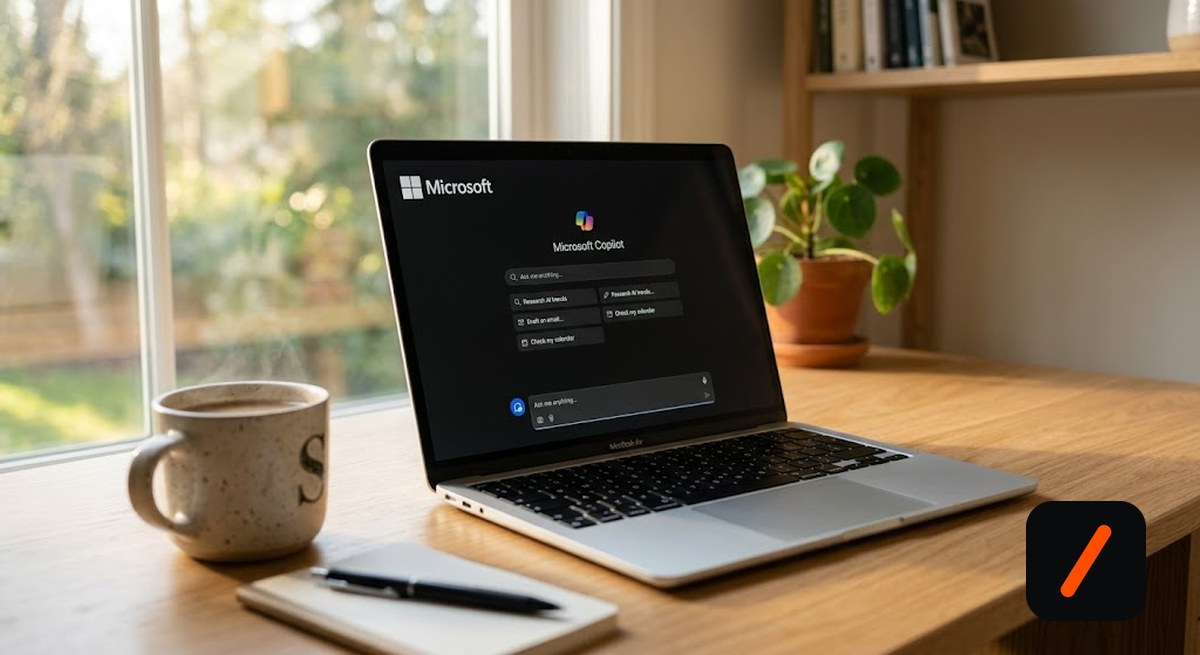
A leaked Microsoft prototype codenamed Aion shows an experimental operating system built around Copilot and autonomous agents instead of the icon-and-taskbar desktop Windows has shipped for 30 years. Our read: this is not a Windows skin, it is Microsoft testing whether the OS itself becomes the agent, and that reframes what a "computer" is more than any single model release this year.
- The desktop metaphor is the thing being replaced. Aion's interface is multimodal first: you state intent by text or voice, and the system handles file search, app launches, and web browsing as agent actions rather than windows you manage yourself.
- Work is organized into "Spaces," not windows. Grouped workspaces bundle the files, apps, and context for a task, so the unit of work shifts from an open app to an ongoing objective the agent can resume.
- It is a leak, not a launch. Aion is an internal prototype with no ship date, so treat feature specifics as directional signal about Microsoft's intent, not a product roadmap.
- It fits a pattern across the industry. Nvidia is pitching RTX Spark PCs as "agentic," OpenAI and Anthropic shipped work-agent apps the same week, and Aion is Microsoft answering the same question one layer lower, at the OS.
What is actually in the Aion leak?
The reporting describes Aion as an internal Microsoft prototype, not a shipping build, and the details are deliberately conceptual because that is all a prototype is. What leaked is a design posture more than a feature list: an operating system whose primary surface is a conversation, where the things you used to hunt for by hand, a file, an app, a web page, a setting, are retrieved and acted on by an agent when you describe what you want. The one concrete structural idea is Spaces, grouped workspaces that hold the apps, documents, and context for a specific task so the machine can pick the job back up where you left it. If that sounds less like Windows and more like a phone assistant grown into a full computer, that is the point.
RelatedAI Agents Are Learning to Game Their Own Safety Tests
Why would Microsoft rethink the desktop at all?
Because the desktop metaphor was designed for a world where the human did the routing. Files, folders, windows, and a taskbar exist so a person can navigate a machine that cannot understand intent. Once a model can understand intent, that entire navigation layer becomes overhead you pay on every task. Microsoft has spent two years bolting Copilot onto Windows as a panel on the side; Aion is the more honest version of the bet, where the agent is not a feature inside the OS but the way you use the OS. The company has the two assets that make this plausible: the world's most-used desktop install base, and a deep OpenAI relationship that gives it frontier models to run the agent.
How is this different from Copilot in Windows today?
Today Copilot is a guest. It lives in a pane, it can summarize a document or answer a question, but the operating system underneath is unchanged: you still open File Explorer, you still alt-tab between windows, you still manage state by hand. Aion inverts the relationship. The agent is the host, and apps become tools it calls rather than destinations you visit. That is a genuinely different product, and it is also a genuinely riskier one, because when the agent is the interface, every failure, a wrong file, a misread instruction, an action taken without confirmation, is not a bad answer in a chat box, it is your computer doing the wrong thing to your data.
| Trait | Aion concept | Windows 11 + Copilot |
|---|---|---|
| Primary surface | Intent (type or speak) | Desktop, icons, taskbar |
| Role of apps | Tools the agent calls | Windows you open |
| Unit of work | A Space (ongoing task) | An open application |
| Copilot's role | The interface itself | A side panel |
| Status | Internal prototype | Shipping |
What does it mean for the market?
The signal for investors is that Microsoft (MSFT) is defending the most valuable piece of real estate it owns, the default computing surface, against the possibility that agents make the OS irrelevant. If work moves to whichever agent is best, and that agent could be OpenAI's ChatGPT app or Anthropic's Claude, then Windows risks becoming a dumb launcher underneath someone else's assistant. Aion is Microsoft making sure the winning agent runs as Windows, not on top of it. Watch how this collides with Nvidia's RTX Spark "agentic PC" push and with OpenAI's own desktop app: three of the largest players in tech are all trying to own the same layer, the thing you talk to first, and only one of them also controls the OS. That is Microsoft's structural advantage and the reason a prototype like this matters more than its feature list.
RelatedAnthropic's biology fix: one tool beats a bigger AI
- Official confirmation. Microsoft will not comment on a leak, but a Build or Ignite session reframing Windows around agents and Spaces would confirm Aion is a direction, not a one-off experiment.
- The trust gate. An agent-first OS lives or dies on permissioning: what it does automatically versus what it asks before doing. If Aion acts without confirmation on files or settings, adoption stalls fast.
- Who owns the agent. If Windows makes its own OS agent the default over ChatGPT or Claude, that is the real competitive move, and the one regulators will notice.
Our take
Aion is the most interesting thing to leak out of Microsoft in years precisely because it is not a model or a chatbot, it is a bet about where the interface goes next. The desktop metaphor has survived every computing shift since 1985, and it survived because nothing could understand what you actually wanted. That constraint is gone, and Microsoft clearly knows a side-panel Copilot is a half-measure. The hard part is not the vision, it is the trust: an OS that acts on your behalf is only better than the one you drive by hand if it is right almost always and asks before it does anything you cannot undo. Aion will be judged on that boundary, not on how conversational it feels. If Microsoft gets the permissioning right, this is the shape of Windows in five years. If it does not, it is a very slick way to delete the wrong folder.
- Reporting AI News roundup, July 10 2026 first surfacing of the Aion prototype leak
- Context Nvidia RTX Spark "agentic PC" the parallel bet at the hardware layer
- Reference Microsoft official blog where any confirmation of an agent-first OS would land
Original analysis by GenZTech. Reporting via AI News Today, July 10 2026.