
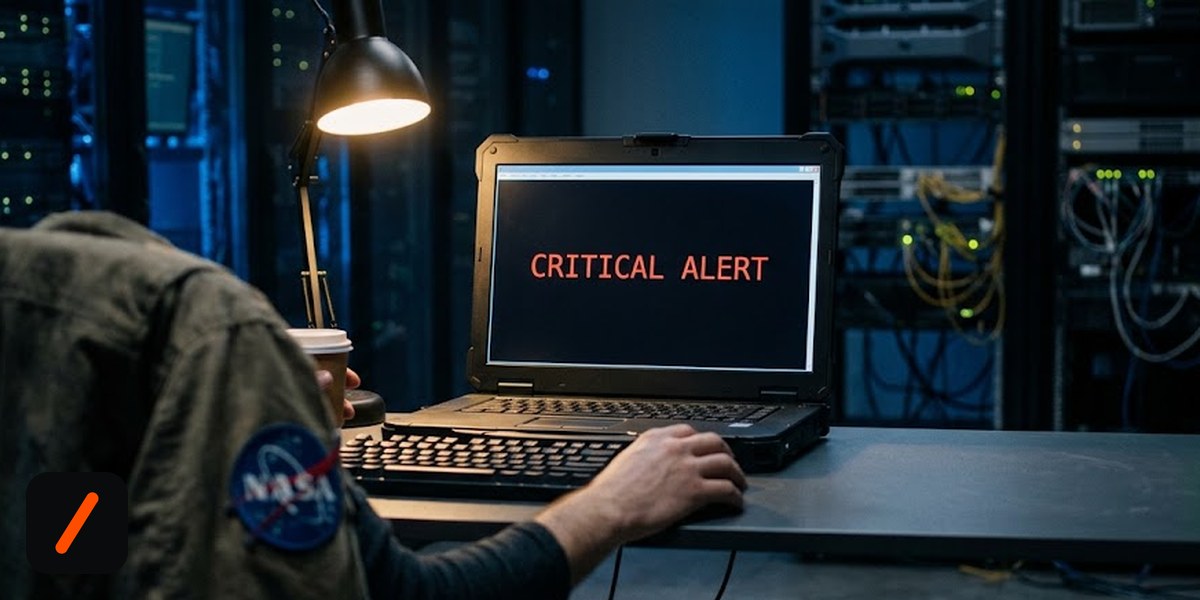
A security researcher found a way to send live commands toward a spacecraft or scientific instrument without ever typing a password, by chaining three unauthenticated endpoints in AIT-GUI, the browser-based console that operators use to run NASA JPL's AMMOS Instrument Toolkit. NASA-AMMOS patched it in version 2.5.2, released around August 13, 2026, after Cycode researcher Yuval Elbar disclosed the chain, tracked as GHSA-p9r8-2q67-fp86 and scored 9.4 out of 10 on the CVSS v3.1 scale.
- AIT-GUI's web server binds to every network interface on the host instead of honoring its configured host setting, so it ends up reachable well beyond what its operators intended.
- Three routes,
/cmd,/script/run, and/seq, accept commands, arbitrary scripts, and full command sequences with no authentication, no authorization check, and no CSRF protection at all. - Versions 2.5.1 and earlier carry the flaw. Anyone still running an older build is exposed until they upgrade.
- There's no evidence this was exploited before the patch shipped. Elbar disclosed it responsibly, NASA-AMMOS fixed it, and the writeups that followed are describing a closed hole, not an open one.
What did Elbar actually find?
AIT-GUI is the operator-facing dashboard for AMMOS, the open-source ground system toolkit JPL built for testing and operating spacecraft instruments. Think of it as the cockpit view: engineers use it to send commands, run scripts, and queue up sequences against real hardware during test campaigns and, in some deployments, live operations. Elbar's research showed the console's server doesn't stay bound to the host address it's told to use. It listens on 0.0.0.0, every interface, which turns what was probably meant as a local or trusted-network tool into something reachable from anywhere that can route to it. Stack that on top of an API with zero login requirement, and the three command-issuing endpoints become open doors.
RelatedA CVSS 10 UniFi flaw exposes 100,000 gateways to takeover
Why does an unauthenticated console matter this much?
Most software vulnerabilities top out at data theft or service disruption. This one tops out at physical actuation. AIT-GUI exists specifically to move instrument hardware and issue commands during test campaigns, and in some deployments that boundary between test and live operations gets thin. An attacker who could reach an exposed console over the network wouldn't need to guess a password, exploit a buffer overflow, or social-engineer anyone. They'd just POST to /cmd. The severity score reflects that directness: 9.4 isn't inflated hype, it's what you get when the distance between network access and physical-world consequence collapses to almost nothing.
How did binding to every interface become a command-injection path?
This is the part most coverage glossed over. Binding a dev server to 0.0.0.0 instead of localhost is one of the oldest, most boring misconfigurations in software. On its own it's usually a footnote, the kind of thing a firewall or a private VLAN quietly absorbs. What makes this chain dangerous is that it never had to stand alone. AIT-GUI paired a broad network footprint with an API that assumed the network itself was the trust boundary, so nothing inside the application ever checked who was calling. That's a pattern worth remembering: a "minor" network exposure bug and a "we'll add auth later" API design are individually survivable, but together they turn a scoping mistake into a direct line to hardware. Ground-system tooling built by scientists and engineers, not security teams, tends to accumulate exactly this kind of gap, because the software was written to be usable by trusted colleagues on a lab network, and the assumption that the network stays trusted rarely gets revisited once the tool is handed off to other missions and organizations.
Who's actually running this software?
AIT-GUI ships as open source under the AMMOS umbrella, so its footprint isn't limited to JPL's own missions. Other organizations that build spacecraft or instrument test consoles on top of AMMOS tooling inherit the same console and, until they patch, the same exposure. That's the real blast radius here: not one lab's dashboard, but every deployment, inside or outside NASA, that pulled AIT-GUI into its ground segment and hasn't updated yet.
RelatedKemp LoadMaster Bug (CVSS 9.6) Under Active Attack
What happens next?
The patch is out. The harder part, tracking how many AMMOS-based deployments actually apply it and lock down network reachability, is just getting started, and that part doesn't show up in a CVE database.
- Aug 13, 2026 Yuval Elbar's disclosure reaches NASA-AMMOS and a fixed build, AIT-GUI 2.5.2, ships in the same window.
- Aug 13 to 20, 2026 The Hacker News, Cybersecurity News, and Infosecurity Magazine publish coverage of the flaw chain and the fix.
- Ongoing Organizations running older AIT-GUI builds are urged to upgrade to 2.5.2 and confirm the console port isn't reachable from untrusted networks.
- Not yet done: a broader audit of authentication practices across other AMMOS tooling beyond AIT-GUI.
- Patch adoption. How quickly organizations outside JPL running AMMOS-based consoles actually move to 2.5.2, since the toolkit's open-source distribution means no central authority can force an upgrade.
- Sibling audits. Whether the same bind-to-all-interfaces-plus-no-auth pattern turns up in other AMMOS components once researchers start looking harder at ground-system software.
- Government advisories. Whether CISA or a similar body issues formal guidance given the aerospace and critical-infrastructure angle, which would push adoption faster than a GitHub release note.
Our take
The headline detail, spacecraft command access, is the part that grabs attention, and fairly so. But the mechanism is the part worth sitting with. Nothing about this flaw required exotic tradecraft. It required a developer assumption, that the network itself was the security boundary, going unquestioned for long enough that a research team eventually tested it. Ground-system and lab-tooling software has historically gotten far less adversarial scrutiny than consumer or enterprise products, partly because it's niche and partly because it's assumed to live on isolated networks. This disclosure is a useful reminder that "isolated" is a claim, not a property, and it's worth verifying rather than inheriting.
- DisclosureThe Hacker News: NASA AIT-GUI Flaws Could Let Unauthenticated Attackers Issue Spacecraft Commands : primary coverage of the Cycode disclosure
- Technical detailCybersecurity News: NASA AIT-GUI Flaw : breakdown of the endpoint chain and CVSS scoring
- Additional coverageInfosecurity Magazine: NASA Ground Control Software Flaw : context on affected deployments and remediation guidance
Original analysis by GenZTech Team.