
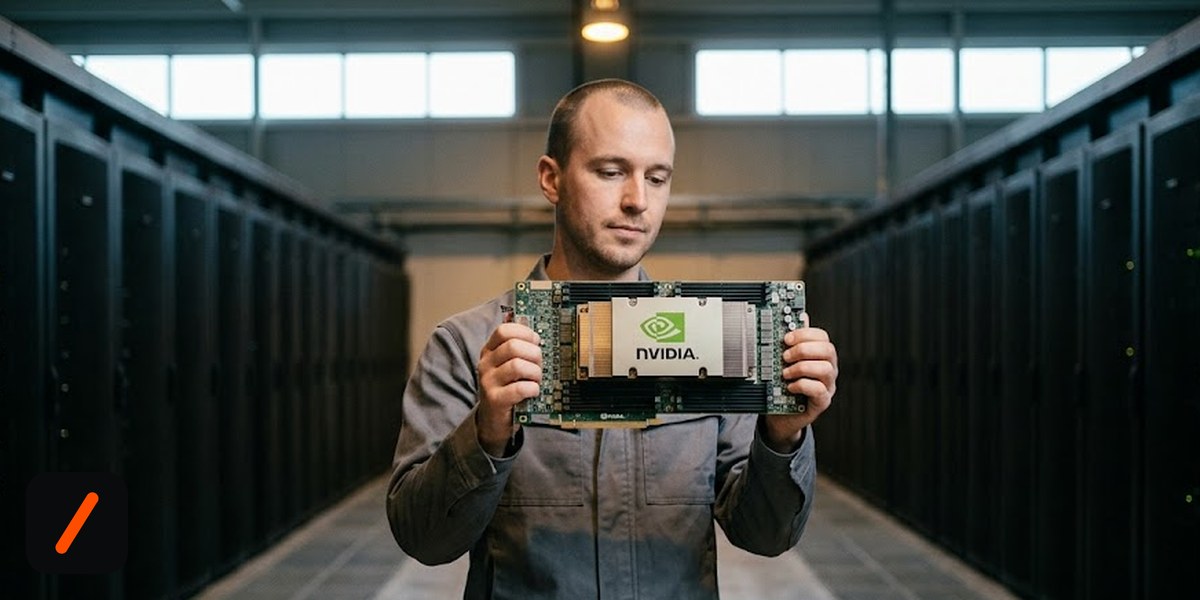
NVIDIA and SK Group put a number on Korea's AI buildout on Friday: more than $500 billion, covering AI data centers and next-generation memory. NVIDIA pushed it out on its own channels this morning Korea time, and it is the largest single figure yet attached to a national AI infrastructure program. It is also, read closely, mostly a wrapper around commitments that already existed. One item inside it is genuinely new, and that is the part worth your attention: SK Telecom now has a 2 gigawatt AI factory on the books.
What did NVIDIA and SK Group actually announce?
The announcement bundles three separate tracks under one headline number. Taken individually they have different ages, different levels of specificity, and different odds of happening on schedule.
RelatedHBM4 Enters Production for NVIDIA's Vera Rubin
- SK Telecom's 2 gigawatt AI factory. Built on NVIDIA's Vera Rubin platform with SK hynix HBM4 memory. The first facility is slated to come online in 2027. This is the new hard number.
- The SK hynix memory partnership. A long-term agreement to co-develop next-generation memory, including HBM, aimed at AI training, agentic workloads, and physical AI. NVIDIA and SK hynix first announced this multiyear technology partnership on June 7, covering Vera Rubin, Vera CPUs, RTX Spark PCs, and Jetson Thor.
- The NAVER data center expansion. An enlargement of NAVER's Korean AI data center, now with Brookfield involved on the infrastructure side. NAVER's sovereign AI buildout on NVIDIA DSX was announced earlier this month, starting at 55 megawatts with stated ambitions toward gigawatt scale.
Why does the $500 billion number need unpacking?
Aggregate figures in AI infrastructure are soft by construction. There is no line item, no signed contract total, and no disclosure of what counts: land, power, construction, GPUs, memory, or the electricity bill across a decade of operation. Nobody published a breakdown. When a number spans multiple companies, multiple years, and capital that has not been raised yet, it functions as a statement of intent rather than an accounting fact.
Track the sequence and the pattern is clear. Korea has been announcing pieces of this all year, and Friday gathered them under one banner with one new spec attached.
- 30 Oct 2025NVIDIA and SK Group announce an AI factory with more than 50,000 GPUs first phase targeted for late 2027
- 7 Jun 2026NVIDIA and SK hynix sign a multiyear memory partnership Vera Rubin, Vera CPUs, RTX Spark, Jetson Thor
- 7 Jun 2026SK Telecom commits to a gigawatt-scale AI Cloud no capacity figure given at the time
- Jul 2026NAVER expands sovereign AI on NVIDIA DSX starts at 55 MW, targets gigawatt scale
- 24 Jul 2026The $500B+ umbrella lands, SK Telecom's facility specced at 2 GW Vera Rubin silicon, HBM4 memory
- 2027First SK Telecom facility scheduled to come online the date that actually tests all of this
How big is 2 gigawatts, really?
This is the number that deserves the headline. Two gigawatts is not a data center in the sense most people picture. It is a power commitment on the scale of a national grid negotiation, roughly the output of two large nuclear reactors, dedicated to one company's compute.
The contrast with Korea's other flagship AI project makes the scale legible. NAVER's sovereign AI buildout, covered here earlier this month, opens at 55 megawatts and describes gigawatt capacity as a direction of travel. SK Telecom is starting the conversation at 2,000 megawatts. Whether the grid, the construction timeline, and the HBM4 supply can all arrive together by 2027 is the open question, and it is a harder question than the money.
| Project | SK Telecom AI factory | NAVER sovereign AI | SK Group AI factory |
|---|---|---|---|
| Scale | 2 GW | 55 MW at start | 50,000+ GPUs |
| Silicon | Vera Rubin + HBM4 | NVIDIA DSX | RTX PRO 6000 Blackwell |
| First online | 2027 | phased through 2026 | late 2027, first phase |
| Announced | 24 Jul 2026 | Jul 2026 | 30 Oct 2025 |
Why did memory stocks fall on the same day?
Here is the part that looks contradictory. A $500 billion commitment to buy Korean memory and Korean data center capacity landed in a session where memory names sold off hard. SK hynix and Micron each dropped around 6 percent, SanDisk fell about 9 percent, and the DRAM ETF gave up 7 percent. NVIDIA itself closed down slightly.
The announcement did not cause that. The selloff traces to an overnight KOSPI decline led by Samsung and SK hynix, which flowed into US-listed memory names because those stocks now trade increasingly as a proxy for the Korean index. Layer on a Nasdaq that had already fallen three sessions running after Alphabet and Tesla results, and the sector move explains itself without reference to Friday's news at all.
The useful signal for anyone watching this space: the market has stopped repricing on announcement volume. Korea has produced a steady run of nine and ten figure AI infrastructure headlines this year, and the marginal one no longer moves the stocks it names. What still moves them is shipment timing, which is the same thing that took SK hynix down 15 percent on July 13 when a single brokerage note questioned HBM4 delivery schedules. Announcements are free. Shipped HBM4 is not, and that gap is where the volatility lives. None of this is investment advice; it is a note on what the tape is currently reacting to.
Who is actually exposed here?
SK hynix has the most direct leverage. It supplies the HBM4 in the SK Telecom facility, it is inside the same corporate group, and it now has a co-development agreement pointed at NVIDIA's roadmap through multiple generations. That is real revenue visibility if the buildout lands on time.
RelatedAMD's MI455X and Helios Take Direct Aim at Nvidia
NVIDIA's exposure is more about geography than dollars. Korea joins a short list of countries buying full-stack DSX reference architecture rather than loose GPU allocations, which locks in software, networking, and operational tooling alongside the silicon. Sovereign AI programs are stickier customers than hyperscalers, because switching cost is measured in national policy rather than procurement cycles.
The constraint everyone shares is power. A 2 gigawatt commitment in a country with Korea's population density and grid profile is not a procurement problem, it is an energy siting problem, and the 2027 target gives roughly eighteen months to solve it.
- Grid approval, not GPU orders. The binding constraint on 2 gigawatts is interconnection and generation, and that process is public. Watch Korean utility filings before watching NVIDIA shipment guidance.
- HBM4 volume, not HBM4 announcements. SK hynix has now attached itself to three separate NVIDIA-facing commitments. The July 13 selloff showed the market cares about shipment dates, not signature dates.
- Whether the $500B ever gets itemized. If a breakdown appears in an SK Group filing or a Korean government budget line, the number is real. If it never does, treat it as framing.
- The 2027 date slipping. First facility online in 2027 is aggressive for a site this size. A quiet move to 2028 would be the honest tell about how much of this was ready versus aspirational.
Our take
The $500 billion is the headline and the 2 gigawatts is the story. Strip the aggregate figure away and what remains is a specific, checkable commitment: one facility, one silicon platform, one memory generation, one date. That is more information than most AI infrastructure announcements contain, and it is the only part of Friday's news that can be proven right or wrong.
The bundling itself is not dishonest, it is just how national industrial policy gets communicated. Korea is making a positioning argument, that it intends to be where AI compute physically lives rather than only where the memory for it gets fabricated. The argument is credible. It rests on SK hynix, Samsung, and a manufacturing base that already exists, which is more than most countries announcing sovereign AI programs can say.
What would change our read: a published capital breakdown, or a power purchase agreement filed for the SK Telecom site. Either one converts intent into schedule. Until then the number to hold onto is 2,000 megawatts by 2027, and the number to ignore is the one in the headline.
- OfficialSK Telecom and NVIDIA Build AI Infrastructure NVIDIA Newsroom, gigawatt-scale AI Cloud and DSX platform
- OfficialNVIDIA and SK hynix multiyear memory partnership the June 7 agreement now folded into the initiative
- OfficialNVIDIA and SK Group Build AI Factory the October 2025 baseline, 50,000+ GPUs
- AnnouncementNVIDIA on the $500B+ initiative the post that broke the figure
- ReferenceHigh Bandwidth Memory why HBM4 supply is the schedule risk
Original analysis by GenZTech. Figures current as of July 2026. Source: NVIDIA.