
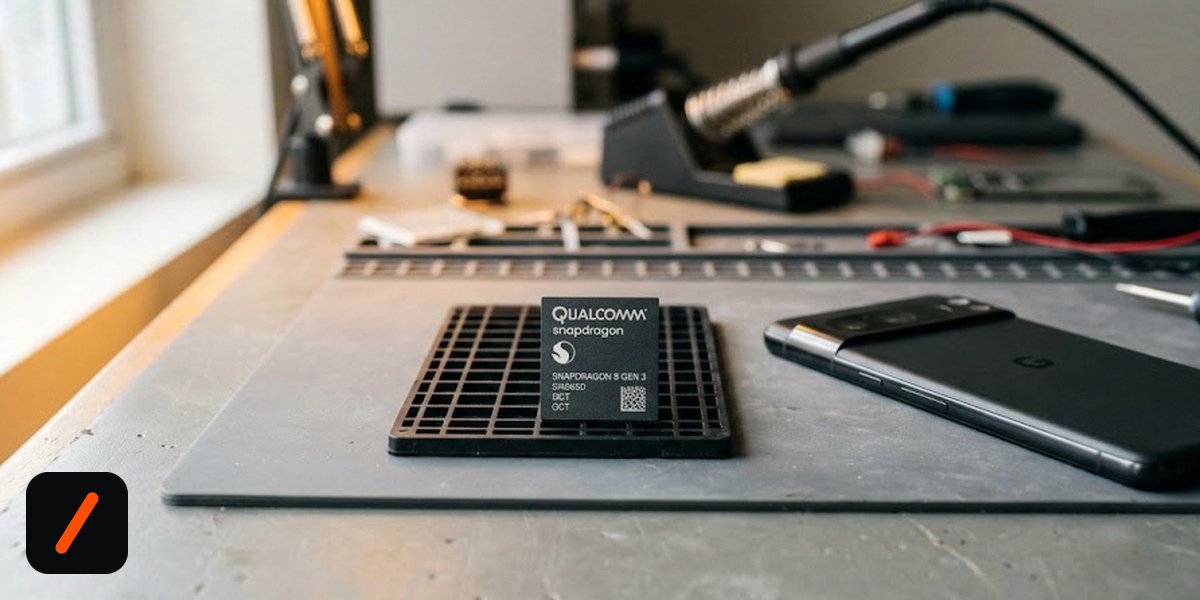
Qualcomm sent its customers a letter on Friday warning that chip prices are going up by a double-digit percentage for anything shipped after September 1. Bloomberg reported the notice first. Translated out of supply-chain language: the most expensive part in a flagship Android phone just got materially more expensive, and the companies that buy it have about five weeks of current pricing left.
The reason Qualcomm gave is that it has run out of room to absorb what its own suppliers charge. The company said it had already gone looking for alternative components from new vendors before deciding to reprice. Coming from the firm that has held pricing power over the Android handset market for the better part of two decades, that is a striking thing to put in writing.
RelatedTSMC Hikes Wafer Prices as Its Foundry Grip Tightens
Why is Qualcomm raising prices now?
The pressure is not coming from phones. It is coming from AI data centers.
Every hyperscaler building out accelerator capacity needs high-bandwidth memory, and HBM comes off the same lines, from the same three companies, that supply the LPDDR going into your phone. When Micron, SK Hynix and Samsung can sell a wafer's worth of capacity into the data center at data center margins, mobile memory gets whatever is left over. Advanced packaging is tight for the same reason. TSMC has already moved wafer prices up.
Qualcomm sits in the middle of all of that. It designs the chip and buys everything else: foundry capacity, packaging, and the memory that ships alongside the SoC. When three input costs move at once, there is a point where design margin can no longer swallow the difference. Friday's letter says Qualcomm reached it.
Who actually pays for this?
Not Qualcomm. That is the entire point of a pass-through. The real question is which link in the chain has the least room to push the cost further along.
Apple is insulated. It designs its own application processor and has spent years moving its modem in-house, which was expensive at the time and looks considerably smarter this week.
Samsung is partly insulated, because it dual-sources between Snapdragon and its own Exynos parts and can shift the mix at the margin. It is also one of the memory makers collecting on the other side of this trade, which is a strange position to be in.
The exposed group is everyone else. Xiaomi, Oppo, Vivo, Honor, Motorola, Nothing and the long tail of Android brands have no in-house silicon and very little leverage. Those companies run single-digit hardware margins. A double-digit increase on the largest line in their bill of materials is not something they can quietly eat.
Google is the interesting middle case. Tensor is designed and fabricated outside Qualcomm's supply, so Pixel dodges this specific increase. It does not dodge the memory squeeze underneath it.
| Handset maker | Own application processor? | Exposure to this increase |
|---|---|---|
| Apple | Yes, plus in-house modem | None directly |
| Google (Pixel) | Yes, Tensor | Indirect, via memory |
| Samsung | Partly, Exynos dual-source | Partial, can shift mix |
| Xiaomi / Oppo / Vivo | No | Full |
| Motorola / Nothing / Honor | No | Full, least leverage |
What it means for the market
QCOM shares slipped around 2% on the report, which is the correct reaction and worth understanding. A price increase is normally good news for a chip company. This one is not being read that way, because Qualcomm explicitly framed it as cost pass-through rather than pricing power. Investors treat those very differently. Pricing power expands gross margin. Pass-through defends it, at best.
The signal for investors is in the next two earnings calls, not in the letter. Watch gross margin. If Qualcomm raises prices by double digits and margin comes in flat, the increase went straight through to suppliers and shareholders got nothing from it. Watch customer commentary too, because if Xiaomi or Oppo start publicly shopping alternatives, MediaTek is the obvious share-gain candidate in the mid-range, where price sensitivity is highest and switching costs are lowest.
Then note who is on the other side of the trade. The cost Qualcomm cannot absorb is revenue for somebody, and that somebody is the memory industry. The same AI buildout inflating Qualcomm's inputs is inflating Micron's, SK Hynix's and Samsung Semiconductor's outputs. Read as a whole, this is less a Qualcomm story than a visible symptom of capital rotating out of consumer silicon and into data center silicon. That is analysis, not investment advice.
RelatedThe Memory Supercycle Is Here, and AI Priced Everyone Out of RAM
- Earlier 2026TSMC raises wafer prices foundry cost moves first
- Jul 24, 2026Qualcomm letter to customers double-digit increase, reported by Bloomberg
- Sep 1, 2026New pricing takes effect applies to product shipped after this date
- Late 2026Holiday phones ship unaffected built on chips already bought
- 2027Increase reaches retail higher prices, thinner specs, or both
What does this do to phone prices?
Nothing before September, and probably not much before spring. Phones launching this quarter were built on chips bought months ago. The increase lands on devices being designed now and shipping in 2027.
When it does land, expect it in two forms rather than one. Some becomes a sticker price increase. The rest becomes silent de-contenting: less base storage, a smaller battery, a downgraded ultrawide camera, one fewer year of promised software updates. De-contenting is far easier to ship than a price rise, because reviewers measure price on every chart and rarely measure what quietly left the spec sheet.
There is also a hedge already in motion. 9to5Google reports Qualcomm has been working on a cheaper variant of the Snapdragon 8 Elite Gen 5, which is precisely what you build when you expect customers to trade down instead of paying more.
- Qualcomm's gross margin. Flat margin after a double-digit increase confirms the whole thing went to suppliers.
- MediaTek's mid-range wins. The first public design loss to MediaTek tells you the increase broke a customer relationship, not just a spreadsheet.
- Base storage on 2027 flagships. If 128GB tiers reappear after years of 256GB baselines, that is de-contenting doing the work.
- A second letter. Qualcomm framed this as a one-time correction. A follow-up notice would mean memory pricing has not peaked.
Our take
The interesting part is not that chips cost more. It is that Qualcomm chose to explain itself in writing.
Companies with pricing power raise prices and say nothing. Companies passing through pain explain, because the explanation doubles as a negotiating position with their own customers: this is not us, this is memory, please do not go shopping. That letter is aimed at Xiaomi and Oppo at least as much as at the market.
The bigger read is that the AI buildout has stopped being an abstract capex line and started showing up in consumer bills of materials. For two years the cost of AI infrastructure sat with the companies building it. Friday was the day a piece of it got handed to whoever buys a mid-range Android phone next year.
- ReportBloomberg: Qualcomm Tells Customers That Prices Are Going Up by Double Digits broke the customer letter
- Reference9to5Google: Snapdragon prices going up by double digits September 1 effective date, cheaper 8 Elite Gen 5 variant
- MarketsYahoo Finance: Qualcomm tells customers of double-digit price increases QCOM reaction on the day
- OfficialQualcomm newsroom company has not published its own statement on the increase
Original analysis by GenZTech. Reporting on the customer letter by Bloomberg.