
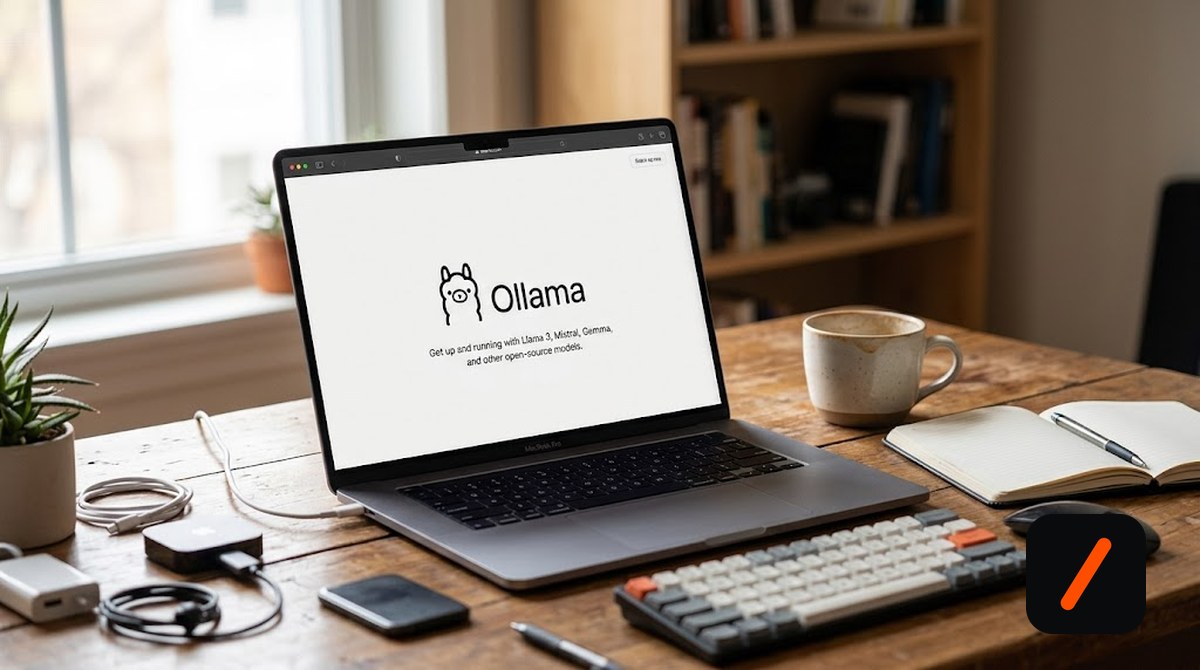
Ollama, the open-source tool that turned "run a large language model on your own computer" into a single command, has raised a $65 million Series B led by Theory Ventures. That is a serious check for a project best known as a developer convenience, and it reflects a real thesis: as open-weight models close the gap with closed ones, running AI locally, privately, and for free-at-the-margin becomes a durable market rather than a hobbyist detour. Ollama is betting the future of AI is not only in someone else's cloud.
- The round. $65 million Series B led by Theory Ventures, a notable jump in scale for a tool with open-source roots.
- The product. Ollama pulls and runs open models locally with one command, exposing a clean API on localhost for apps to build on.
- The thesis. Open-weight models are good enough now that local, private inference is a real alternative to cloud APIs for many tasks.
- The tailwind. On-device AI hardware and capable open models are converging, making local inference practical on ordinary machines.
Why does running AI locally matter?
Three reasons, and they compound. Privacy: local inference means your prompts and data never leave the machine, which is decisive for healthcare, legal, finance, and anyone under strict data rules. Cost: once you have the weights, running them locally has no per-token bill, so high-volume or always-on workloads that would be expensive on a cloud API become effectively free at the margin. Control: no rate limits, no surprise deprecations, no dependency on a provider's uptime or terms. For a long time the tradeoff was quality, because open models trailed the closed frontier badly. That gap has narrowed sharply, and Ollama's bet is that for a growing share of real tasks, a good open model on your own hardware is simply the better default.
RelatedTogether AI Raises $800M to Undercut Closed AI Models
What did Ollama actually build?
Ollama's genius was packaging. Running open models used to mean wrestling with dependencies, quantization formats, and GPU drivers. Ollama collapsed that into a single command that pulls a model and runs it, and it exposes a clean local API so developers can build apps against localhost the same way they would against a cloud endpoint. That developer experience is why it spread through the open-source community and became the default way people try open models on their laptops. The Series B is essentially capital to turn that beloved tool into a company: better performance, broader model support, and the infrastructure teams need to run local AI in production, not just experiment with it.
What does it mean for the market?
The signal for investors is that the AI stack is not consolidating entirely around a handful of cloud API providers, and money is flowing to the local-and-private layer as a real category. Theory Ventures leading a $65 million round validates that open-weight inference is a business, not a feature. It is a hedge against the cloud-API incumbents, and it rides two tailwinds at once: open models are getting genuinely capable, and on-device AI hardware, from beefier laptop NPUs to personal-AI PC chips, is making local inference practical. The competitive question is whether Ollama can build durable revenue on top of an open-source tool people are used to getting for free, which is the classic open-core tension. But the market it is targeting, private and cost-controlled AI, is expanding fast, and it has the clearest brand in it.
Who else is in this space?
Ollama is not alone, which is part of why the raise matters. Projects like llama.cpp provide the low-level inference engine many tools build on, LM Studio offers a polished desktop app for running models, and vLLM targets high-throughput server deployments. Ollama's edge has been developer ergonomics and mindshare: it became the verb people use for "run a model locally," much as Docker did for containers. The Series B is capital to defend and extend that position, funding performance work, broader model and hardware support, and the reliability features teams need to move from tinkering to production. In a crowded field, distribution and developer habit are moats, and Ollama has more of both than any rival.
RelatedTogether AI Raises $800M as Aramco Backs Open AI
- Monetization path. How Ollama turns a free, beloved tool into durable revenue without alienating its base.
- Enterprise local AI. Whether regulated industries standardize on local inference for privacy.
- Open-model quality. If open weights keep closing the gap, local inference gets more compelling.
- Hardware tailwind. How much on-device AI silicon expands the addressable market.
Our take
This raise is a good read on where AI is actually going. The narrative has been that everything funnels into a few giant clouds, but the counter-current, private and local inference, is real and growing, and Ollama is its most recognizable name. The company's challenge is the eternal open-core problem: how do you build a business on software people love partly because it is free and open. But the timing is right, because open models finally cross the "good enough" threshold for a lot of work exactly as the hardware to run them locally arrives on ordinary machines. For developers, funders, and enterprises tracking the money in AI, Ollama's Series B is worth a cross-reference against the broader funding picture; see our Funding Tracker and the ranked Biggest AI Funding Rounds. Local AI just got a well-funded standard-bearer.
- OfficialOllama blog product and funding announcements
- FundingGenZTech Funding Tracker tracked rounds and investors
- ReportingTech Startups July 2026 funding roundup
Original analysis by GenZTech. Reporting via Tech Startups.