
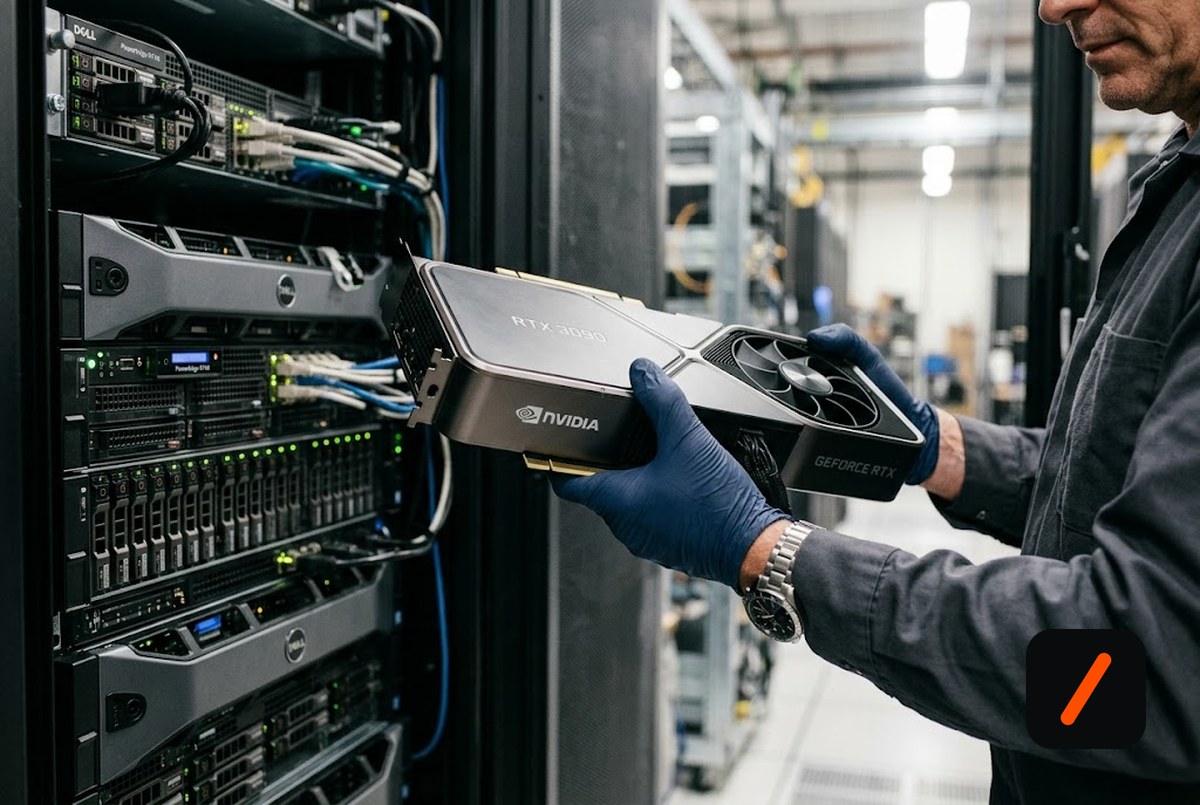
RunPod, a startup that rents GPUs by the second for AI training and inference, has raised a $100 million Series A led by Summit Partners, announced June 25 2026. The round is a bet on a simple thesis: the AI boom created a structural shortage of accessible GPU compute, and the researchers and smaller labs who cannot secure hyperscaler capacity on acceptable terms will pay a nimbler provider that can. RunPod's job is to be the cloud for people who found the big clouds too expensive, too slow to provision, or too hard to get capacity from at all.
- RunPod raised a $100M Series A led by Summit Partners on June 25 2026, a large A-round that reflects capital clustering in AI infrastructure.
- The product is an on-demand GPU cloud: spin up a container on a GPU in seconds, pay by usage, tear it down.
- The market is real: a compute shortage has given any credible GPU supplier pricing power below hyperscaler rates.
- The competition is everyone: hyperscalers above, and neoclouds like CoreWeave and Lambda alongside.
What does RunPod actually sell?
Speed and simplicity around a scarce resource. A developer can launch a container on a specific GPU in seconds, run a training job or serve a model, and pay only for the time used, without the enterprise contracts, quota requests, and provisioning delays that make hyperscaler GPUs painful for small teams. That per-second, self-serve model is the whole appeal: it turns GPU access into something closer to a utility than a procurement project. For an independent researcher or a seed-stage startup, the difference between filling out a capacity request and clicking a button is the difference between shipping this week and next quarter.
RelatedGimlet Labs Raises $300M at $3B to Bet Against Nvidia Lock-In
Why is this market so hot right now?
Because demand for leading-edge AI compute still outruns supply, and that shortage hands pricing power to anyone who can put GPUs online. Training large models and serving them at scale both consume enormous GPU time, and the hyperscalers ration their best capacity toward their largest customers. That leaves a huge underserved middle: researchers, indie developers, and smaller labs who cannot secure hyperscaler capacity at acceptable terms. A $100M Series A is a signal that investors see that gap as durable, not a blip, and want RunPod stocked with GPUs to capture it while the shortage lasts.
| Option | RunPod | Hyperscaler | Buy your own GPUs |
|---|---|---|---|
| Spin-up time | Seconds | Quota + setup | Weeks to months |
| Pricing | Per second, usage-based | Premium, committed | Huge upfront |
| Capacity for small teams | Self-serve | Often rationed | Whatever you bought |
| Best for | Devs, researchers, startups | Large enterprises | Steady heavy use |
What is the risk in the model?
The business is capital-intensive and cyclical. GPUs are expensive, they depreciate, and their scarcity is the entire moat, so if supply catches up to demand, pricing power erodes and margins compress across every GPU-cloud provider at once. RunPod is also squeezed from two sides: hyperscalers can undercut on price when they choose, and well-funded neoclouds like CoreWeave and Lambda are chasing the same customers. Raising $100M helps stock inventory, but it also means the company now has to grow into a valuation set during a compute crunch that will not last forever. Utilization, not headline capacity, is the number that decides whether the economics work.
What does the round say about the market?
That 2026 venture money is crowding hard into AI, defense, and infrastructure, and rewarding commercial proof over pitch theatre. A $100M Series A is enormous by historical standards, and it fits the pattern of a market where capital clusters in a few sectors and founders with concrete demand can raise large early rounds. AI infrastructure is the clearest example, because the spend is legible: buyers can explain exactly why they need GPUs and what they will run on them. That legibility is why picks-and-shovels plays like RunPod attract capital even as investors grow warier of application-layer startups with fuzzier stories.
RelatedFireworks AI Raises $1.5B Series D at $17.5B Valuation
- Utilization rates. The moat is scarce GPUs kept busy. Idle inventory is the fastest way to burn a $100M round.
- Supply loosening. As newer accelerators ship and capacity grows, watch whether pricing power holds.
- Neocloud consolidation. Expect the GPU-cloud field to thin out. RunPod needs to be a survivor, not a target.
- Enterprise pull. Moving upmarket into bigger, stickier contracts would de-risk the cyclical retail-developer base.
Our take
RunPod is a clean example of a picks-and-shovels bet in the AI gold rush, and those bets tend to age well as long as the shortage they exploit persists. The product solves a real, felt pain: getting a GPU quickly and cheaply without an enterprise sales cycle is genuinely hard, and the underserved middle of the market is large. The risk is entirely about timing and cycle. Compute scarcity is the moat, and moats made of scarcity dry up when supply catches up, which it eventually will. The winners in GPU cloud will be the ones who keep their expensive inventory busy and move toward stickier customers before pricing power fades. A $100M Series A buys runway to do exactly that; now the company has to execute against a valuation set at the peak of the crunch.
- OfficialRunPod the GPU-cloud product and pricing
- FundingSummit Partners the lead investor on the Series A
- ReferenceVC funding roundup, July 2026 round details and context
Original analysis by GenZTech. Figures current as of July 2026. Source: Tech Startups.