
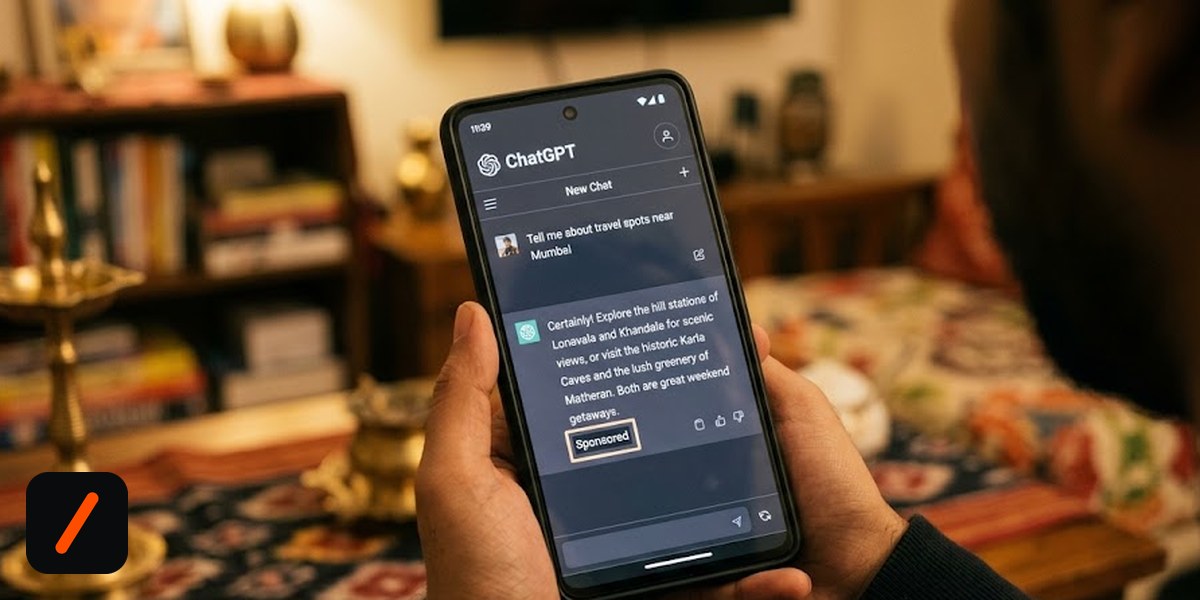
ChatGPT now shows ads in India. If you're logged in as an adult on the Free tier, or paying Rs 399 a month for the Go tier, you'll start seeing sponsored content below some of the chatbot's answers. Anyone on Plus, Pro, Business, Enterprise or Education still gets an ad-free experience, and OpenAI says the ad box itself is clearly labeled and separated from the actual response, not woven into it.
- Ads launch only for logged-in adult users on ChatGPT's Free and Go tiers in India; minors are excluded entirely.
- Over 50 brands go live this week through OpenAI's first Indian agency partners, WPP and Omnicom.
- OpenAI says advertisers see only aggregate metrics like impressions and clicks, never chat content, history or memories.
- A self-serve ChatGPT Ads Manager opens to Indian businesses on September 4, with daily budgets starting at Rs 725.
What exactly did OpenAI launch?
The ad unit sits at the bottom of a ChatGPT response, visually boxed off and marked as sponsored, so it reads more like a footnote than part of the answer. It only appears for adults who are signed in, on Free or the Go plan, which OpenAI introduced in India as a budget-tier subscription below Plus. Anyone paying for Plus, Pro, Business, Enterprise or Education keeps the ad-free product they already had. More than 50 brands are expected to be live by the end of this week, and OpenAI is running the launch through two agency partners, WPP and Omnicom, rather than opening the floodgates to every advertiser on day one.
RelatedGitHub Down Worldwide While Git Operations Stay Online
Why India, and why now?
India passed 100 million weekly ChatGPT users in February 2026, making it OpenAI's second-largest market, full of students, developers, educators and small businesses who mostly use the free product. That's a huge audience generating essentially zero direct revenue per person. Meanwhile OpenAI's costs keep climbing: training frontier models and running inference at ChatGPT's scale requires data centers and chips that don't get cheaper just because usage grows. Subscriptions and enterprise/API deals are OpenAI's existing revenue lines, and reporting has framed this ad launch explicitly as a third leg, timed ahead of a planned IPO. Investors evaluating that IPO will want to see more than one way the company can make money, and a market as large and price-sensitive as India is a logical place to prove ads can work without wrecking the free experience.
Does this put your chat data at risk?
OpenAI's line is that advertisers never touch your conversations, your memory settings, or anything that identifies you personally. What they get back is closer to a billboard company's dashboard: how many people saw an ad, how many clicked it. No transcripts, no chat history exports, no targeting built from what you told the model at 2am. OpenAI also says it won't sell user data outright and has drawn a line around sensitive subjects, so ads won't run next to conversations about health, mental health or politics, and minors won't see ads at all.
The part that gets glossed over in most coverage is subtler than "do advertisers see my chats." Even without reading a single message, a company that knows you asked ChatGPT for career advice ten minutes before an ad shows up for an online course is still learning something about the moment you're in, just from correlation rather than content. Aggregate, anonymized targeting can still describe intent pretty precisely once it's layered against timing, tier, and location. That's not a violation of the stated policy. It's just a reminder that "we don't share your chats" and "advertisers learn nothing about you" aren't quite the same promise, and OpenAI has only made the first one explicitly.
Who else is already doing this?
ChatGPT isn't the first AI assistant to lean on ads, and it won't be the last. Google has been threading sponsored placements into AI Overviews and is widely expected to extend that logic into Gemini's free tier over time, largely because Google already runs the biggest ad business on the planet and the infrastructure is sitting right there. Perplexity has experimented with sponsored questions and suggested follow-ups in its free product. Anthropic, notably, has stayed out of advertising so far and leans on Claude being subscription and enterprise funded instead, which gives it room to market "no ads, ever" as a selling point if rivals start filling free tiers with sponsored content.
| Monetization angle | ChatGPT (Free / Go) | Google Gemini | Perplexity |
|---|---|---|---|
| Ads on free tier | Yes, launched in India, Aug 2026 | Not yet in Gemini app; ads exist in AI Overviews | Sponsored questions tested, limited rollout |
| Free-tier usage limits | Message caps apply regardless of ads | Generous free quota tied to Google account | Daily query caps on free Pro searches |
| Ad-free paid tier | Plus and above stay ad-free | Google One AI Premium, no separate ad promise yet | Perplexity Pro, no ads by default |
| Self-serve ad tools | Ads Manager launching Sept 4, 2026 | Rolled into existing Google Ads stack | No public self-serve product yet |
What happens next?
The rollout has a second phase already dated. On September 4, 2026, OpenAI opens a self-serve ChatGPT Ads Manager to Indian businesses, letting them set up campaigns with daily budgets as low as Rs 725, which is a low enough floor to pull in small and mid-size advertisers, not just the big agency-run brands going live this week. Given India is being used as the proving ground, expect OpenAI to watch engagement and revenue numbers closely before deciding how fast to push ads into other markets. The obvious open question is whether Go-tier pricing and ad tolerance in India becomes the template for lower-cost markets generally, while wealthier markets get pushed toward paid tiers instead.
RelatedRocky Linux's Founder Wants an Open AI Data Commons
What it means for the market
This is a real signal, not a minor product tweak. OpenAI burns enormous amounts of cash on compute, and subscriptions plus enterprise API revenue haven't been enough on their own to change that math quickly. Advertising is a third lever, and proving it works at scale in a market with 100 million-plus weekly users gives OpenAI a cleaner profitability story to tell ahead of an IPO. It also puts pressure on everyone else. Google has the ad infrastructure to move fast if it decides Gemini's free tier should carry sponsored content too. Perplexity is smaller and under more pressure to find revenue anywhere it can. Anthropic, so far, gets to look like the premium option by simply not doing this, and "no ads" could become a genuine differentiator the same way it did for streaming and email years ago. None of this is a comment on OpenAI's future valuation or IPO price. It's about which monetization model AI chat settles on, and right now there isn't a consensus answer.
Our take
Ads at the bottom of a chat response are a much smaller intrusion than ads baked into search results or social feeds, and OpenAI's design choice to keep them visually separate is the right call. The privacy promise also sounds solid on paper: no chat access, no data sales, no ads next to sensitive topics. But "solid on paper" is doing some work here. The real test isn't whether advertisers can read your messages on day one, it's whether the definition of "aggregate data" stays narrow five years from now, once the ad business is generating real revenue and there's pressure to make targeting sharper. Free AI tools were never going to stay free forever without some kind of trade-off. Ads are a more honest trade than most alternatives, including quietly training on your data or squeezing free tiers until they're unusable. Whether that stays true depends entirely on how disciplined OpenAI is once the ad business matters more to its bottom line than it does today.
- Sept 4 Ads Manager launch: watch whether daily budgets as low as Rs 725 pull in a wave of small Indian businesses, which would validate the low-cost end of the model.
- Global expansion signals: any statement from OpenAI about testing ads in other price-sensitive markets would confirm India was a pilot, not a one-off.
- Plus-tier ad creep: if ads ever appear for paying subscribers, even in a limited form, that would break the current line between free and paid experiences.
- Rival responses: watch for Google or Perplexity announcements on free-tier ads, or Anthropic explicitly marketing an ad-free stance as a Claude selling point.
- OfficialTechCrunch report rollout details
- ReferenceOpenAI company site
Original analysis by GenZTech, based on reporting from TechCrunch and other outlets.