
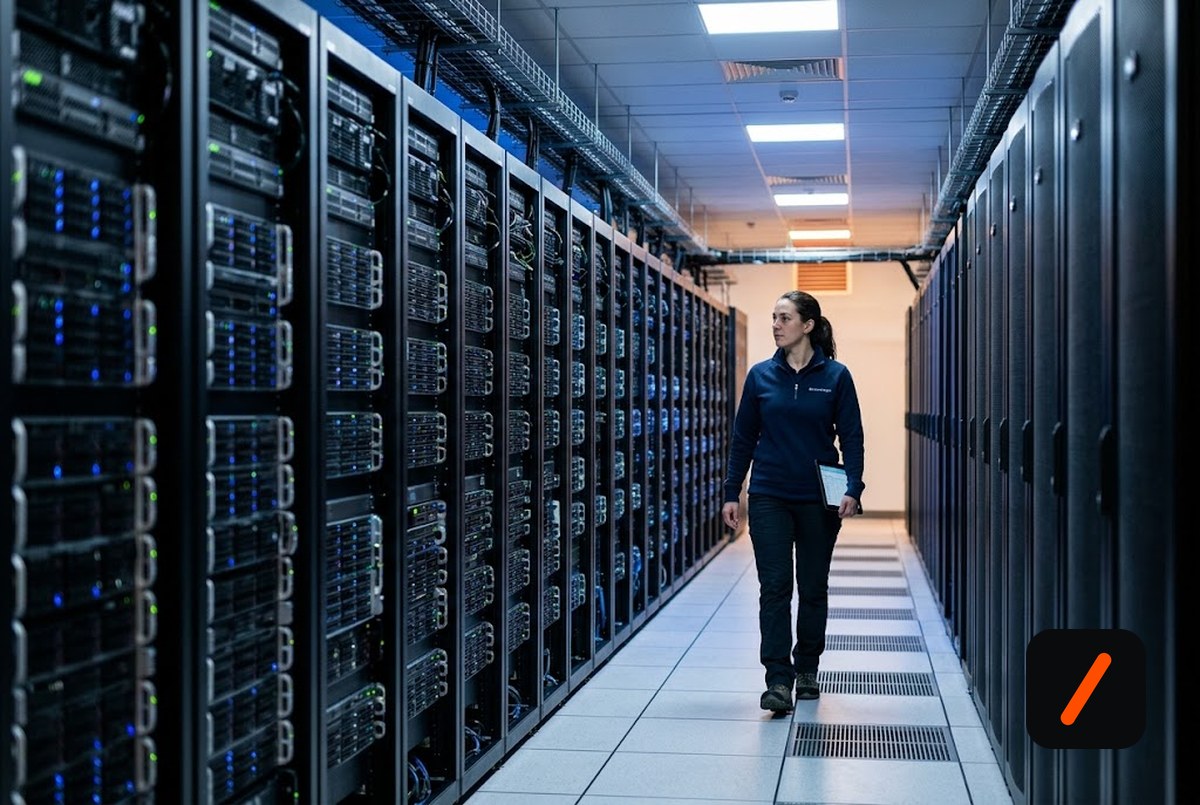
The money in AI keeps flowing to the layer underneath the models rather than the apps on top, and Together AI just proved it again. The company closed an $800 million Series C at an $8.3 billion post-money valuation, roughly doubling its worth, to expand a platform that lets enterprises train and run AI on open-source models instead of closed APIs. The tell is who wrote the checks: the round was led by strategic investors including the venture arm of Saudi Aramco, a signal that energy and cloud players now see owning a piece of AI infrastructure as a core position, not a side bet.
- Together AI raised $800M in a Series C at an $8.3B post-money valuation, about double its prior worth.
- The platform trains and serves open-source models, an alternative to depending on closed providers like OpenAI or Anthropic.
- Saudi Aramco's VC arm helped lead the round, part of a pattern of energy and cloud giants buying into AI infrastructure.
- It lands in a market where capital is concentrating in the AI stack: the sector drew $211B in 2025 alone.
What does Together AI actually do?
It runs the plumbing for companies that want to build on open models rather than rent a closed one. When a business chooses an open-weights model like Llama, DeepSeek or Qwen, it still has to fine-tune it, host it, and serve inference fast and cheaply at scale, which is hard, GPU-intensive work. Together AI provides that as a platform: managed training, optimized inference and the cluster orchestration underneath, so a customer gets the control and cost profile of open models without operating a data center. The value proposition is independence. Instead of being locked into one frontier vendor's API, pricing and terms, an enterprise can run the model it wants on infrastructure tuned for efficiency, and that pitch has grown more compelling as open models have closed the quality gap with closed ones.
RelatedTogether AI Raises $800M to Undercut Closed AI Models
Why did the valuation double?
Because demand for exactly this layer is exploding and investors are paying up to own it. Global venture funding hit $425 billion in 2025, with the AI sector alone drawing $211 billion, the highest in a decade, and within that pool the biggest checks have gone not to consumer apps but to the operating layers of the AI stack: cloud model operations, specialized hardware and inference platforms. Together AI sits squarely in that favored tier. As open-source models became genuinely competitive, the market for someone to train and serve them efficiently grew with it, and a doubling to $8.3 billion reflects investors betting that the infrastructure for open AI is a durable, high-demand business rather than a moment. In a selective funding environment, capital is concentrating in fewer companies with clear differentiation, and Together AI made the cut.
| Round | This raise | Detail |
|---|---|---|
| Stage | Series C | Growth-stage |
| Amount | $800M | Among the largest AI-infra rounds |
| Post-money valuation | $8.3B | Roughly doubled |
| Lead type | Strategic | Incl. Saudi Aramco's VC arm |
| Use of funds | Scale platform | Training + inference for open models |
What does Aramco's involvement signal?
That the AI boom and the energy business are converging, and the people who sell power want to own the thing that consumes it. AI's growth is bottlenecked by compute, and compute is bottlenecked by electricity, so energy giants increasingly see AI infrastructure as adjacent to their core business rather than a financial flyer. For a sovereign-linked investor like Aramco's venture arm, a strategic stake in a platform that trains and serves models is also a way to build capability and relationships in a sector every government now treats as critical. It fits a broader 2026 pattern in which strategic money, cloud providers, chipmakers and energy players, rather than pure financial VCs, leads the biggest AI-infrastructure rounds, because those backers get more than returns: they get a seat in the supply chain they depend on.
What are the risks in this bet?
Concentration and commoditization, in both directions. The AI-infrastructure tier is crowded and capital-intensive, competing against the hyperscalers' own managed offerings and a field of well-funded inference startups, and margins on serving models can compress fast as the work becomes commoditized. Together AI's thesis depends on open models continuing to matter, if the frontier closed models pull far enough ahead that most serious work migrates back to them, the independence pitch weakens. There is also the macro risk that hangs over the whole sector: enormous sums are being poured into AI infrastructure on the assumption of continued explosive demand, and any cooling would hit the capital-heavy middle layer hard. The counterweight is that open models keep improving and enterprises keep wanting alternatives to vendor lock-in, which is precisely the demand Together AI is funded to serve.
RelatedGimlet Labs Raises $300M at $3B to Bet Against Nvidia Lock-In
- Open vs closed. Together AI's fortunes track how competitive open-weights models stay against frontier closed ones.
- Strategic money. More energy and cloud giants leading AI-infra rounds would confirm the convergence thesis.
- Margin pressure. Whether inference serving stays profitable or commoditizes as rivals pile in.
- Macro cooling. Any slowdown in AI demand would hit the capital-heavy infrastructure layer first.
Our take
Together AI's raise is a clean read on where smart money thinks the durable value in AI sits: not in the app of the week, but in the infrastructure that everyone building on open models will need. That is the picks-and-shovels logic, and it is sound as far as it goes, because the demand for efficient training and inference is real and growing, and vendor-independence is a pitch enterprises genuinely want to hear. The Aramco-led structure is the more revealing detail, a marker that AI, compute and energy are collapsing into one strategic conversation, and that the biggest checks now come from players buying position in the supply chain, not just chasing multiples. The risk is the same one shadowing the entire sector: a lot of capital is riding on demand curves staying vertical, and the infrastructure middle is where a correction would bite first. But if open models keep closing the gap, betting on the company that makes them practical to run is a defensible place to be.
- CompanyTogether AI the platform, products and funding announcements
- FundingCrunchbase News the week's biggest AI funding rounds in context
- ReferenceTech Startups funding roundup early-July 2026 venture activity
Original analysis by GenZTech. Funding details current as of July 2026. More at Together AI.