
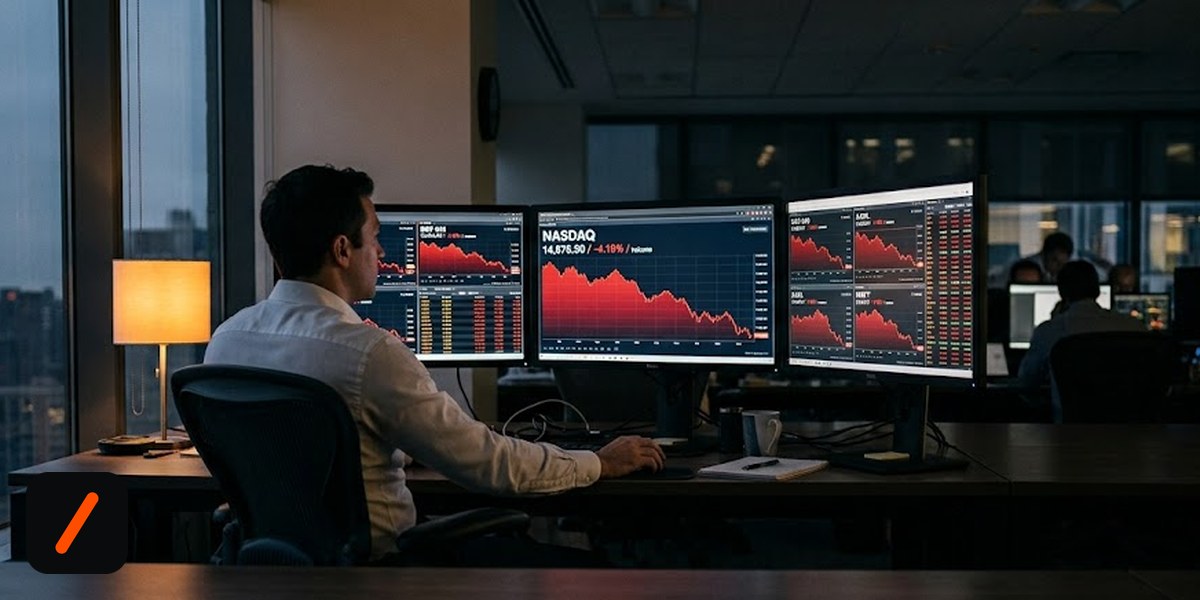
Situational Awareness, the AI-focused hedge fund Leopold Aschenbrenner started in 2024, is down roughly 67% in July. The number reached investors in a letter on Thursday and hit the wires a few hours ago. It arrived days after the firm sold its entire public equities book to Ken Griffin's Citadel in a single pre-market block trade on July 30, raising cash to meet margin calls from its prime brokers.
The fund is still up about 78% for 2026. Both of those numbers are true at once, and reconciling them is the actual lesson here. A portfolio does not lose two thirds of its value in four weeks because its thesis was wrong. It loses two thirds of its value in four weeks because it was borrowing roughly four dollars for every one it had.
RelatedKimi K3's Weights Are Due Today. Can You Run Them?
- Situational Awareness reported a 439% net return through June 30, disclosed in a July 24 investor letter.
- Assets peaked near $45 billion at the start of July, sat around $20 billion by late month, and fell to roughly $10 billion after the Citadel sale.
- The firm's $5 billion Anthropic stake survived the unwind, because it was never the collateral. Only the liquid book was.
- "We let you down this month," Aschenbrenner wrote to investors, per the letter's contents as described to the Wall Street Journal.
What actually happened this week?
The sequence matters more than the headline number. Six days before the liquidation, the fund was buying. Aschenbrenner's July 24 letter described the AI selloff as "one of the best buying opportunities since early last year." That is not the language of a manager preparing to exit. It is the language of someone adding.
Then the financing side moved. On July 29, credit-default-swap spreads on AI infrastructure borrowers widened sharply, and the equity market read it as a funding problem rather than a demand problem. Nebius dropped about 10% and CoreWeave about 9% in that session alone. For a book concentrated in exactly those names and levered several times over, that was enough. Goldman Sachs, JPMorgan and Bank of America issued margin calls. The next morning, before the open, the whole public portfolio went to Citadel in one trade.
- 2024Fund launched Aschenbrenner, then 23 and freshly out of OpenAI's superalignment team, raises several hundred million from Jane Street, the Collison brothers, Daniel Gross and Nat Friedman.
- Jun 30, 2026+439% net year to date Levered long AI infrastructure, short legacy software. The trade of the cycle.
- Early JulAssets peak near $45B Inflows chase the track record into the top of the move.
- Jul 24"Best buying opportunity" Investor letter frames the drawdown as an entry point, not a risk event.
- Jul 29Credit spreads blow out Nebius down 10%, CoreWeave down 9% as AI-cloud financing costs reprice.
- Jul 30Entire book sold to Citadel One pre-market block. Assets roughly halve to $10B.
- Jul 30"We let you down this month" Investor letter puts July at about minus 67%.
- Oct 2026Anthropic IPO expected The remaining $5B position, and the fund's path back, runs through it.
Why does a 17% move in the book become a 67% loss?
This is the part most coverage skips, and it is just arithmetic. Reporting puts the fund's gross exposure at roughly four times its capital. At that ratio, every 1% move in the underlying portfolio lands as about 4% on the fund's net asset value. Run it backwards from the reported loss and the implied move in the underlying book is somewhere near 17%.
Seventeen percent is a bad month for a concentrated AI infrastructure portfolio. It is not a catastrophe, and it is not a repudiation of the thesis. Several of the fund's disclosed longs, including Nebius, SanDisk, Micron and CoreWeave, each fell more than 35% in July, while short positions in legacy software names such as Adobe moved against the book at the same time. Both sides losing in the same month is what turns a manageable drawdown into a margin event.
Why sell the stocks you still believe in?
Because a margin call does not ask what you believe. It asks what you can sell today.
Situational Awareness held two very different kinds of assets. On one side, a liquid public book: SK Hynix, SanDisk, Nebius, Micron, CoreWeave, Bloom Energy, the picks-and-shovels of AI buildout. On the other, private positions that cannot be sold on a Thursday morning, led by a stake in Anthropic valued around $5 billion, plus holdings in the chipmaker MatX and the AI data-center startup Fluidstack.
Prime brokers lend against the liquid side. When the call came, the private stake could not be posted, sold, or partially trimmed to raise cash. So the fund sold the only thing that was sellable, which happened to be the exact positions its thesis was built on. Aschenbrenner ends July having liquidated the trade he was publicly defending six days earlier while keeping the position he never had to defend.
RelatedDeepSeek Pauses $1.5B Raise After Leaked Compute Remarks
| Position | Role in the book | Outcome |
|---|---|---|
| Nebius | Long, AI cloud | Down 35%+ in July, sold |
| CoreWeave | Long, AI cloud | Down 36% in a month, sold |
| SK Hynix | Long, HBM memory | Down 30%+, sold |
| Micron / SanDisk | Long, memory and storage | Down 35%+, sold |
| Bloom Energy | Long, data-center power | Down 30%+, sold |
| Adobe | Short, legacy software | Moved against the position |
| Anthropic | Private, roughly $5B | Retained, never collateral |
What does this mean for AI infrastructure stocks?
The immediate read is that a large, concentrated, levered buyer of AI infrastructure equities has been removed from the market, and its inventory now sits at Citadel. That is a supply overhang on Nebius, CoreWeave, SanDisk, Micron and SK Hynix for as long as Citadel chooses to work out of it, and Citadel is under no obligation to say when.
The signal for investors is narrower than "AI is over." July's decline started in credit, not in demand. Widening swap spreads on AI-cloud borrowers repriced how expensive it is to finance GPUs, and equity followed. Nothing in the past week said customers stopped buying inference. Worth watching: the next round of AI-cloud debt issuance and the spreads it clears at, because that is the variable that actually moved, and it is the one that will tell you whether this was a positioning washout or the beginning of a financing squeeze. Anthropic's expected October IPO is now the single largest mark on Situational Awareness's remaining book, which makes it a live question for the fund's survival as well as for the sector.
- Citadel's exit pace. How quickly the acquired book gets distributed sets the ceiling on any bounce in Nebius and CoreWeave.
- Redemption notices. Investors who bought in near the $45 billion peak are sitting on losses even though the fund is up for the year. Gate terms will be tested.
- The Anthropic mark. A strong October IPO makes the remaining $5 billion stake a recovery story. A soft one leaves the fund concentrated in an asset it cannot sell.
- AI-cloud credit spreads. The clean tell for whether July was a leverage unwind or a demand signal.
Our take
The instinct will be to read this as an AI bubble popping. It reads more like a lesson in plumbing. A manager with an unusually good call on AI infrastructure, up 439% in six months, is now down two thirds in a month and no longer owns the assets he was right about. The thesis did not fail. The financing structure around it did, and the fund's own success made that structure heavier: $45 billion of assets chasing a track record into a crowded, levered trade is a setup, not a triumph.
Aschenbrenner is 25 and has now run both ends of that experiment inside a single calendar year. Whether the fund raises fresh capital will say more about how much of AI investing is conviction and how much is access to margin. For everyone else, the useful takeaway is smaller and more durable: in a levered book, being early and being wrong produce the same margin call.
- ReportWall Street Journal: Situational Awareness down 67% in July — first report of the July figure and the investor letter's contents
- ReportCNBC: Aschenbrenner forced to unwind all public stock positions — the Citadel block trade and margin calls
- ReportTechCrunch: the Anthropic stake survives the unwind — holdings breakdown, private positions, fund background
- ReferenceSituational Awareness, the 2024 essay series — Aschenbrenner's original AI-scaling thesis, which the fund was built to express
- DataGENZ TECH Funding Tracker — our running record of AI rounds and valuations, including Anthropic's
Original analysis by GenZTech. Figures are as reported by the Wall Street Journal, CNBC and TechCrunch from investor-letter contents and people familiar with the trade; the fund has not published performance publicly. Leverage math in Fig 2 is our own arithmetic from reported gross exposure and is illustrative, not a disclosed figure. Nothing here is investment advice.