
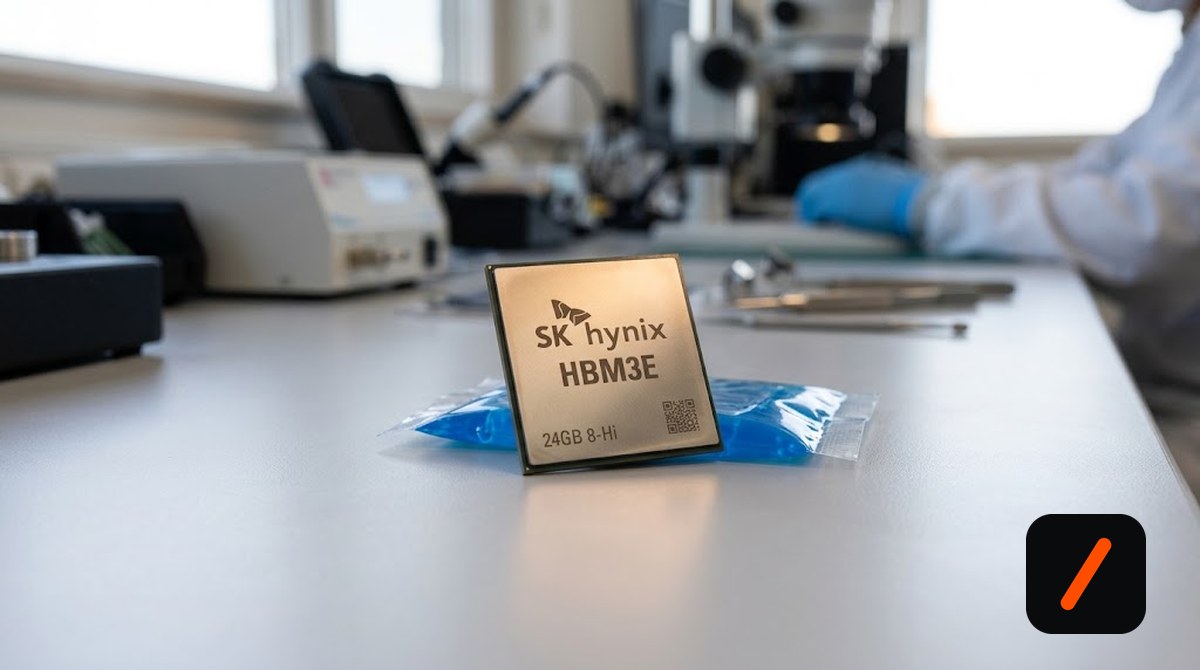
SK hynix priced the largest US listing ever by a foreign company on Friday morning, July 10, selling 177.9 million American depositary shares at $149 each to raise about $26.5 billion on Nasdaq under the ticker SKHY. That makes it the second-biggest share sale in history, behind only SpaceX, and it hands the world's leading maker of AI memory a war chest aimed squarely at one thing: building far more high-bandwidth memory. The message to Samsung and Micron is blunt. SK hynix intends to out-spend everyone in the shortage that is defining the AI buildout.
- The raise. $26.5 billion at $149 per ADS, the biggest US IPO ever by a foreign firm, topping Alibaba's $25 billion in 2014.
- The demand. The book was covered roughly seven times over, a sign investors want direct exposure to the AI memory shortage.
- The dominance. SK hynix says it holds 56.4% of the HBM market, the memory Nvidia's AI accelerators depend on.
- The catch. The new capacity the money funds is not expected online until at least late 2027, so it will not ease today's shortage.
What exactly did SK hynix do?
SK hynix, already a public company in Seoul, floated a separate slug of American depositary shares on Nasdaq to tap the deepest pool of investors in the world. It sold 177.9 million ADS at $149 apiece and started trading Friday, July 10, as SKHY. Gross proceeds land near $26.5 billion before fees. That figure clears Alibaba's $25 billion from 2014 to become the largest US listing ever by a foreign company, and it slots in as the second-largest share sale of all time, ahead of Saudi Aramco's $25.6 billion in 2019 and behind SpaceX's record $85.7 billion debut last month. Bloomberg reported the offering was oversubscribed roughly sevenfold, so pricing at the top was never in doubt.
RelatedMistral Raises €3B, Europe's Biggest-Ever Tech Funding Round
Why is a memory maker suddenly worth this much?
High-bandwidth memory. HBM is the stacked, ultra-fast memory bolted next to every serious AI accelerator, and it has become the single tightest link in the AI supply chain. Only three companies make it at scale: SK hynix, Samsung, and Micron. In its SEC filing SK hynix put its HBM share at 56.4%, and Nvidia CEO Jensen Huang has publicly called SK hynix his "largest partner" for the foreseeable future because the memory shortage is expected to run for years. That position turned a cyclical commodity business into the closest thing the AI boom has to a toll road. SK hynix generated roughly $65 billion in revenue in 2025 with profit near $28 billion, roughly double the prior year, as memory prices and demand surged.
How does SK hynix stack up against Samsung and Micron?
Samsung ships more memory overall, but SK hynix leads where it counts right now, in HBM, and Micron trails in share yet trades at a richer valuation because US investors can buy it easily. The Nasdaq listing is partly a fix for exactly that gap.
| Maker | SK hynix | Samsung | Micron |
|---|---|---|---|
| HBM position | Leader, ~56% share | Largest overall memory volume | Third, gaining |
| Key AI customer | Nvidia "largest partner" | Qualifying HBM with Nvidia | Shipping HBM3E to Nvidia |
| US access for investors | New: Nasdaq SKHY | Korea-listed | Long US-listed (MU) |
| Fresh capital raised | $26.5B (this listing) | Internal cash flow | Public markets |
What will SK hynix do with $26.5 billion?
Build fabs and buy the machines that fill them. In its prospectus SK hynix said the proceeds fund new chipmaking facilities plus the advanced packaging and leading-edge equipment needed to expand DRAM wafer output and HBM stacking at once. It is also extending its US footprint with an advanced chip-packaging plant in West Lafayette, Indiana, backed by $458 million in CHIPS Act funding. The honest caveat, and one most excited coverage skips: this capacity takes years. SK hynix and its peers were slow to add supply for fear of a glut, and the extra output is not expected to come online until at least the end of 2027, with some HBM customers waiting into 2028. So the raise is a bet on the shortage lasting, not a cure for it.
RelatedHelsing Raises $1.8B at $18B Valuation for Defense AI
- 2014Alibaba raises $25B in NYSE debut prior foreign-firm US record
- 2019Saudi Aramco IPO raises $25.6B then the largest ever
- Jun 2026SpaceX debuts, raising $85.7B sets the all-time mark
- Jul 10, 2026SK hynix lists on Nasdaq as SKHY, $26.5B biggest foreign-firm US listing
- 2027-28New HBM and DRAM capacity comes online what the raise actually funds
What does it mean for the market?
The signal for investors is that AI memory is now its own investable theme, decoupled from the historically brutal memory cycle, at least while the shortage holds. SK hynix's Nasdaq presence gives US buyers a direct instrument they lacked, which pressures the valuation gap with Micron (MU), the memory name most Americans already own. Counterpoint Research's MS Hwang framed the raise as "firepower to out-scale Samsung, close the valuation gap with US rivals such as Micron, and secure elite talent." Watch two things. First, whether Micron's premium compresses now that SKHY offers a purer HBM play. Second, the cyclicality risk buried in every memory story: heavy capex across all three makers is exactly what has historically produced oversupply and collapsing prices once demand cools. The bull case needs AI demand to keep outrunning the capacity this money builds. This is analysis, not investment advice.
- Micron's premium. Whether MU's valuation gap to SK hynix narrows now that a pure HBM leader trades on Nasdaq.
- Capacity timing. If the funded fabs slip past 2028, the shortage and pricing power last longer.
- Samsung's HBM catch-up. Whether Samsung qualifies competitive HBM with Nvidia and erodes SK hynix's 56% share.
- Cycle risk. Signs of a memory glut as all three makers spend heavily at the same time.
Our take
This is the clearest sign yet that the AI trade has moved down the stack from models to the physical bottlenecks that feed them, and memory is the tightest one. Raising $26.5 billion, the biggest foreign listing the US market has ever seen, is not a defensive move; it is SK hynix trying to convert a temporary lead in HBM into a structural one by simply building more than Samsung and Micron can. The risk is the oldest one in this industry. Everyone racing to add capacity into a shortage is precisely how memory gluts are born, and the new fabs will not arrive until the demand picture is much harder to read. But for now SK hynix has done the rational thing: raise historic money while the market is paying historic prices for exactly what it makes. For readers tracking where the AI money is really going, this belongs next to the compute and infrastructure rounds in our Funding Tracker.
- FilingSEC EDGAR SK hynix listing prospectus and share data
- FundingGenZTech Funding Tracker tracked AI infrastructure raises
- ReportingCNN Business record US listing coverage
Original analysis by GenZTech. Reporting via CNN Business.