
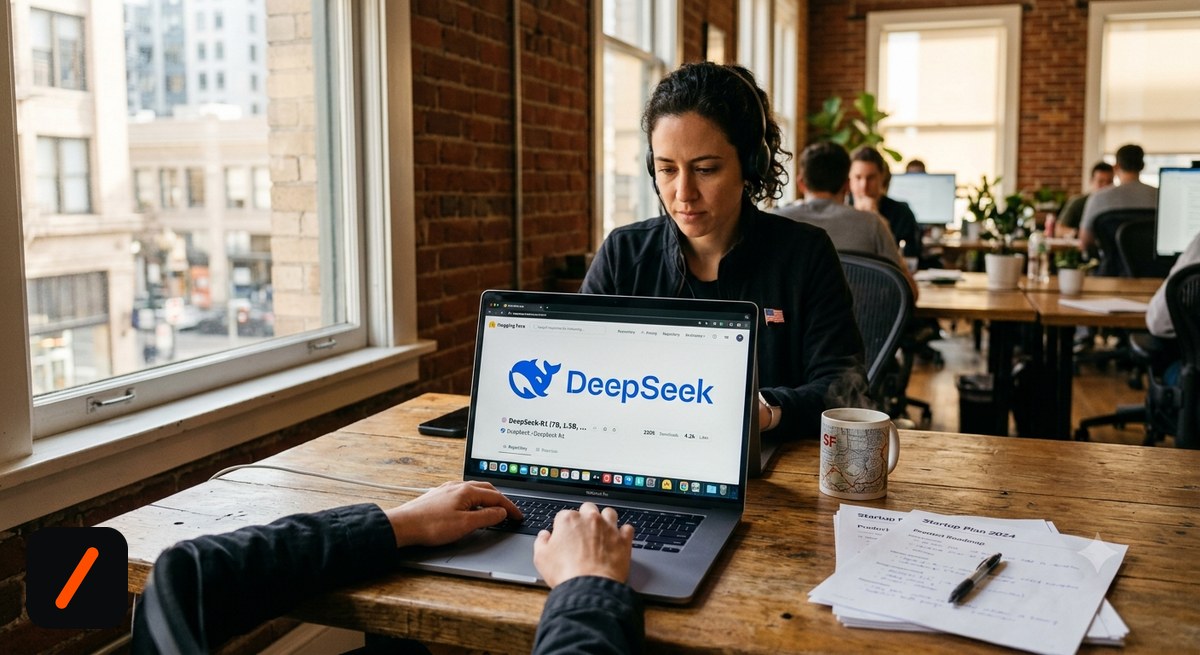
Nearly 200 venture-backed startups sent a coordinated letter to President Donald Trump on Wednesday asking him not to cut off American access to Chinese open-weight AI models, and their argument is arithmetic rather than ideology. The open models these companies build on run about $0.87 per million output tokens. The American frontier APIs they would be pushed onto run $25 to $50. That is the gap the letter is really about, and it landed hours before the White House escalated its own case against Moonshot AI.
- The letter was sent Wednesday, July 22, by the newly formed Little Tech Association, addressed to Trump, Commerce Secretary Howard Lutnick and Office of Science and Technology Policy Director Michael Kratsios.
- It asks for two things at once: world-leading American open-weight models, and continued access for US builders to open models already published worldwide.
- The trigger was Moonshot AI's Kimi K3 on July 16, an Axios report that a wholesale ban was under discussion, and Treasury Secretary Scott Bessent's July 21 threat to sanction foreign labs that steal US intellectual property.
- On our own AI coding leaderboard, the best genuinely downloadable open-weight coder, DeepSeek V4 Pro, scores 80.6% on SWE-bench Verified at $0.87 per million output tokens, against $25 for Claude Opus 4.8. That 29x spread is what founders mean when they say a ban kills companies.
What did the startups actually send?
The Little Tech Association is new, and this is its first coordinated intervention. Its executive director is Harry Godfrey, its founding members include Proton, Replit and Yelp, and Y Combinator is among the backers. Roughly 200 venture-backed companies signed. The core line of the letter is a balanced one: "American leadership requires two things: world-leading American open-weight models and continued access for U.S. builders to open models already available worldwide."
RelatedSakana AI Ditches the Frontier Model for Fugu Ultra v2
That framing matters, because it is not a defense of Chinese labs. It is a request that Washington solve the problem by building rather than blocking. Godfrey put the group's position as a question about proportionality: "What is the lightest-touch way that doesn't raise costs, limit access or inhibit American innovation while still addressing legitimate security concerns."
The bluntest version came from Suhail Doshi, founder of the AI infrastructure startup Particle: "There'll be hundreds of companies that instantly die. It's great for Anthropic. We're all going to have to spend money on Anthropic."
Why would a ban kill companies rather than inconvenience them?
Because for a large class of AI products, inference cost is the product's gross margin. A support-automation tool or a coding agent that burns tens of millions of tokens per customer per month is viable at $0.87 per million output tokens and underwater at $25. Nothing about the code changes. The unit economics simply invert.
The numbers we track make the size of the jump concrete. DeepSeek V4 Pro, released under an MIT license and self-hostable, is the highest-scoring downloadable coder on our board at 80.6% on SWE-bench Verified, priced at $0.435 in and $0.87 out per million tokens. Claude Opus 4.8 scores 88.6% at $5 and $25. Claude Fable 5, the strongest American model on the board after GPT-5.6 Sol, scores 95.0% at $10 and $50. A startup trading 80.6% for 88.6% pays roughly 29 times more per output token. Trading up to Fable 5 costs about 58 times more.
Founders are not claiming those American models are worse. They are claiming that an eight-point capability gain is not worth a 29x cost increase for most shipping products, and that the choice should be theirs.
What is actually being considered in Washington?
Less than the headlines suggest, and more than the White House admits. Axios reported on July 21 that the administration was weighing a wholesale ban on Chinese open-source models. Officials distanced themselves from that report almost immediately, and a White House spokeswoman, Liz Huston, said the administration is "doubling down on innovation to widen the gap between America and the rest of the world." Other officials called the reporting baseless speculation.
What is on the record is narrower and sharper. Treasury Secretary Scott Bessent told Fox Business on July 21 that the government would examine Chinese open-weight releases for evidence of intellectual property theft: "If we see, especially, that overseas models are stealing from our great companies, we have the ability to sanction them because of this theft." Sanctions on a named lab are a very different instrument from a blanket import ban on model weights, and the Little Tech letter is aimed at keeping the response in the first category.
- Jul 16, 2026Moonshot AI unveils Kimi K3 billed as open weights, third best coding score we track
- Jul 21, 2026Axios reports a wholesale ban is under discussion officials distance themselves the same day
- Jul 21, 2026Bessent threatens sanctions over IP theft Fox Business interview, no named target
- Jul 22, 2026Little Tech Association letter goes to Trump, Lutnick, Kratsios ~200 signatories
- Jul 23, 2026Kratsios accuses Moonshot of large-scale distillation of Anthropic's Fable the case for action gets specific
- Jul 27, 2026Date Moonshot says K3 weights will be published the deadline that makes this urgent
The detail most coverage skips: Kimi K3 is not open yet
Every account of this fight describes Kimi K3 as an open-weight model. It is not one today. We checked on July 19 and again this week: there is no K3 repository under huggingface.co/moonshotai, and the GitHub repo returns a 404. Moonshot's own blog still says the full weights land by July 27, 2026. Until then K3 is an API product, and we flag it as closed on our leaderboard for exactly that reason.
This is not a pedantic correction. The policy debate is being driven by a model that nobody outside Moonshot can download, and the July 27 date is why the pressure is spiking now. If the weights ship on schedule, a 93.4% SWE-bench Verified model becomes free to self-host anywhere on earth, and every enforcement option that depends on blocking a download gets substantially harder. If Washington intends to act on the open-weight question at all, it has a few days.
RelatedA 28.9M-Parameter LLM Now Runs on an $8 Microcontroller
| DeepSeek V4 Pro | Kimi K2.6 | Laguna S 2.1 | North Mini Code | |
|---|---|---|---|---|
| Maker | DeepSeek (CN) | Moonshot AI (CN) | Poolside (US) | Cohere |
| Access | Open weights, MIT | Open weights | Open weights, OpenMDW-1.1 | Open weights, single H100 |
| SWE-bench Verified | 80.6% | 80.2% | not yet scored | not yet scored |
| Output per 1M | $0.87 | $4 | $0.20 | free to self-host |
| Downloadable today | Yes | Yes | Yes | Yes |
The table also shows why the letter's first ask is not rhetorical. American open-weight models do exist, and Poolside's Laguna S 2.1 is priced below anything from China. What they lack is an independent benchmark score. No neutral evaluator has run either American entry on SWE-bench Verified yet, which means a US builder choosing on evidence rather than on flag still lands on DeepSeek.
What does it mean for the market?
The clearest read is on pricing power, not on stock direction. Anthropic and OpenAI are private, so there is no ticker to watch directly, but their pricing floor is set by what open weights can do for free. Remove the cheap Chinese tier and the floor rises, which is precisely why Doshi framed a ban as a gift to Anthropic rather than a blow to China. The signal for investors is that any restriction here is a margin event for the closed US labs and their backers, Microsoft and Amazon among them, before it is a security event.
The second-order read runs through hardware. Self-hosting an open-weight model means buying or renting GPUs, so a restriction that pushes startups back onto hosted APIs shifts demand from long-tail GPU rental toward the hyperscalers who already have capacity contracted. Nvidia sells into both, which is why it is roughly neutral on this specific question. Alibaba, whose Qwen line is one of the models under discussion, has the most direct exposure to a US access restriction among listed Chinese names.
- July 27. Whether Moonshot actually publishes K3 weights. That date, not the letter, sets the deadline for any restriction that works by blocking downloads.
- The instrument, not the rhetoric. Targeted sanctions on a named lab for IP theft are survivable for US startups. An import restriction on weights as a class is not. Watch which one Commerce reaches for.
- An American open-weight benchmark. If Poolside or Cohere gets an independent SWE-bench Verified score near 80%, the letter's first ask stops being aspirational and the policy gets much easier.
- Whether the Little Tech Association survives its first fight. A new trade group that loses its opening campaign rarely gets a second hearing in the same administration.
Our take
The security concern is real and the proposed remedy is aimed at the wrong layer. If Moonshot distilled Anthropic's model, that is a case against Moonshot, and sanctions on Moonshot are a proportionate answer. Blocking a category of published weights does not undo the distillation, does not retrieve the intellectual property, and does not stop a determined adversary from downloading files that are already mirrored across the internet. It does raise the cost of building an AI company in America by roughly 29 times, for the specific set of companies least able to absorb it.
The letter's more interesting half is the part nobody is arguing about. America has open-weight models. It does not have an open-weight model anyone has independently verified as frontier-class. That is a fixable problem, and it is a far better use of the administration's attention than an import ban with a July 27 expiry date on its own effectiveness.
- ReportingPolitico: Startup founders urge Trump not to shut off Chinese open weight AI , first report of the letter and its signatories
- Benchmarkvals.ai, SWE-bench Verified , the independent harness behind every score quoted here
- DataGenZTech AI Coding Leaderboard , our tracked scores, prices and open-weight flags
- Referencehuggingface.co/moonshotai , still no Kimi K3 repository as of this week
- ContextWhite House accuses Moonshot of distilling Anthropic's Fable , the escalation this letter is responding to
Original analysis by GenZTech. Reporting on the letter via Politico.