
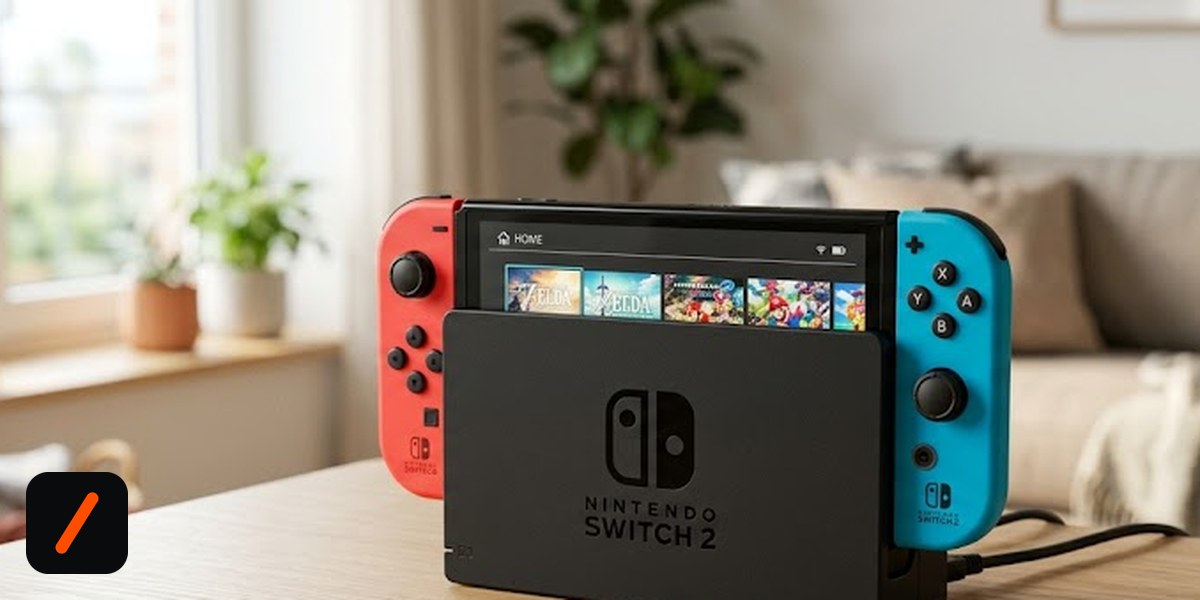
Nintendo shipped 3.82 million Switch 2 consoles between April and June, a 34.4% drop year on year, and operating profit still climbed 150.5% to 142.6 billion yen. Those two numbers, released in Tokyo this morning, only look contradictory until you remember what last year's June quarter was: the Switch 2's launch window. The decline is arithmetic. The profit is the actual news.
- Hardware slowed, as scheduled. 3.82 million Switch 2 units in the quarter, bringing lifetime shipments to 23.68 million.
- Software carried the quarter. 9.46 million Switch 2 games sold, up 9.2% year on year, for 58.17 million since launch.
- The profit beat was not close. 142.6 billion yen in operating profit against a consensus near 70.3 billion from 15 surveyed analysts.
- One item was a one-off. Roughly $300 million in refunded US tariffs was booked as a reduction in cost of sales.
Why did hardware shipments fall by a third?
Because the comparison quarter was not a normal quarter. The Switch 2 went on sale in early June 2025, so Nintendo's fiscal first quarter last year captured a launch spike compressed into a few weeks of availability. Working backwards from the disclosed 34.4% decline puts that quarter at roughly 5.82 million units. Any console measured against its own launch window posts a decline in year two. Sony and Microsoft both show the same shape in their second-year hardware lines.
RelatedMario Kart Tour Dies September 30 With No Offline Mode
The number worth watching is not the direction but the level. 3.82 million units in a quiet spring quarter, with no major hardware bundle and no price cut, is a healthy run rate for a console that is barely a year old.
How does revenue fall 9.5% while profit jumps 150%?
Three forces, and only one of them is temporary.
The first is mix. Console hardware is a low-margin business, sold close to cost or below it early in a cycle to build an installed base. Software is where the margin lives. Nintendo sold 9.46 million Switch 2 games this quarter, up 9.2% even as hardware fell by a third. When the revenue mix tilts from hardware toward software, gross margin rises even as the top line shrinks. Net sales were down 9.5%. Profit went the other way.
The second is the hardware cost curve. A console's bill of materials is at its most expensive on launch day and falls steadily as component pricing improves and manufacturing yields mature. The Switch 2 units Nintendo shipped this spring cost it meaningfully less to build than the ones it rushed out last June.
The third is the one-off: about $300 million in refunded US tariffs, recorded as a reduction of cost of sales. Nintendo had absorbed those tariffs rather than raising console prices for American buyers, so the refund flows straight to the bottom line. Strip it out and the profit growth is still large, but this is the line item that will not repeat next quarter.
| Metric | Q1 FY2026 | Q1 FY2027 |
|---|---|---|
| Switch 2 hardware shipped | 5.82M (derived) | 3.82M |
| Switch 2 software sold | 8.66M (derived) | 9.46M |
| Operating profit | ~56.9B yen (derived) | 142.6B yen |
| Net sales | baseline | down 9.5% |
| Analyst consensus, operating profit | n/a | 70.3B yen |
| US tariff refund in cost of sales | none | ~$300M |
Is the Switch 2 tracking ahead of or behind plan?
Ahead, on Nintendo's own arithmetic. The company is guiding to 16.5 million Switch 2 units for the fiscal year ending March 2027. This quarter alone delivered 3.82 million of them, which is roughly 23% of the annual target booked in the first quarter. Nintendo's holiday quarter is always its largest, so front-loading nearly a quarter of the year in spring is not the shape of a company about to miss.
Hideki Yasuda, a senior analyst covering the company, made the same point in blunter terms: a first quarter normally accounts for about 15% of annual unit sales, and this one cleared 20% of the target, which suggests Nintendo beats its own outlook by a considerable margin.
Nintendo nonetheless left the full-year forecast untouched: 2.05 trillion yen in net sales, 370 billion yen in operating profit, 16.5 million Switch 2 consoles, 60 million Switch 2 games and 105 million games for the original Switch. Holding guidance flat after doubling the consensus profit estimate is a familiar move from this management team. They have historically preferred to raise late rather than cut.
For scale, the original Switch sits at 156.59 million lifetime units after nine years. The Switch 2 is at 23.68 million after roughly fourteen months. It is early, and the installed base is compounding at a rate that makes the software line the one to watch from here.
RelatedValheim Hits 1.0: Deep North, PS5 and Switch 2 Launch
- Jun 2025Switch 2 launches roughly 5.82M units in the launch quarter
- Feb 2026Nintendo holds its forecast at Q3 hardware passes 17 million units
- Aug 6, 2026Q1 FY2027 results profit up 150.5%, lifetime hardware 23.68M
- Nov 2026Q2 results first quarter with no tariff refund cushion
- Mar 2027Fiscal year ends 16.5M hardware target, currently 23% booked
What does it mean for the stock?
Nintendo shares (7974 on the Tokyo exchange) have had a rough year, down about 28% year to date while the Nikkei benchmark rose roughly 30%. The stock closed up 2.9% ahead of the announcement. That gap between the share price and the operating performance is the interesting part: the market has been pricing the hardware deceleration, and this report says the deceleration is not where the earnings power sits.
The signal for investors is a margin story, not a volume story. Watch three things over the next two quarters. Whether software attach holds up once the launch-window titles age. Whether the tariff position stays favourable, because roughly $300 million of this quarter's profit came from a refund that does not recur. And whether Nintendo revises its full-year guidance upward at the Q2 print in November, which is the moment the conservatism gets tested. None of this is a recommendation, and a single quarter with a one-off in it is thin evidence for anything.
- The November print. First clean quarter without the tariff refund, and the first real read on underlying margin.
- Software attach. 58.17 million games against 23.68 million consoles is about 2.5 titles per unit. That ratio is the whole margin thesis.
- Guidance revision. Holding 16.5 million after booking 23% of it in Q1 looks deliberately low. A raise would confirm it.
- Tariff policy. Nintendo chose to absorb rather than pass through. If that reverses, US console pricing moves.
Our take
Most coverage of this report will lead with the 34% hardware decline, and that framing is close to meaningless. Comparing any console's second-year spring quarter against its launch quarter produces a decline every single time, for every manufacturer. It tells you when the console shipped, not how it is doing.
The number that actually moved is the profit line, and it moved because Nintendo's business is finally behaving the way console businesses are supposed to behave in year two: hardware volume normalises, hardware cost falls, software volume grows, and margin expands underneath a shrinking top line. The tariff refund flatters this quarter and deserves an asterisk. Everything else in the report looks structural.
The risk sits in the guidance. A company that just beat consensus by more than 2x and left its forecast untouched is either being careful or knows something about the back half that the market does not. November tells us which.
- OfficialNintendo, Financial Results Explanatory Material (Q1 FY2027) the filing itself, released 6 August 2026
- ReferenceNintendo, hardware and software sales units the running lifetime shipment table
- ReportReuters via RTE, Nintendo quarterly results consensus estimates and the tariff refund detail
- ReportCNBC, Nintendo fiscal first-quarter earnings profit and revenue against estimates
Original analysis by GenZTech. Figures as disclosed by Nintendo on 6 August 2026; prior-year comparatives marked "derived" are calculated from the percentage changes in the company's own release. Source: Nintendo investor relations.