
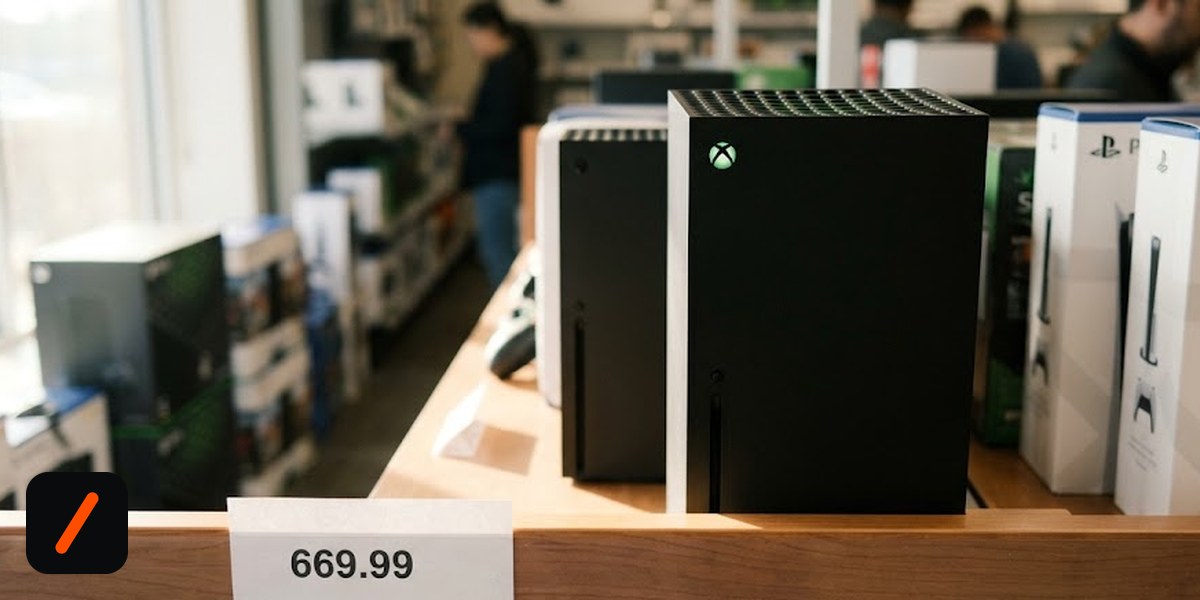
Microsoft's Xbox price rise reached Europe and the UK overnight, and the numbers landed harder than the June announcement suggested. The disc version of the Xbox Series X now sells for £669.99 in the UK, up from £499.99, and €799.99 in the eurozone, up from €599.99. Microsoft published only US figures when it gave notice on 25 June. The European and British prices were never disclosed in advance: they simply appeared at checkout when the change took effect on 1 August, and the full picture was only pieced together across 2 August.
How much did each Xbox actually go up?
Four models remain on sale after Microsoft discontinued the 2TB Series X. Every one of them moved, and the increases are not proportional. In cash terms the 1TB machines all took the same £170 hit, which means the cheapest console in the lineup absorbed the largest percentage jump.
RelatedXbox Outage Blocks Disc Games, Not Just Digital Ones
| Model (UK) | Old | New | Change |
|---|---|---|---|
| Series S 512GB | £299.99 | £429.99 | +£130 (43%) |
| Series S 1TB | £349.99 | £519.99 | +£170 (49%) |
| Series X 1TB Digital | £449.99 | £619.99 | +£170 (38%) |
| Series X 1TB Disc | £499.99 | £669.99 | +£170 (34%) |
Eurozone pricing follows the same shape: £130 becomes €150 on the 512GB Series S, which goes from €349.99 to €499.99, and £170 becomes €200 on every 1TB model. The Series X Digital sits at €749.99, the disc model at €799.99. That last figure converts to roughly $900, for a console that launched at $499 in November 2020.
- The entry-level Xbox Series S 512GB is now £429.99 in the UK, a 43% increase in a single day.
- Microsoft blames component costs, saying console storage and memory prices have risen more than 2.5x with another doubling expected by autumn 2027.
- The 2TB Xbox Series X has been discontinued rather than repriced.
- A disc-drive PS5 with 1TB now undercuts the equivalent Series X by £100 in the UK.
Why is a five-year-old console getting more expensive?
Consoles almost never go up in price. The business model runs the other way: sell the box thin or at a loss, make it back on software and subscriptions, then cut the price as silicon matures. Microsoft said the quiet part out loud in its June notice, that consoles "are typically not sold at a profit, but instead for less than they cost to make." When the bill of materials climbs, there is no margin cushion to absorb it.
The specific cost is memory. Microsoft's own wording: "console storage and memory prices have increased by more than 2.5x and we expect another doubling by the fall of 2027." A Series X carries 16GB of GDDR6 plus a custom NVMe SSD, so DRAM and NAND are among the largest single line items in the build after the SoC. When contract prices for those parts multiply, a console maker either eats it or passes it on.
We have been tracking that squeeze since June. The AI buildout pulled fab capacity toward high-bandwidth memory, conventional DRAM and NAND supply tightened behind it, and contract pricing began climbing fast. See our earlier reporting on the memory supercycle, the DRAM price surge and the broader 2026 memory shortage. This is the moment that industrial cost story reached a mass-market living-room device, and it is the clearest consumer-visible proof yet that the shortage is not confined to datacenter procurement teams.
- Jun 2026Memory contract prices climb as HBM demand crowds out conventional DRAM and NAND covered in our earlier supercycle reporting
- 25 Jun 2026Microsoft gives notice of an Xbox price rise, publishing US increments only +$100 on 512GB, +$150 on 1TB, 2TB discontinued
- 1 Aug 2026Increase takes effect worldwide; European and UK prices become visible at checkout no advance regional disclosure
- 2 Aug 2026Full UK and eurozone tables reported, up to £170 and €200 per console
- Autumn 2027Microsoft's own forecast has memory and storage costs doubling again implies this is not the last move
What does this do to the Xbox and PlayStation matchup?
It hands Sony a straightforward advantage at the till. A 1TB PS5 with a disc drive sits at £569.99 in the UK, which is £100 below the equivalent Series X at £669.99. Sony faces the same memory market, so the gap may not hold, but for now the shopper comparing two boxes on the same shelf sees a clear winner on the label.
The harder problem is the Series S. It exists to be the impulse-purchase, budget-tier, kids-first-console option. At £429.99 for the 512GB model, that positioning is gone. A console designed around a sub-£300 price point is now more expensive than the launch price of a full Series X, and the value argument it was built on no longer holds. Microsoft is also entering the back half of 2026 with a very large software release cycle ahead of it, which makes an install-base squeeze awkward timing.
RelatedMoss: The Forgotten Relic Brings Quill Off VR at Last
What it means for the market
Xbox hardware is a small line inside Microsoft (MSFT), so the direct revenue effect is minor. The signal for investors is about attach rates rather than console margin: Microsoft's gaming strategy leans on Game Pass and cross-platform publishing, and both depend on the install base continuing to grow. A price wall at the entry tier slows that. Sony (SONY) gets a temporary pricing edge but sits in the same component market. The names actually benefiting are the memory suppliers, Samsung, SK hynix and Micron, whose pricing power is what shows up as a £170 sticker change in a British game shop. Watch whether Sony matches within the quarter: if it does, the pass-through is industry-wide and the story stops being about Xbox at all. This is analysis, not investment advice.
Our take
The prices are defensible. The communication was not. Microsoft had the regional figures in June and chose to publish US dollars only, which meant British and European buyers found out by watching a console gain £170 between one visit to a store page and the next. Six weeks of advance notice went to one market. Everyone else got a surprise.
What matters more than the sticker is the forecast attached to it. Microsoft did not describe a one-off correction. It told everyone to expect memory costs to double again by autumn 2027, which is not the language of a company that thinks it is finished raising prices. If that forecast is right, this generation ends up as the first in console history where hardware gets steadily more expensive over its life instead of cheaper, and the assumption that waiting saves you money stops being true.
- A Sony response. If PS5 pricing moves within the quarter, this is a component story, not an Xbox story.
- Series S positioning. Either Microsoft finds a cheaper entry configuration or it concedes the budget tier entirely.
- A second increase. Microsoft's own 2027 memory forecast leaves the door open, and it has now set the precedent for mid-generation rises.
- Cloud as the hedge. Expect harder promotion of streaming and Game Pass as the cheap way in, since the hardware on-ramp just got expensive.
- OfficialXbox Wire: Updated Xbox Console Prices Microsoft's June notice and the component-cost statement
- ReferenceXbox UK console store current live UK retail pricing
- ReportVGC: Europe and UK increases fully revealed regional price tables, 2 August
- ContextGenZTech: the 2026 memory shortage our earlier reporting on the DRAM and NAND squeeze behind this
Original analysis by GenZTech. Reporting on the European and UK price tables via The Verge.