
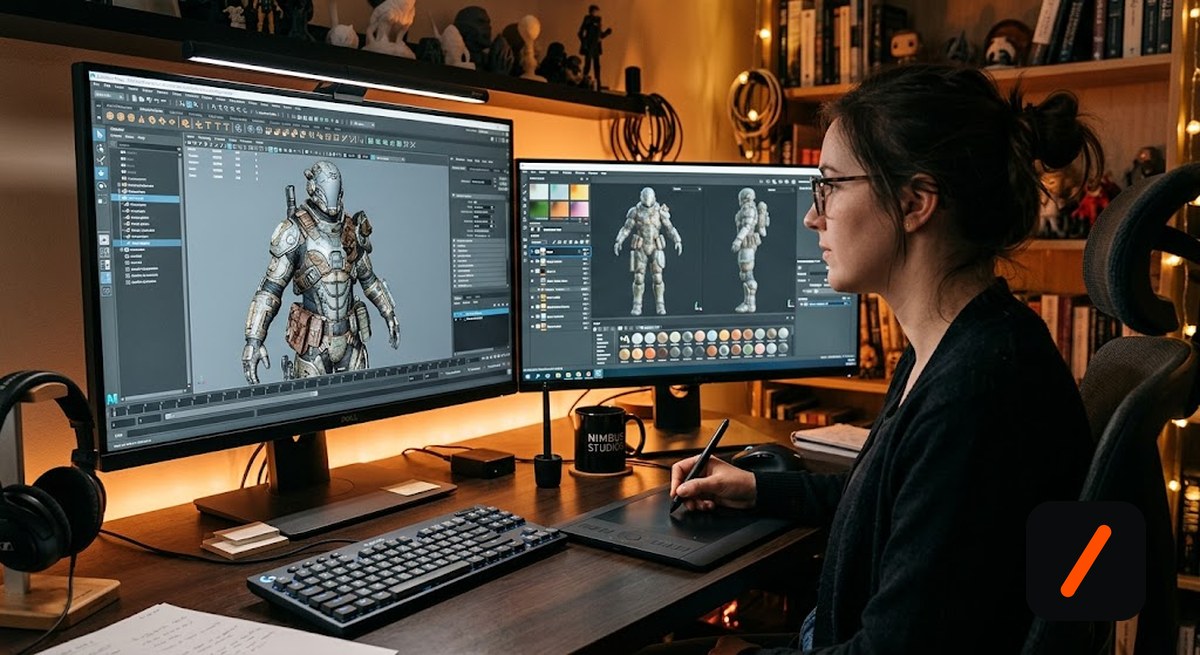
Tripo AI has raised approximately $147 million in a Series A extension, backed by gaming company 4399.com and other investors, to scale its generative 3D and world-model technology. The round, disclosed in early July 2026, is one of the larger checks written into 3D-focused generative AI, and it reflects a growing thesis: after text, images, and video, the next frontier for generative models is navigable, usable 3D content that games, robotics, and spatial computing all need.
- The round: about $147M in a Series A extension, with gaming firm 4399.com among the backers.
- The product: generative 3D, turning prompts and images into usable 3D assets, plus world-model ambitions.
- The thesis: 3D is the bottleneck for games, robotics simulation, AR/VR, and virtual production, and generating it is slow and expensive today.
- The signal: AI Series A rounds are elevated, and 3D/world models are drawing capital as the frontier beyond image and video generation.
What does Tripo AI actually build?
Tripo AI develops generative 3D technology: systems that turn text prompts or reference images into 3D models, and it is pushing toward world models, AI that can represent and generate coherent 3D environments rather than isolated objects. Today, authoring 3D content is one of the most labor-intensive tasks in software. A single game-ready asset can take an artist hours or days, and populating a full environment or a robotics simulation multiplies that cost. Generative 3D promises to compress that work the way image models compressed illustration and video models compressed motion graphics. The $147M extension is capital to scale the models, the compute behind them, and the pipeline that turns raw generations into assets people can actually use.
RelatedUpscale AI Raises $190M Series A at a $2B Valuation
Why is 4399.com backing it?
The involvement of a gaming company as a backer is a tell about where the near-term value lies. Games are the most obvious and immediate market for generative 3D: studios need enormous volumes of models, environments, and props, and the cost of authoring them by hand is a real constraint on how much content a team can ship. A strategic investor from gaming brings not just money but distribution and a demanding first customer, the kind of partner that forces a generative-3D product to meet the bar of real production pipelines rather than impressive demos. That grounding matters, because the gap between a striking 3D generation and a clean, riggable, game-ready asset is exactly where these products succeed or fail.
Why are world models the bigger prize?
Generating a single object is useful; generating a coherent, navigable world is transformative. World models, AI systems that understand and produce consistent 3D environments with physics and spatial relationships, are increasingly seen as foundational to two enormous markets: robotics, which needs vast amounts of simulated environments to train on, and spatial computing, which needs generated 3D content to fill AR and VR experiences. If Tripo can move from assets to environments, it positions itself upstream of both. That is the ambition the funding is really underwriting, and it is why 3D generation is drawing capital as the frontier beyond the now-crowded fields of image and video generation.
What it means for the market
For investors watching generative AI, this round is a data point in a clear rotation: capital is moving past text and image models toward the harder, less saturated modalities, with 3D and world models near the top of the list. The read is that the value is shifting to modalities that unlock physical and spatial industries, gaming, robotics, and AR/VR, rather than another chatbot. The competitive landscape is real, with structure-prediction and 3D efforts from larger labs and well-funded rivals, so the signal for anyone tracking the space is execution: whose generations are actually production-usable, and who lands the studio and robotics partnerships that turn a model into revenue. For related public names in gaming engines and GPUs, more generative-3D demand is another incremental tailwind. This is analysis, not investment advice.
RelatedGeneral Intuition Raises $320M to Train AI on Games
What are the risks?
Two big ones. First, the quality-to-usable gap: a 3D generation that looks good in a demo often needs substantial cleanup, retopology, and rigging before it can enter a real pipeline, and closing that gap is a hard, unglamorous engineering problem. Second, competition and compute: world models are expensive to train, and Tripo is up against both specialized startups and the 3D ambitions of much larger, better-capitalized labs. The $147M extension buys runway and scale, but the market will reward whoever makes generative 3D genuinely production-ready first, not whoever has the most impressive single render. The gaming backer helps, but the company still has to prove its output holds up under professional demands.
- Production usability. The metric that matters is how much manual cleanup a Tripo asset needs before it ships in a real game.
- World-model progress. Moving from objects to coherent environments is the leap that justifies the valuation.
- Robotics partnerships. Simulation demand from robotics could become a larger market than games.
- Competitive checks. Watch how larger labs' 3D efforts and rival raises reshape the field.
Our take
Tripo's raise is a clean read on where generative AI capital is flowing next. Text and image generation are crowded and increasingly commoditized; 3D and world models are hard, expensive, and sit upstream of some of the biggest spatial industries, which is exactly why they attract nine-figure checks despite the difficulty. The involvement of a gaming backer is the smart part of this story, because games are the market that will pay for generative 3D first and stress-test it hardest. The unknown is execution: whether Tripo can close the demo-to-production gap and then make the jump from assets to worlds before better-funded rivals do. If it can, $147M will look like an early entry point into a foundational layer of spatial computing. If it cannot, it will be another well-funded lab chasing a frontier that stayed just out of reach.
- OfficialTripo AI the company's generative-3D products
- FundingGenZTech Funding Tracker our running record of major AI and tech rounds
- ReferenceBiggest AI Funding Rounds the ranked list this round joins
Original analysis by GenZTech. Based on funding disclosures as of July 2026.