
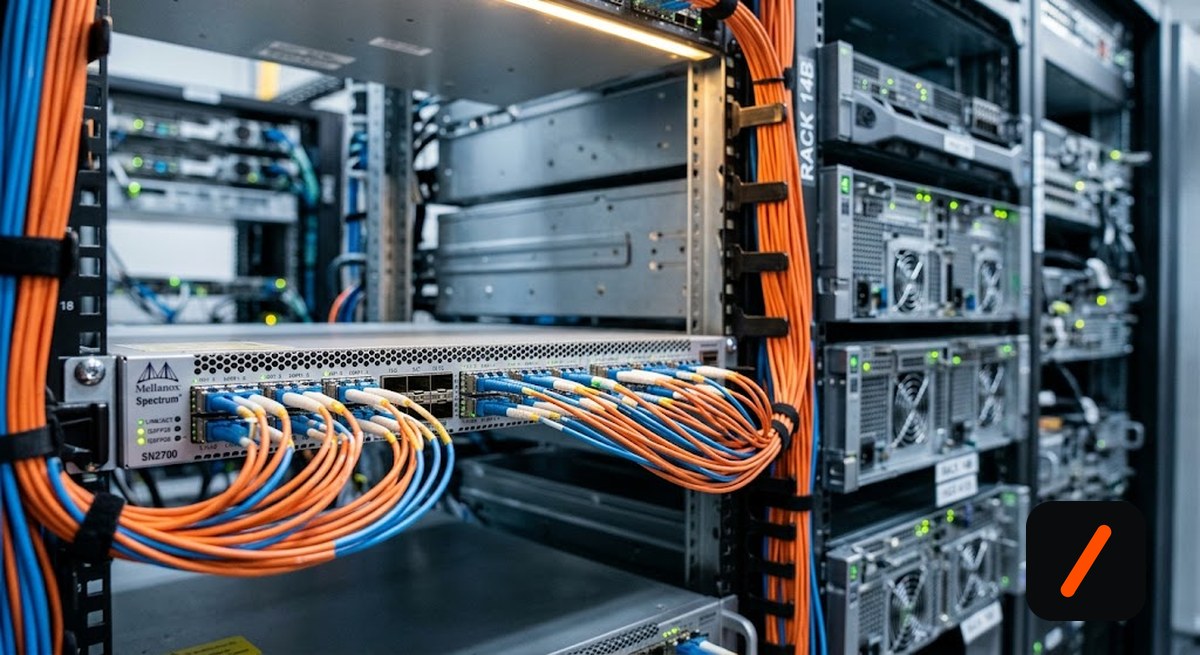
Upscale AI, a Santa Clara startup building networking infrastructure for AI data centers, has raised a $190M Series A extension led by Premji Invest, pushing its total financing to roughly $500M and its valuation to $2B. The size of an "extension" Series A is the story: investors are treating AI networking, the fabric that connects thousands of GPUs into one training cluster, as the next scarce layer after the chips themselves. Our read is that this round is a wager that the bottleneck in AI has quietly moved from compute to interconnect.
- The $190M extension brings Upscale AI's total raised to about $500M and sets a $2B valuation.
- Premji Invest led the round; the company is based in Santa Clara and targets AI data-center networking.
- The raise reflects a thesis shift: GPUs are only as useful as the network stitching them into a cluster.
- AI Series A rounds now average far above non-AI peers, and infrastructure plays command the richest ones.
What does Upscale AI actually build?
Upscale AI builds networking infrastructure for AI data centers, the switches, interconnect, and software that turn a room full of individual GPU servers into a single machine capable of training a frontier model. This is a genuinely hard layer. When you scale a training job to thousands of accelerators, the network becomes the limiter: bandwidth, latency, and congestion control decide whether the GPUs stay busy or sit idle waiting for data. A startup that can move that ceiling is selling directly into the most capital-intensive buildout in tech.
RelatedGimlet Labs Raises $300M at $3B to Bet Against Nvidia Lock-In
Why is the network the new bottleneck?
Because compute has partly caught up to itself. The industry has spent two years obsessed with GPU supply, but as clusters grow past thousands of chips, the marginal problem shifts to keeping them fed. An idle GPU is wasted money, and at frontier scale a poorly designed fabric leaves a meaningful fraction of very expensive silicon waiting on the wire. That is why an interconnect startup can raise at a $2B valuation before it is a household name: the customers are the same hyperscalers and neoclouds buying the chips, and they will pay to stop stranding them.
What does the market signal say?
The signal for investors is that AI infrastructure is where the richest early rounds now concentrate. Series A funding for AI startups averages well above non-AI peers, and the very top of that distribution goes to the physical and networking layers rather than another chat app. Premji Invest leading a $190M extension at a $2B mark, on top of an already large raise, is a vote that Upscale AI is a durable infrastructure supplier rather than a feature. The competitive context is steep, though: it is selling into a space where Nvidia's own networking stack, Broadcom, and a field of well-funded challengers already operate.
Who does Upscale AI have to beat?
The incumbents are formidable. Nvidia bundles its own high-speed interconnect with its GPUs and has every incentive to keep networking inside its platform. Broadcom is the merchant-silicon heavyweight for data-center switching. And a cluster of other startups is chasing the same "AI networking" narrative with their own funding. Upscale AI's $500M war chest buys it the ability to compete on engineering and to land reference deployments, but the moat has to be real performance at scale, not just a well-timed raise. Infrastructure buyers are unsentimental; they benchmark.
RelatedLovable raises $400M at $13.3B, doubling in eight months
Who actually buys AI networking?
The customer list is short but rich. It is the hyperscalers building their own frontier clusters, the neoclouds renting GPU capacity by the hour, and the sovereign and enterprise data centers standing up private AI. All of them share the same pain: they can buy accelerators faster than they can wire them together efficiently, and every point of stranded utilization is money burned at data-center scale. That concentration cuts both ways for Upscale AI. A handful of enormous buyers means a few reference wins can validate the whole company, but it also means the sales cycle is long, technical, and unforgiving, and losing one flagship account can reshape the growth story. A $2B valuation assumes it lands several of them.
- Named deployments. Whether a major cloud or neocloud publicly runs Upscale AI's fabric at scale.
- Benchmark proof. Independent numbers showing higher GPU utilization versus incumbent stacks.
- Nvidia's response. Whether the platform leader tightens its networking bundle to squeeze challengers.
Our take
This round is a clean read on where sophisticated money thinks the AI buildout is tightest. The chip shortage narrative has matured, and the smart capital is moving one layer down the stack to the interconnect, because a cluster that cannot keep its GPUs fed is burning money no matter how many accelerators it holds. Upscale AI raising half a billion dollars before broad name recognition is not hype so much as a bet on a specific, verifiable bottleneck. The caveat is that this is the hardest possible neighborhood to build a business in, wedged between Nvidia's platform and Broadcom's silicon. The $2B valuation is a promise; the reference deployments and the utilization numbers are what will have to pay for it. For funding-round context, our Funding Tracker and the ranked Biggest AI Funding Rounds page track how this stacks up.
- FundingCrunchbase News venture coverage round size, lead, and valuation
- DataGenZTech Funding Tracker our running record of AI rounds
- DataBiggest AI Funding Rounds ranked by size
Original analysis by GenZTech. Reporting informed by Crunchbase News.