
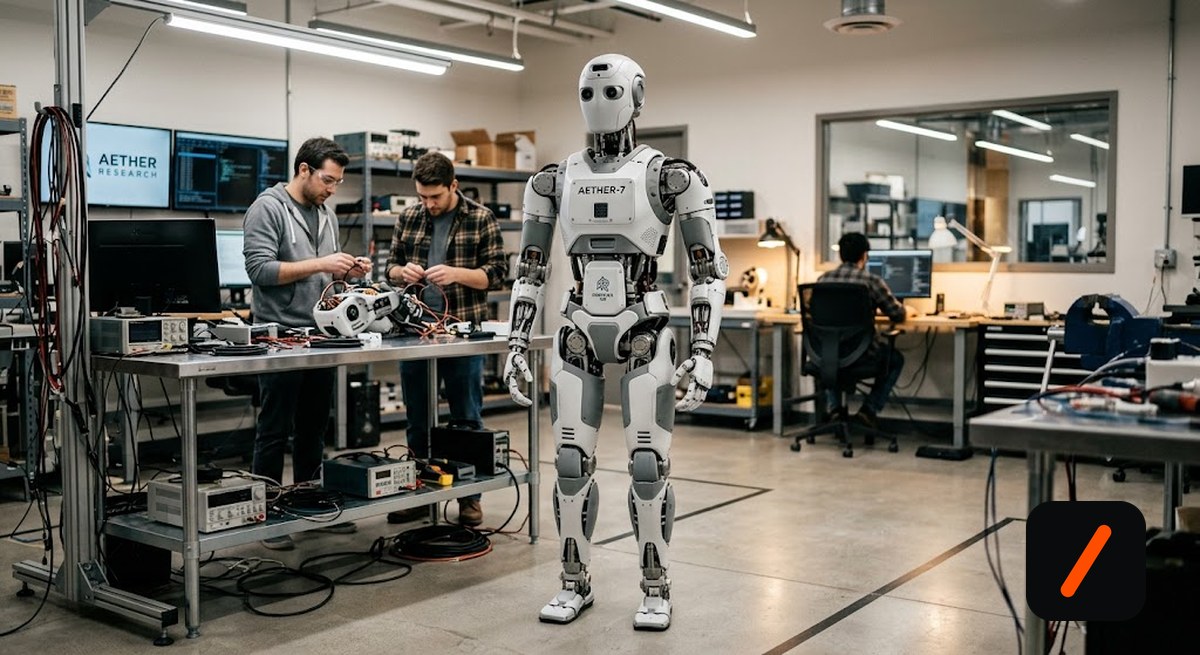
Zeroth has raised roughly $73.6 million in a Series A led by Ant Group, one of the larger early rounds for a humanoid robotics startup this year and a clear sign that the money chasing physical AI is not slowing down. The raise lands in a 2026 funding market that is up more than 100 percent year over year but ruthlessly selective, with capital concentrating in infrastructure, defense, and robotics rather than spreading thin. Ant Group anchoring the round matters: it puts a major Chinese fintech and AI player behind the bet that the next platform is a machine with legs.
- Zeroth closed about $73.6 million in Series A funding for humanoid robotics, led by Ant Group.
- The round sits among a wave of 2026 robotics raises, including Yingzhi XBOT's $56 million Series B for robotics and AI systems.
- US equity funding hit roughly $406 billion through July 2026, up about 109 percent versus the same period in 2025, but concentrated in fewer, larger bets.
- Investors are backing "physical AI," the fusion of foundation models with actuators and sensors, as the next frontier after chatbots.
What is Zeroth building?
Zeroth is in the humanoid robotics race, the effort to build general-purpose robots with a human-like form that can operate in spaces designed for people. The pitch across this category is consistent: pair a foundation-model "brain" that understands language and vision with a body of actuators and sensors, so a single machine can be taught many tasks rather than programmed for one. A $73.6 million Series A buys the expensive part of that ambition, hardware iteration, real-world data collection, and the engineering talent that both demand. It is early-stage money at a scale that signals investors expect a long, capital-heavy road.
RelatedPixxel Raises $100M in India's Largest Spacetech Round
Why did Ant Group lead it?
Ant Group leading is the most strategically interesting detail. Ant is a fintech and AI heavyweight, and its involvement gives Zeroth capital, a powerful backer, and a potential path into large-scale deployment. For Ant, humanoid robotics is a way to place a stake in physical AI beyond software and payments. Corporate-affiliated leads like this are a defining feature of the 2026 market: strategic investors with deep pockets are shaping which robotics startups get the runway to survive a famously hard hardware journey.
| Player type | Focus | Edge |
|---|---|---|
| Zeroth | Humanoid, foundation-model driven | Ant Group backing |
| Big-tech robot programs | Vertically integrated humanoids | Scale and capital |
| Actuator specialists | Hardware components | Sell to everyone |
What does it mean for the market?
The signal for anyone tracking startup capital is that physical AI is now a magnet for the biggest checks, even as the broader early-stage market stays selective. With US equity funding up roughly 109 percent year over year but concentrated in fewer deals, a $73.6 million Series A is a statement that robotics has graduated from a curiosity to a priority allocation. Watch whether these rounds translate into deployed robots with paying customers, because that is the line that separates the winners from the well-funded. For the money view, our Funding Tracker logs rounds like this as they land, and the Biggest AI Funding Rounds board ranks where the largest AI bets are flowing.
Why is humanoid robotics so capital-hungry?
A humanoid robot is one of the hardest products in technology because it demands excellence in three expensive disciplines at once: mechanical engineering for actuators and joints that are strong, precise, and durable; hardware and power systems that fit in a human-sized frame; and AI good enough to perceive a messy real world and act safely in it. Each of those alone can consume a company's budget, and a humanoid needs all three to work together. That is why rounds here run large and losses run long. There is no shortcut where clever software substitutes for physical reliability, because a robot that drops a box or falls over is worthless regardless of how smart its model is. The 2026 funding wave reflects investors accepting that reality and pricing in years of costly iteration before revenue.
RelatedHelion Raised $465M for Fusion, and the Bet Just Got Bigger
It also frames the geopolitics quietly sitting behind this round. Ant Group leading a humanoid raise is part of a broader contest between US and Chinese firms to lead physical AI, a category widely seen as the next strategic technology after chips and large language models. Capital, manufacturing capacity, and supply chains all matter here, and China has structural strengths in hardware production. Watching who funds these companies is watching where the robotics center of gravity may settle.
- Commercial pilots. Whether Zeroth moves from demos to robots doing paid work in real environments.
- Ant's deployment reach. If Ant Group opens distribution or manufacturing scale for Zeroth's hardware.
- Category funding pace. Whether humanoid raises keep growing or cool as reality checks the hype.
Our take
Zeroth's round is a good barometer for where 2026 venture money is heading: away from thin software wrappers and toward the hard, expensive, physical problems where a big check actually buys progress. Humanoid robotics remains one of the most capital-intensive bets in tech, and most entrants will not make it, so a strategic lead like Ant Group is worth more than the dollar figure alone. The honest caveat is that funding is not traction. The companies that matter in three years will be the ones whose robots are doing real work, not the ones with the flashiest launch video. Zeroth now has the capital to try; the market will judge it on deployment.
- ReportVC and startup funding roundup, July 2026 Tech Startups
- FundingGenZTech Funding Tracker live rounds
- ReferenceWeek's biggest funding rounds Crunchbase News
Original analysis by GenZTech. Reporting via Tech Startups.