
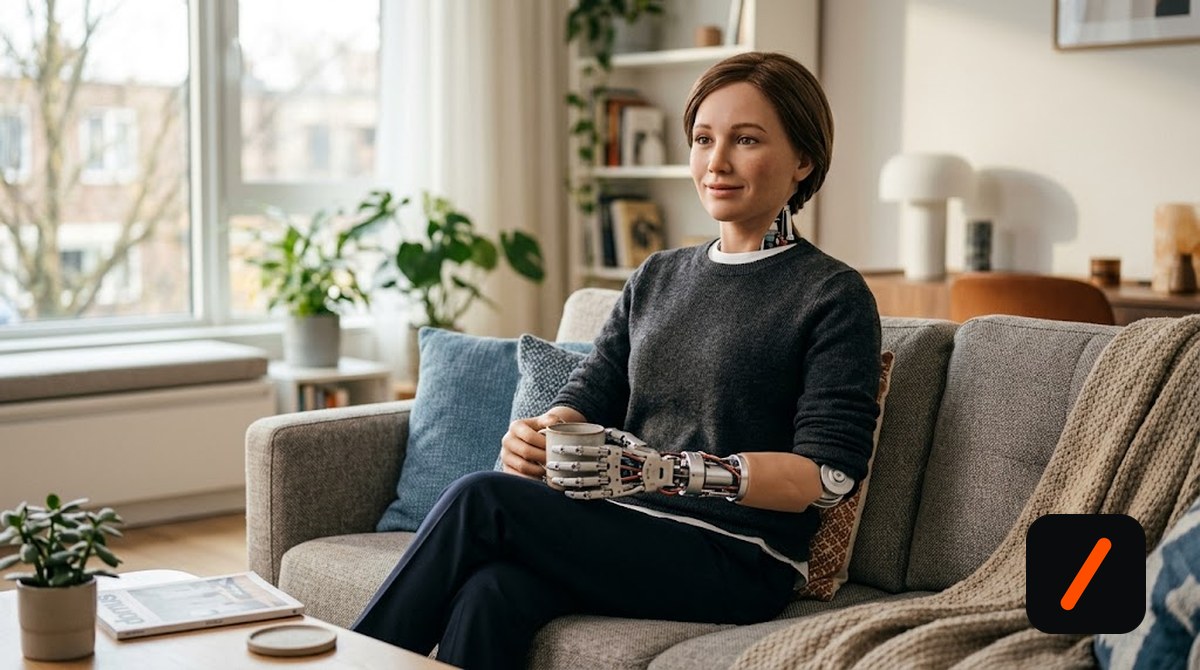
The humanoid robot just walked out of the factory and into the living room. UBTech, the world's first publicly traded humanoid maker, has launched the U1, a consumer robot designed for companionship rather than warehouse labor. It has lifelike silicone skin, 88 servo joints, and an emotional-AI model that runs locally on the device, and it can hold eye contact, converse, and even hold your hand. Priced from roughly 119,800 yuan (about $17,650) with preorders already past 10,000 units, the U1 is one of the first serious attempts to sell a hyper-realistic humanoid to ordinary households.
- The product. A companion humanoid in male and female versions (183cm and 168cm), with silicone skin and 88 servo joints for roughly human-like movement.
- The AI. An emotional model that reads 20-plus emotional states from face and voice, running locally on a Rockchip RK3588 with data stored on the device.
- The price. From about $17,650 for the Lite up to roughly $138,000 for the Ultra, with preorders already exceeding 10,000 units.
- The debate. A lifelike companion robot reignites the question of whether artificial companionship helps loneliness or deepens it.
What exactly did UBTech launch?
Unveiled in Shenzhen, the U1 comes in male and female versions standing 183cm and 168cm, in Lite, Pro, and Ultra variants. The body uses 88 servo joints to reproduce about 90% of basic human movements, wrapped in a silicone exterior meant to look and feel lifelike. The headline feature is behavioral: the robot maintains eye contact, converses, and can perform gestures like holding the owner's hand, all aimed squarely at companionship rather than chores. It is a deliberate pivot from the industrial and educational robots UBTech is known for, toward the emotional, consumer end of the humanoid market that most rivals have avoided.
RelatedSnap's $2,195 Specs Bet AR Glasses Beat the Phone
Why does the local emotional AI matter?
The U1's emotional-AI model claims to identify more than 20 emotional states with over 90% accuracy by reading facial expressions and voice, then adjusting its own responses. Critically, that model runs locally on a Rockchip RK3588 processor, and user data is stored on the robot itself rather than uploaded to the cloud. That on-device design is the most important engineering choice in the whole product. A companion robot that watches your face and listens to your voice all day is a privacy nightmare if that stream goes to a server. Keeping the intelligence and the data on the device is what makes the concept even arguably acceptable, and it reflects the same shift toward local AI happening across phones and PCs.
Who is actually buying this?
The price range tells the story: from about $17,650 for the Lite up to roughly $138,000 for the Ultra, this is not a mass-market appliance yet. Yet UBTech says preorders have already topped 10,000 units, with a 2026 goal of scaled production capacity around 50,000. Sales are restricted to adults. The early market is affluent buyers and the genuinely lonely, in a country facing an aging population and rising social isolation, which is exactly the demographic pressure companion robots are built to address. The demand signal is real even if the price keeps it niche for now, and volume is the lever that pulls that price down over time.
What does it mean for the market?
The signal for the humanoid industry is that the consumer companionship segment is now a live commercial category, not a research demo, and UBTech, as a publicly traded maker, is planting a flag there ahead of Tesla's Optimus and 1X's NEO reaching consumers. Companionship is a shrewd wedge: it tolerates imperfect dexterity, since a robot that holds your hand and talks does not need to fold laundry flawlessly, which is the hard problem stalling general-purpose humanoids. The risk is social and reputational as much as technical, because a lifelike companion robot invites intense scrutiny about whether it soothes loneliness or worsens it. For a listed company, that debate is a stock narrative, not just an ethics seminar, and how UBTech handles it will shape the category's public reception.
RelatedTCL's 2026 flagship TV hits 10,000 nits and 20,000 zones
- Delivery and scale. Whether UBTech converts 10,000+ preorders into shipped units toward its 50,000-unit goal.
- The loneliness debate. How society and regulators react to lifelike companion robots in the home.
- Price trajectory. How fast volume brings the entry price down from ~$17,650.
- Rival consumer humanoids. How Tesla Optimus and 1X NEO position against a companionship-first product.
Our take
The U1 is the most interesting humanoid launch of the year precisely because it sidesteps the hardest problem. Everyone else is chasing a general-purpose robot that can do useful physical labor, which remains genuinely difficult. UBTech went the other way and chased emotional presence, where "good enough" movement plus convincing conversation is a shippable product today. The on-device AI is the detail that makes it defensible rather than dystopian, keeping the intimate data of a companion robot off the cloud. Whether hyper-realistic companions are healthy for people is a real and unresolved question, and it deserves the scrutiny it is getting. But as a piece of consumer hardware and a market signal, the U1 is a milestone: the humanoid has left the factory floor, and it is knocking on the front door.
- OfficialUBTech Robotics product line and announcements
- ReportingNikkei Asia on the U1 consumer launch
- ReferenceSCMP specs, pricing, and preorders
Original analysis by GenZTech. Reporting via Nikkei Asia.