
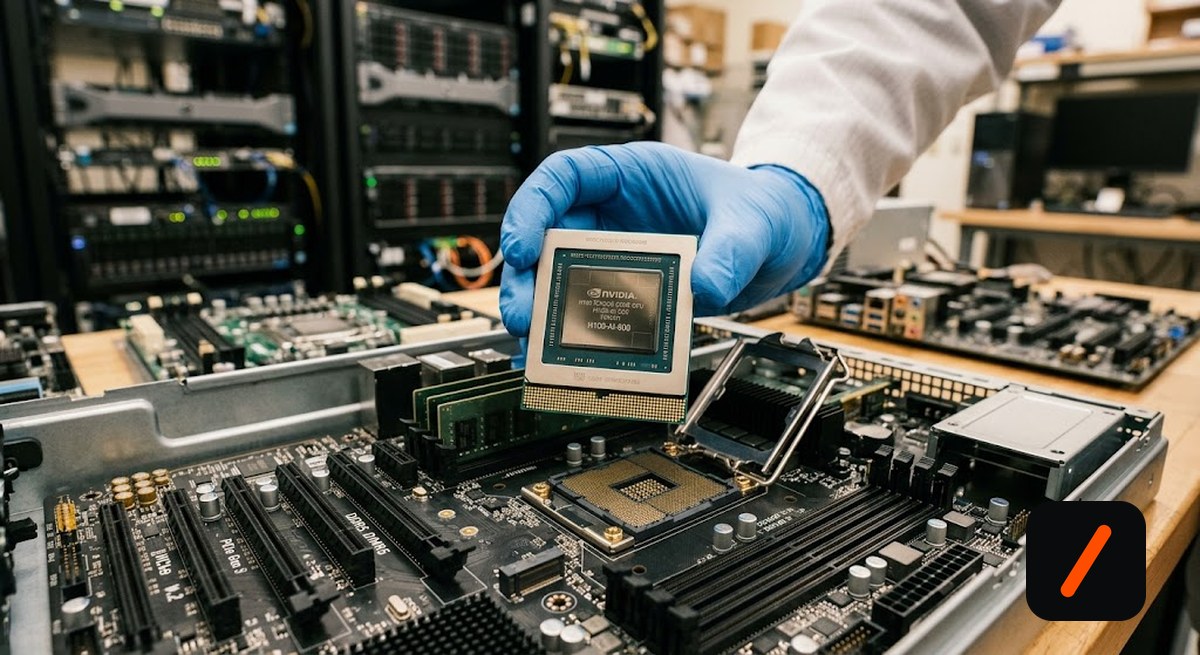
SambaNova Systems has closed the first tranche of a $1 billion Series F led by General Atlantic, valuing the Palo Alto AI-chip maker at $11 billion. The raise landing just five months after its previous mega-round is the real signal: capital is chasing credible alternatives to Nvidia for AI inference, and SambaNova is being funded to prove one exists at scale.
- $1B at $11B, led by General Atlantic. The growth-equity lead and the size put SambaNova firmly in the tier of AI-infrastructure companies raising at data-center scale.
- Five months between mega-rounds. Raising this much this fast is what a company does when demand is outrunning the capital it has, not when it is scraping for runway.
- The bet is inference, not training. SambaNova's pitch is efficient, high-throughput serving of large models, the workload that dominates costs once a model is deployed.
- It joins a crowded challenger field. Cerebras, Groq, and others are all funded to attack the same opening: Nvidia's margins and the industry's desire for a second source.
Who is SambaNova and what does it sell?
SambaNova builds AI accelerators and the systems around them, competing with Nvidia's GPUs on the workload that increasingly dominates AI spend: inference, the job of actually serving a trained model to users at high throughput and low cost. Its architecture is built to run large models efficiently, and its commercial pitch to enterprises and governments is a full stack, hardware plus software, rather than a bare chip. That positioning matters because the AI-infrastructure market has bifurcated: training the largest frontier models is a capital arms race dominated by a few labs, but inference is a recurring cost that every company deploying AI pays forever, and whoever serves it cheaply captures a durable, growing market.
RelatedGimlet Labs Raises $300M at $3B to Bet Against Nvidia Lock-In
Why raise $1B just five months after the last round?
Because building and shipping AI silicon at scale is brutally capital-intensive, and because demand is real enough to justify it. Companies raise back-to-back mega-rounds when the constraint is capital, not customers: you need cash to secure manufacturing capacity, build out systems, fund long enterprise sales cycles, and hold your own against a rival with effectively unlimited resources. General Atlantic leading, a growth-equity firm rather than an early-stage venture fund, signals the round is about scaling a business with traction, not seeding a bet. The $11 billion valuation is the market pricing in the possibility that SambaNova becomes a meaningful second source for AI compute, not just a science project.
What does it mean for the market?
The signal for investors is that the "second source" thesis is now funded at scale, and it is fundamentally a bet against Nvidia's (NVDA) margins. Nvidia's dominance rests on more than silicon, its CUDA software moat is the real lock-in, and that is the wall every challenger has to climb. But the sheer size of AI infrastructure spending, hundreds of billions of dollars, means even a modest share of the inference market is an enormous business, and hyperscalers actively want alternatives to reduce their dependence and their bills. SambaNova, Cerebras (fresh off winning OpenAI's GPT-5.6 wafer-scale serving deal), and Groq are each funded to prove that a differentiated architecture plus a software layer can pry loose a slice of that spend. For public-market investors, the read-through is that the AI-compute duopoly narrative is being actively contested with real money, and the challengers' private valuations are a leading indicator of how seriously that contest is being taken. See our Funding Tracker and the ranked Biggest AI Funding Rounds for where this sits.
What is the risk in the bet?
The moat, and the incumbent's willingness to defend it. Nvidia iterates its architecture on an annual cadence, controls the developer ecosystem, and can price aggressively when threatened. A challenger has to be not just competitive but decisively better on the specific axis it targets, throughput per dollar, energy efficiency, latency, and it has to make switching cheap enough that a customer will leave CUDA behind. History is littered with well-funded chip startups that had good silicon and could not crack the software and ecosystem lock-in. SambaNova's $11 billion valuation prices in success; the risk is that "credible alternative" and "actually displaces the incumbent at scale" are separated by a gap that a lot of capital has failed to close before.
RelatedEtched hits $10.3B valuation on its Sohu inference chip bet
- Named deployments. The proof is not the raise, it is disclosed enterprise or hyperscaler deployments serving real inference at scale, the way Cerebras landed the GPT-5.6 wafer deal.
- Software traction. Watch adoption of SambaNova's stack; beating CUDA on developer experience matters as much as beating GPUs on throughput.
- The second-source pull. If hyperscalers keep funding and buying alternatives to diversify away from Nvidia, the whole challenger field re-rates upward.
Our take
A $1 billion round five months after the last one is not a story about SambaNova so much as a story about how badly the market wants a Nvidia alternative to exist. The inference market is the right target, it is enormous, recurring, and cost-sensitive in a way training is not, and General Atlantic writing a growth check at $11 billion says sophisticated capital thinks this is a scaling business, not a moonshot. The sober counterpoint is that every AI-chip challenger has faced the same wall, and it is made of software, not silicon: CUDA, not transistor counts, is what keeps customers on Nvidia. SambaNova has the money and the architecture to make the argument. Whether it can make customers actually switch is the only question that matters, and it is the one no funding round can answer.
- Funding VC funding roundup, July 2026 SambaNova Series F first close and valuation
- Company SambaNova Systems architecture and enterprise inference positioning
- Data GenZTech Biggest AI Funding Rounds where this round ranks among 2026's raises
Original analysis by GenZTech. Funding detail via Tech Startups.