
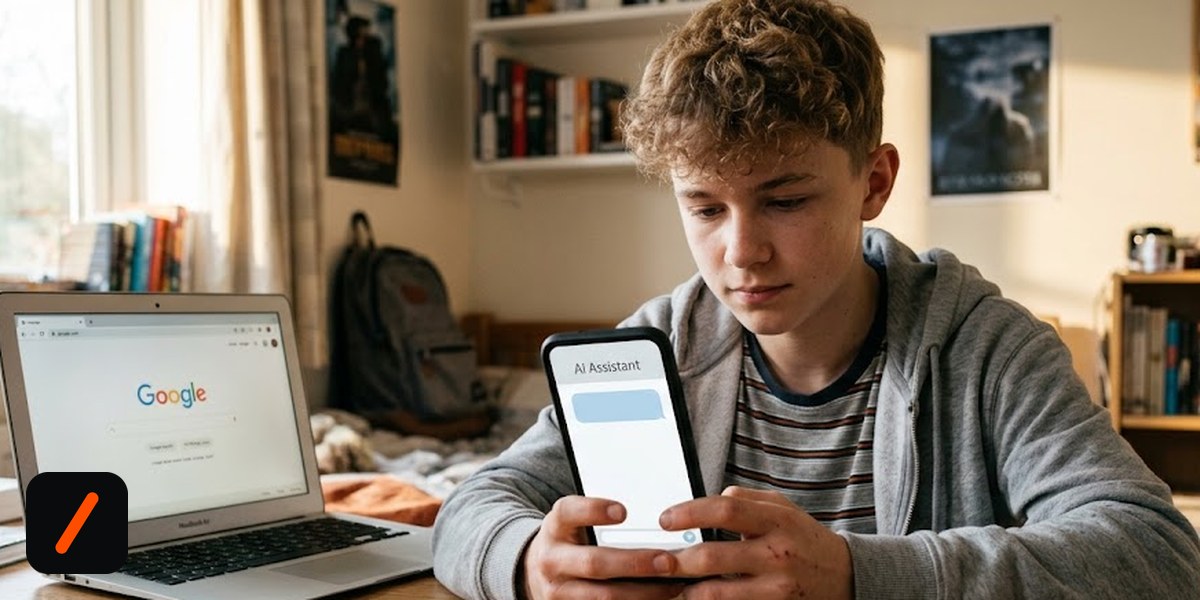
Google search use among Norwegian 9 to 18 year olds fell from 72% in 2024 to 47% in 2026, according to a literature review published today by NTNU (the Norwegian University of Science and Technology). The review, led by PhD research fellow Hilde Storrøsæter with two Czech universities, pulled together 173 international studies on generative AI in schools and found the drop lines up with a broader shift: kids are asking a chatbot instead of typing into a search box.
- Google search use among Norwegian 9-18 year olds dropped from 72% (2024) to 47% (2026), a 25-point swing in two years.
- 39% of Norwegian 11-12 year olds already use AI chat tools directly, below the 13+ minimum most of those services set in their own terms.
- ung.no, Norway's public youth-information site, saw traffic fall from 24 million to 18 million visits between 2024 and 2025 as the same audience moved to AI answers.
- Researchers describe AI's effect on critical thinking as "dual nature": the same tool sharpens reasoning when it's used to challenge an answer, and dulls it when it's used to skip straight to one.
What did the NTNU review actually find?
Storrøsæter and her co-authors didn't run a new survey; they synthesized 173 existing papers on generative AI in education, looking for patterns across age groups, countries, and study designs. Two numbers anchor the piece: Google search use among Norwegian 9-18 year olds fell from 72% to 47% between 2024 and 2026, and ung.no, the country's official youth-information portal, lost roughly a quarter of its traffic (24 million to 18 million visits) over the same window. Both point the same direction: when a chatbot can answer a question directly, a generation raised on search boxes is skipping the box.
RelatedGemini 3.5 Flash Makes Computer Use a Native Tool
Why are kids abandoning search for chat?
A search engine hands back ten blue links and expects you to do the reading. A chatbot hands back an answer, in the voice of a conversation, with no click-through required. For a homework question, a "what does this word mean" lookup, or a "how do I fix this" moment, that's a strictly faster path, and it's the same convenience curve that pulled adults toward voice assistants a decade earlier, just compressed into two years instead of ten. The review notes this isn't a Norway-only phenomenon; it's the international literature the researchers pulled from that shows the same direction of travel across markets, with Norway's own national data giving it a concrete, current number.
What's the "dual nature" mechanism researchers are worried about?
Storrøsæter's framing is deliberately not alarmist: AI itself doesn't make young people worse thinkers. It depends entirely on how the tool gets used. Ask an AI to poke holes in your own argument, or to show its reasoning before it answers, and it functions as a sparring partner that strengthens critical thinking. Ask it for the finished answer and paste it in, and the thinking step never happens at all. The review's concern is that younger children, who haven't yet built the habit of interrogating a source, are more likely to default to the second pattern, simply because they don't yet know there's a first one to choose.
Who's actually affected, and how young is too young?
The number that should worry parents more than the headline stat is the 39% of 11 to 12 year olds already using AI chat tools directly. Most mainstream AI assistants, including ChatGPT and Gemini, set a 13+ minimum in their own terms of service (with parental-consent tiers below that in some regions), the same threshold search engines and social platforms have used for two decades under US COPPA rules and the EU's GDPR "digital age of consent." A search engine returning a list of links is a fundamentally different risk profile than a conversational AI producing a direct, confident-sounding answer to an 11 year old with no adult in the loop. The researchers flag this as one of three real knowledge gaps in the literature: there's comparatively little data on children under 13, most of what exists relies on self-reporting rather than observed behavior, and the bulk of the research base skews toward Asian markets, leaving Europe and North America thinner on hard numbers.
RelatedGoogle DeepMind Launches New Institute to Debate AGI Risks
What it means for the market
Google's core business is still built on the ten-blue-links model monetized by search ads, and a 25-point drop in one demographic over two years is a small piece of a much larger user base, but it's a leading indicator, not a lagging one: today's 11 to 18 year olds are tomorrow's primary search demographic, and habits formed now are sticky. Alphabet has been racing to fold AI Overviews and its Gemini-powered "AI Mode" directly into Search precisely to keep users inside its own product instead of losing them to a separate chatbot entirely, and this review is another data point supporting that defensive bet. The signal for investors watching GOOGL isn't a near-term revenue hit; it's confirmation that the search-to-AI transition Alphabet keeps citing as a strategic priority is measurably real among the youngest cohort, which raises the stakes on Google actually winning the AI Mode integration rather than ceding that habit to OpenAI or Anthropic's consumer products.
- Age-gating gets political. A 39% adoption rate among 11-12 year olds using services rated 13+ is the kind of number that draws regulator attention in the EU and UK faster than in the US.
- Search engines keep chasing the chat interface. Expect Google, Microsoft's Bing, and DuckDuckGo to keep expanding AI-answer modes rather than compete on the old results-page format.
- More national data lands. Norway measured this because ung.no is a government-run portal with its own analytics; expect similar national studies to surface in the UK, Germany, and South Korea as school systems formalize AI policy.
Our take
The most useful thing in this review isn't the topline percentage, it's the refusal to call AI simply good or bad for young minds. "Dual nature" is the correct frame: the same tool that lets a curious 16 year old fact-check a claim in real time is the tool that lets a rushed 11 year old skip the thinking part of an assignment entirely, and right now nothing in the product design of ChatGPT or Gemini distinguishes between those two users. Age verification on consumer AI products is still closer to a honor system than a wall, and a 39% adoption rate among 11-12 year olds means that gap is already being exploited, not hypothetically but today. The fix isn't banning the tools; it's building the habit-forming guardrails, prompts that ask a kid to explain their own reasoning before handing over an answer, that the search-box era never needed and the chat era badly does.
- Research NTNU / Norwegian SciTech News: "Young users ditch Google for AI, with unknown consequences" literature review of 173 studies, Hilde Storrøsæter et al., published 2026-09-22
- Reference NTNU (Norwegian University of Science and Technology) Storrøsæter's institution, Department of Teacher Education
Original analysis by GenZTech, based on the NTNU literature review published 2026-09-22. Read the source coverage.