
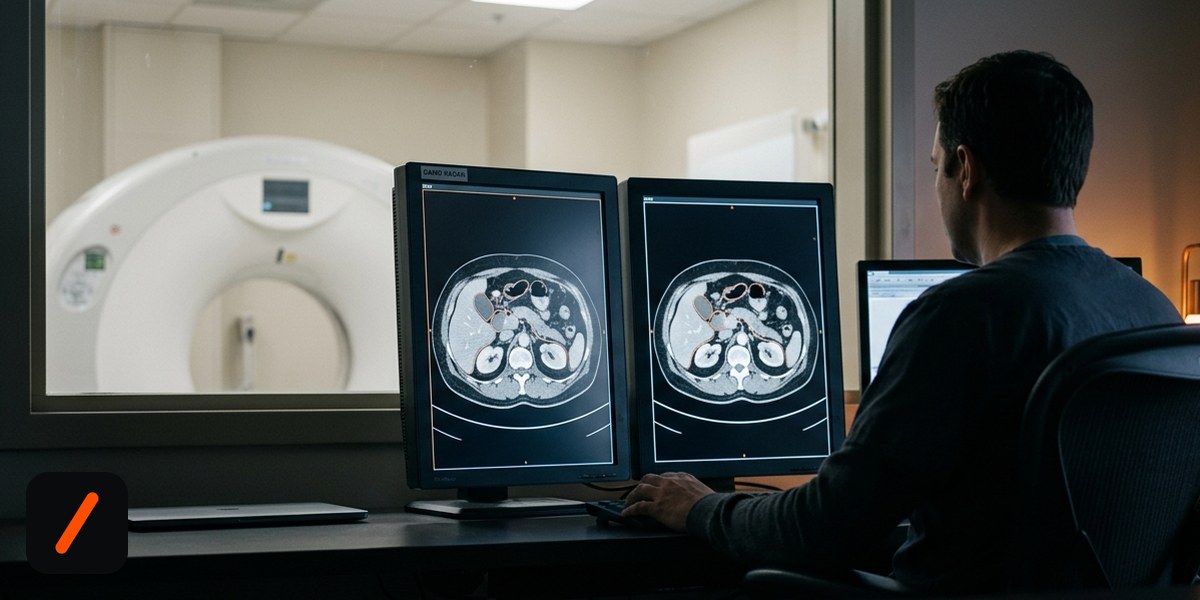
Alibaba's DAMO Academy built a CT model that does not specialize in one disease. RADAR reads a full contrast-enhanced abdominal scan and reports on 146 separate findings, from liver tumors to colorectal cancer, in a single pass through a single network. The research came out in Science on September 17, 2026, and DAMO put the model's weights on GitHub the next day, though strictly for research use, not for a hospital to plug in and run today.
- RADAR reads contrast-enhanced abdominal CT scans and reports on 146 findings across 18 organs, including liver, pancreatic, stomach and colorectal cancers, from one model instead of one detector per disease.
- It was trained on 424,911 CT exams and more than 15 million anatomy-aware image-text pairs, learning from the free-text radiology reports doctors already write rather than from hand-labeled disease datasets.
- On nearly 40,000 real-world exams it scored a mean AUC of 0.913, held up at 0.895 across eight outside hospitals and 0.904 on emergency cases, well ahead of a competing vision-language model's 0.776.
- The code and weights sit on GitHub under a CC BY-NC-SA 4.0 license, research and non-commercial use only, and Alibaba is explicit that RADAR has no regulatory clearance and is not ready for clinical deployment.
What did Alibaba actually release?
DAMO published the underlying study, titled "An expert-level generalist AI for abdominal CT diagnosis," in Science on September 17. A day later, the code and trained weights went up on GitHub under alibaba-damo-academy/damo-radar. That is two separate things bundled into one announcement: a peer-reviewed result, and an actual model anyone can download and run. Most medical-imaging AI papers stop at the first part. RADAR reads a whole contrast-enhanced abdominal CT and covers 18 organs and structures at once, everything from liver and pancreas down to stomach and colorectal tissue, looking for 146 distinct findings in that single pass. Alibaba's own framing is blunt: the team calls it the world's first expert-level generalist medical imaging model. That is a marketing line, not a peer-reviewed claim, and it is worth treating it as exactly that while looking at what the model actually does.
RelatedQwen-Image 2.1 Ships Native RGBA and 2K, But Only for Research
Why train it on radiology reports instead of hand labels?
Most diagnostic imaging AI gets built the slow way. Someone picks a single disease, say pancreatic cancer or lung nodules, hires radiologists to draw bounding boxes around it in thousands of scans, and trains a detector for that one thing. It works, but it does not scale: every new finding needs its own labeling project, which is part of why most cleared imaging AI products still handle one or two conditions each. RADAR mostly skips that step. DAMO trained it on 424,911 contrast-enhanced abdominal CT exams paired with more than 15 million anatomy-aware image-text pairs, using the free-text reports radiologists already write as the supervision signal instead of hand-drawn labels. That is the real news in this release. A generalist model covering 146 findings is only possible because report supervision lets one training run absorb years of already-written clinical documentation, rather than waiting on 146 separate labeling efforts. The accuracy numbers matter, but the training recipe is what other labs will most likely try to copy.
| Approach | Single-disease detectors | RADAR | General vision-language model |
|---|---|---|---|
| Scope | One model per disease or organ | 146 findings across 18 organs, one model | Broad, not CT-specialized |
| Training signal | Hand-labeled disease datasets | Free-text radiology reports, no manual labels | Generic image-caption pairs |
| Abdominal CT accuracy | Varies by product, narrow scope | Mean AUC 0.913 internal, 0.895 external | Mean AUC 0.776 on the same task |
| Regulatory status | A handful hold narrow clearance | Research only, no clearance reported | Not built for clinical use |
| Access | Proprietary, per vendor | Open weights, CC BY-NC-SA 4.0 | Typically a closed API |
Put side by side with the two paths that came before it, the trade-off gets clearer. Narrow detectors trade breadth for a track record. General-purpose vision-language models trade medical specificity for breadth. RADAR is DAMO's attempt at getting a useful amount of both.
How good is RADAR, really?
On nearly 40,000 real-world exams, RADAR posted a mean AUC of 0.913 across all 146 findings. AUC measures how well a model ranks true cases above false alarms across every possible decision threshold, running from 0.5 for a coin flip up to 1.0 for perfect separation, so 0.913 means it gets that ranking right far more often than not, across the full spread of findings rather than only the easy ones. The score held up reasonably well when DAMO tested it somewhere else: 0.895 across eight outside medical centers whose scanners, patient populations and reporting habits it had never seen during training. It also scored 0.904 on more than 27,000 emergency-department CT cases, the scans taken under the worst time pressure and the least clean setup. A competing general-purpose vision-language model tested on the same task scored 0.776, a real gap rather than a rounding difference.
What happens when radiologists actually use it?
DAMO ran RADAR against 26 practicing radiologists reading the same cases, and it outperformed 23 of them on its own. The more useful number is what happened when those radiologists used RADAR as a second opinion instead of a rival: their sensitivity, meaning how many true findings they actually caught, rose by roughly 10%, and their reading time fell by more than 30%. That is the shape most of this technology is likely to take in the near term, not a model that replaces the person reading the scan, but one that reads alongside them and flags what a tired shift might miss.
RelatedSakana AI Ditches the Frontier Model for Fugu Ultra v2
Who can use it, and what's missing before a hospital deploys it?
The GitHub release carries a CC BY-NC-SA 4.0 license, meaning anyone can download, run and modify RADAR for research or non-commercial use, credit DAMO, and release any derivative under the same terms. What it does not permit is a company quietly wrapping RADAR in a paid product without a separate arrangement. That splits who benefits first. Academic hospitals and research groups that need to keep patient scans on their own hardware for privacy reasons get a real generalist model to study without sending data to an outside API. Startups get a serious baseline to build on, even if a commercial license is a separate conversation. What none of them get, at least not yet, is a cleared clinical product. DAMO's own repository says as much: RADAR is intended for research purposes only, and further improvements and prospective clinical studies are still required before it can be used directly for clinical deployment. No FDA or NMPA filing accompanies this release.
- Sept 17, 2026Science publishes the RADAR paper. "An expert-level generalist AI for abdominal CT diagnosis."
- Sept 18, 2026Weights and code go up on GitHub. CC BY-NC-SA 4.0, research and non-commercial use only.
- NextProspective clinical studies. The step DAMO's own repository says still has to happen before clinical deployment.
- NextRegulatory review. No FDA or NMPA filing has been reported for RADAR.
- Open questionWhether report supervision spreads beyond abdominal CT. RADAR is the test of whether the same training recipe generalizes to other scan types.
- Does the accuracy hold outside DAMO's own test sets? 0.895 across eight outside hospitals is reassuring, but wider use will surface cases the training data never saw.
- Who actually builds on the open weights? The non-commercial license invites research groups and hospitals to experiment, not startups looking to resell it directly.
- Does a clinical trial follow? A Science paper and a GitHub release are not a care pathway. Watch for the first prospective study.
- Does report supervision spread to other scan types? If it works for abdominal CT, the same idea could unlock generalist models for chest imaging or MRI without new hand-labeled datasets for every finding.
Our take
The interesting part of RADAR is not the cancer-detection headline, even though liver, pancreatic, stomach and colorectal cancer are the diseases that will get quoted most. It is that report supervision, learning from the reports doctors already write instead of custom labels for each disease, is what let one model cover 146 findings in a single training run. That is a genuinely different way to build medical imaging AI, and it is the part other labs are more likely to copy than the specific accuracy numbers. The caveats here are not small print, they are the other half of the headline: no regulatory clearance, a non-commercial license, and DAMO's own admission that prospective clinical studies still have to happen. Treat this as a serious research release worth watching closely, not a diagnosis tool to trust with an actual patient yet. Both things are true at once, and pretending otherwise would be the real hype.
- PaperScience: An expert-level generalist AI for abdominal CT diagnosis , published Sept 17, 2026
- Codealibaba-damo-academy/damo-radar , weights and inference code, CC BY-NC-SA 4.0
- CoverageSouth China Morning Post , Sept 18, 2026 report on the open-source release
- SecondaryRuntimeWire , additional validation and reader-study figures
Original analysis by GenZTech. Source: Science.