
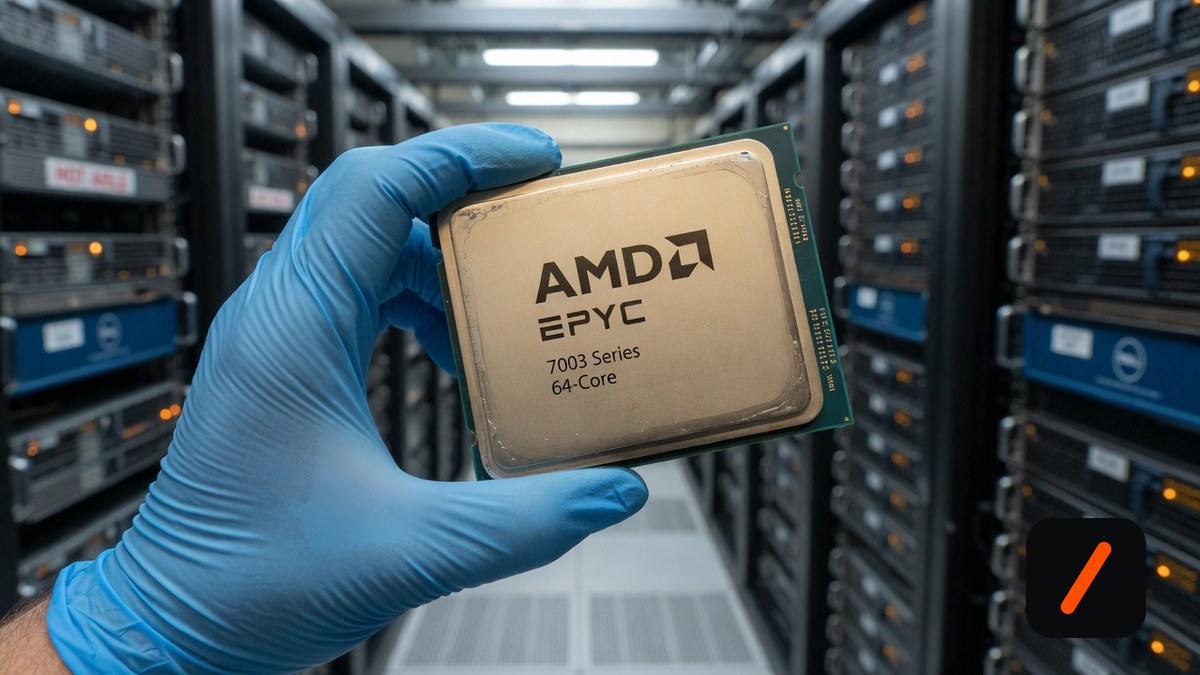
AMD has confirmed that Zen 6 debuts on July 22 to 23 at its Advancing AI 2026 event in San Francisco, and it starts in the data center, not the desktop. The flagship EPYC "Venice" processors scale to 256 cores and 512 threads, a third more than today's 192-core "Turin" line, and AMD claims over 70% higher performance and efficiency versus Zen 5, with peak throughput up to 1.7 times the previous generation. Venice is also the first high-performance CPU to reach production on TSMC's 2nm node.
- Up to 256 Zen 6 cores / 512 threads, a 33% core jump over 192-core "Turin," built from eight 32-core CCDs on TSMC 2nm.
- AMD claims >70% more performance and efficiency than Zen 5 and up to 1.7x throughput, from architecture plus core count.
- A new SP7 socket with 16-channel memory delivers up to 1.6 TB/s of bandwidth, plus PCIe 6 for CPU-to-GPU links.
- Venice anchors AMD's Helios rack platform beside Instinct MI455 accelerators and Pensando networking; consumer Zen 6 Ryzen slips to roughly CES 2027.
What is actually new in Venice?
The headline is not just core count, it is the package. Venice moves to two slender, centralized server I/O dies on a 4nm node, flanked on either side by up to eight compute die (CCDs) built on TSMC's 2nm process, each packing 32 Zen 6 cores. That radical repackaging is what lets AMD reach 256 cores while claiming better efficiency, because the 2nm CCDs do the compute and the 4nm I/O dies handle the plumbing. It is a genuine engineering milestone: Venice is the first HPC processor to ship on 2nm, with manufacturing ramping in Taiwan and future output planned at TSMC's Arizona fab.
RelatedAMD Names Zen 7 and Zen 8, Locking Its Server Plan to 2030
| Spec | EPYC Venice (Zen 6) | EPYC Turin (Zen 5) |
|---|---|---|
| Max cores / threads | 256 / 512 | 192 / 384 |
| Process (compute) | TSMC 2nm | TSMC 3nm |
| Socket | SP7 (new) | SP5 |
| Memory | 16-channel, up to 1.6 TB/s | 12-channel |
| PCIe | PCIe 6 | PCIe 5 |
| Rack platform | Helios + MI455 + Pensando | prior EPYC racks |
Why does a CPU launch matter in an AI world?
Because the accelerator does not run alone. In an AI rack, the CPU feeds data to the GPUs, schedules work, runs the parts of the pipeline that are not matrix math, and increasingly hosts huge in-memory datasets. Venice's 16-channel memory, up to 1.6 TB/s of bandwidth, and PCIe 6 links exist to keep MI455 accelerators fed. That is why AMD is launching Venice at an event named Advancing AI rather than a desktop keynote: the server CPU is now part of the AI story, not a sideshow to it.
What it means for the market
The signal for investors is that AMD (AMD) is pressing its data-center advantage while Nvidia dominates the accelerator layer. A credible 256-core, 2nm EPYC keeps pressure on Intel's server roadmap, where the gap has widened, and strengthens AMD's pitch to sell whole racks (CPU plus Instinct plus Pensando) rather than parts. The move also deepens AMD's reliance on TSMC's leading-edge 2nm capacity, tying its 2026 to 2027 upside to foundry supply that is already stretched by the same memory shortage delaying consumer Ryzen. This is analysis, not advice: the read is that AMD is competing on rack-scale integration, and Venice is the CPU half of that bet.
What about gamers?
They wait. Consumer Zen 6 Ryzen, expected under the "Olympic Ridge" name, has slipped to roughly CES 2027 at the earliest, pushed back by the memory shortage that is steering scarce supply toward more profitable data-center parts. Since EPYC and desktop Ryzen historically share CCD chiplets, Venice will still offer the first real look at Zen 6's IPC and clocks, a preview of what desktop buyers eventually get.
RelatedTSMC Starts 2nm Volume Production, Already Sold Out
How does this reshape the server CPU landscape?
For a decade the server CPU market was a two-horse race where Intel set the terms and AMD chased. Venice inverts that. A 256-core part on a 2nm node, with a new socket built for another generation of expansion, is AMD dictating the roadmap while Intel plays catch-up on both core count and process. The strategic shift is that AMD no longer sells a CPU, it sells a rack: EPYC compute, Instinct acceleration and Pensando networking as one integrated system under the Helios banner. That bundling is how AMD intends to convert its CPU lead into full data-center wins, because hyperscalers increasingly buy validated systems, not components. The risk is execution at volume, since every one of those pieces leans on the same constrained leading-edge supply, but the direction is unmistakable: AMD is trying to own the AI rack end to end, and Venice is the foundation it stands on.
- Independent benchmarks. AMD's >70% and 1.7x are vendor figures. Wait for third-party server benchmarks before treating them as settled.
- 2nm supply. Venice's ramp depends on TSMC N2 output. Watch whether AMD can ship volume or is capacity-limited at launch.
- Helios adoption. The real win is selling full racks. Watch which hyperscalers and neoclouds commit to Venice-plus-MI455 systems.
- Intel's answer. Venice widens the core-count gap. Watch how Intel's next Xeon generation responds.
- OfficialAMD newsroom Advancing AI 2026, EPYC Venice
- ReportingTechPowerUp — Venice launch date confirmed package and spec detail
- ReferenceEPYC (Wikipedia) generational overview
Original analysis by GenZTech. Specs are vendor-reported and current as of July 2026.