
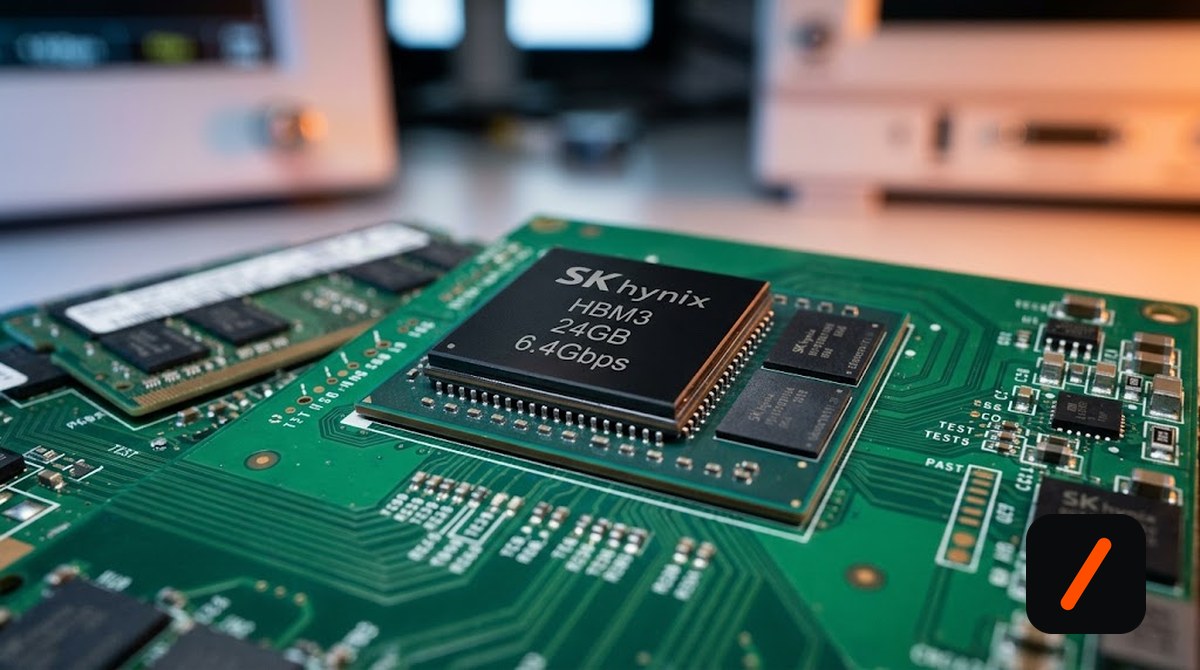
A single brokerage note wiped out weeks of memory-sector optimism on July 13, 2026: South Korea's KIS pegged SK Hynix's second-quarter profit about 8% below consensus, citing slower-than-expected HBM4 shipments, and the stock fell 15% in Asia, its largest single-day drop on record. The damage did not stay in Seoul. Micron, SanDisk, and Western Digital sold off roughly 6% in New York as investors reread the entire high-bandwidth-memory thesis. Our take is that this is a wobble in timing, not in demand, but it exposes how much of the AI hardware trade now rests on one number: how fast HBM4 ships.
- KIS cut its SK Hynix Q2 estimate ~8% below consensus on slipping HBM4 shipment timing, triggering a record 15% single-day fall.
- US memory names fell in sympathy because SK Hynix is the direct read on HBM pricing power for the whole group.
- SK Hynix still leads HBM with roughly 50-55% share, ahead of Samsung at 35-40% and Micron at 5-10%.
- The selloff is about the slope of the ramp, not whether HBM4 demand exists, which nobody in the chain disputes.
What actually happened?
Nothing was reported by SK Hynix itself. KIS, a South Korean brokerage, published a Q2 2026 profit estimate roughly 8% under the Street consensus and attributed it to HBM4 shipments arriving slower than the market had modeled, plus the company's heavy reliance on HBM contracts. That estimate, ahead of the actual print, was enough to crack the core bull case, and the stock posted its worst day ever. The mechanism is pure read-through: SK Hynix is Micron's most direct competitor in DRAM and HBM, so any hint that HBM4 volume is slipping raises the same pricing-power question for every name in the group.
RelatedNvidia's 16-Hi HBM demand triggers a memory sprint
Is HBM4 demand actually weakening?
No, and that is the important distinction. HBM4 is the memory designed for the next wave of AI accelerators. Its I/O count doubles from 1,024 to 2,048 pins, and it is spec'd for Nvidia's Rubin GPUs, which can carry up to 288GB per package, with AMD's MI-class parts going higher. TrendForce still expects HBM4 to become the mainstream share leader in the second half of 2026 as it overtakes HBM3E. The selloff was about the ramp's slope and one quarter's shipment timing, not a collapse in end demand. When the incremental product commands a manufacturing-complexity premium of more than 30%, small timing slips move estimated profit a lot.
What does it mean for the memory trade?
The signal for investors is that the memory names have become a leveraged bet on HBM ramp timing, and the leverage cuts both ways. Micron just guided Q4 revenue to about $50B and says it expects to sell out HBM4 capacity for 2026, and SanDisk, which does not make HBM at all, has ridden the NAND boom to a zero-debt balance sheet. Those are strong hands. But when the group trades on a single Korean brokerage note, position sizing matters more than the thesis. Watch SK Hynix's actual Q2 print and TSMC's July 16 earnings for the real data; the July 13 move was sentiment front-running the numbers.
Why is SK Hynix the whole sector's tell?
Because it sits at the top of the HBM stack with an estimated 50-55% share, ahead of Samsung and well ahead of Micron. When the share leader signals softness, buyers assume pricing discipline across the oligopoly is at risk, and memory is a commodity where price is everything. That is why a name in Boise moves on a note about a company in Icheon. The three suppliers are also taking different manufacturing paths for the HBM4 logic base die, which means yield and cost could diverge, adding another axis of uncertainty on top of shipment timing.
RelatedSK Hynix Set a Profit Record and the Kospi Crashed Anyway
Does the selloff reach the AI names?
Indirectly, and that is the part investors should sit with. If HBM4 really is shipping slower than modeled, the constraint does not stop at the memory makers; it feeds the accelerators those chips go into. Nvidia's Rubin and AMD's next parts need HBM4 stacks in volume, so a genuine ramp delay would ripple into GPU availability and, eventually, into how fast the hyperscalers can stand up new clusters. The counterpoint is that a single quarter's timing rarely bends a multi-year buildout, and the memory suppliers have every incentive to catch up. Still, the July 13 move is a useful reminder that the AI hardware stack is a chain, and the memory link is now the one the market is watching most nervously.
- The actual print. Whether SK Hynix's reported Q2 confirms the 8% shortfall or the brokerage overshot.
- TSMC on Jul 16. CoWoS packaging commentary that gates how fast HBM-laden accelerators can even be built.
- HBM4 yield. Which of the three suppliers proves out the logic base die at scale first.
Our take
This is what a crowded trade looks like when it flinches. The AI hardware complex has priced HBM4 as a near-certainty, and any data point that questions the timing gets amplified because everyone owns the same names. We would treat July 13 as a volatility event, not a thesis break: demand for the memory that feeds Rubin and its rivals is not in doubt, and the leaders have the balance sheets to absorb a soft quarter. The lesson is narrower and more durable. When a sector's entire story compresses into one shipment metric, the stocks will overreact in both directions, and the smart move is to wait for the print rather than trade the pre-announcement.
- OfficialSK Hynix investor relations quarterly results and guidance
- OfficialMicron investor relations HBM4 capacity and revenue guidance
- ReferenceTrendForce HBM4 shipment and share forecasts
Original analysis by GenZTech. Reporting informed by TrendForce.