
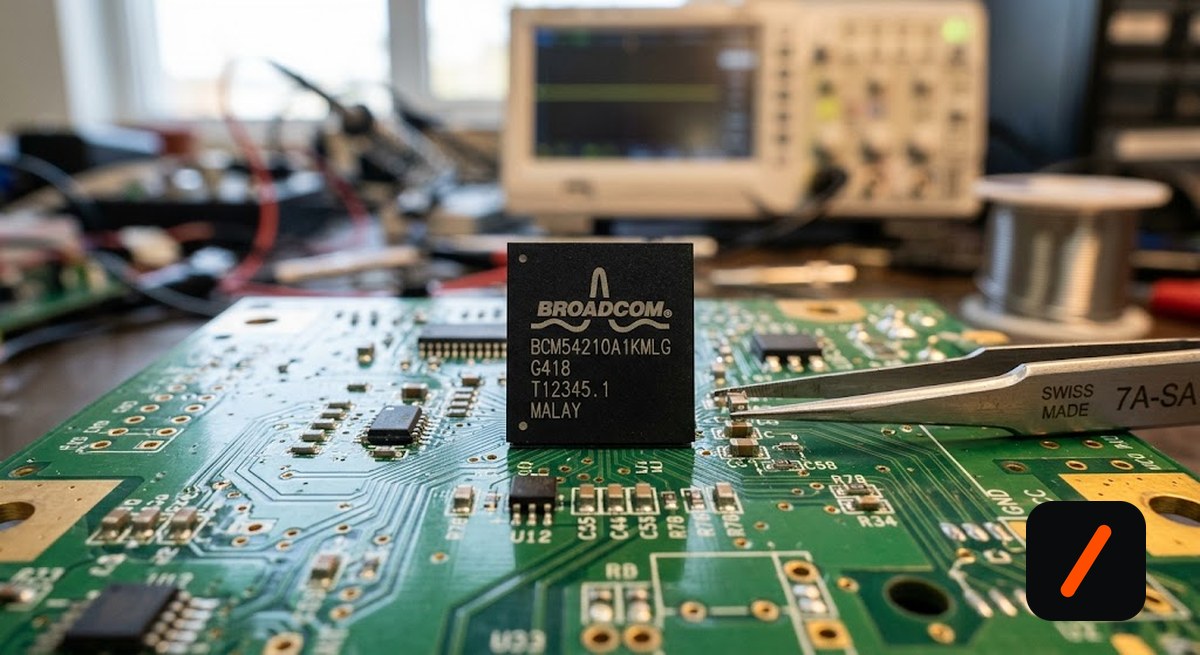
Apple has committed more than $30 billion to Broadcom in a multiyear deal to design and produce custom silicon and wireless connectivity chips for its devices, extending their supply relationship through 2031. As part of the agreement, Broadcom will undertake a $1.5 billion expansion of its Fort Collins, Colorado manufacturing facilities to supply the radio-frequency and wireless components Apple builds into iPhones, Watches, and more. The deal locks in one of the most important supplier ties in consumer electronics for another five years.
- The number is $30B-plus. A multiyear commitment covering custom silicon components and wireless connectivity technologies across a wide range of Apple products.
- It runs through 2031. Apple extended an existing multi-billion-dollar wireless chip supply agreement, giving Broadcom rare long-range revenue visibility.
- Fort Collins gets $1.5B. Broadcom is expanding its Colorado plant to make the RF and wireless parts, a US-manufacturing angle Apple has been eager to showcase.
- Timing is pointed. The deal lands after Broadcom's Q3 AI-chip guidance of $16B undershot the ~$17.2B analysts expected, making a marquee non-AI customer commitment valuable.
What exactly did Apple and Broadcom agree to?
Apple announced a $30 billion-plus multiyear commitment for Broadcom to design and produce custom silicon and wireless connectivity technologies across its product line. It extends an existing wireless-chip supply agreement, now running through 2031. Broadcom's part of the bargain includes a $1.5 billion expansion of its Fort Collins facilities to make the radio-frequency and wireless components, the kind of US-manufacturing investment both companies are happy to publicize. This is not an AI-accelerator deal; it is the unglamorous but essential connectivity plumbing that makes every Apple radio work.
RelatedNvidia Bets $3.5 Billion on MediaTek to Ride the Custom-Chip Wave
Why does the RF front end still matter?
Modern phones live or die on their radios. The RF front end, the Wi-Fi and Bluetooth combo chips, and the FBAR acoustic filters that keep signals clean are precision analog parts that are hard to design and harder to yield. Broadcom is one of a small handful of suppliers that can deliver them at Apple's volume and quality bar. Even as Apple pushes to build more silicon itself, this is a domain where a specialist partner remains the pragmatic choice, which is exactly why Apple was willing to commit years and billions to lock supply.
How does this square with Apple's in-house chip push?
It fits neatly. Apple has spent years insourcing silicon, from the A-series and M-series processors to its own C-series cellular modem, the part long bought from Qualcomm. But the cellular modem and the wireless connectivity front end are different problems. This Broadcom deal covers the latter, meaning Apple can keep bringing the modem in-house while still relying on Broadcom for Wi-Fi, Bluetooth, and RF filtering. The two efforts run in parallel rather than in conflict.
What does it mean for the stock?
For Broadcom (AVGO), the signal is de-risking. The company's most recent quarter beat on revenue at $22.19 billion, but its Q3 AI-chip guidance of roughly $16 billion fell short of the ~$17.2 billion analysts wanted, and it did not raise its full-year AI forecast. Against that backdrop, a $30B-plus commitment from the world's most valuable device maker, stretching to 2031, gives investors a long, visible revenue floor outside the volatile AI-accelerator narrative. For Apple (AAPL), the read is supply security: pinning down critical wireless components years ahead insulates its hardware roadmap from the shortages rattling the rest of the semiconductor market. The investor takeaway is that this is a stability story for both names, not a growth surprise.
RelatedAMD buys Taalas, betting on AI models etched into silicon
What could complicate the deal?
Long supply agreements are only as good as the demand behind them. If iPhone volumes soften or Apple accelerates its own silicon roadmap faster than expected, the practical value of a fixed multiyear commitment could shift, though the structure gives both sides room to adjust. There is also concentration risk: tying a large slice of Broadcom's wireless business to a single customer through 2031 makes Apple's product cadence a direct input to Broadcom's results, for better and worse. And the Fort Collins expansion, while a political and supply-chain positive, adds fixed cost that only pays off if Apple's orders materialize as planned. None of these are red flags today, but they are the variables that decide whether a five-year deal ages into a bargain or a burden.
Our take
This is a boring deal in the best sense. It does not chase headlines about AI compute; it secures the parts that make Apple's products actually connect, and it hands Broadcom a rare multi-year anchor at a moment when its AI guidance is under scrutiny. The Fort Collins expansion adds a domestic-manufacturing sweetener that plays well politically. Watch whether the scope quietly widens as Apple's own silicon ambitions grow, but for now the message is simple: two of tech's most disciplined companies just took uncertainty off the table through the end of the decade.
Original analysis by GenZTech. Details current as of July 2026. Reporting via Reuters.