
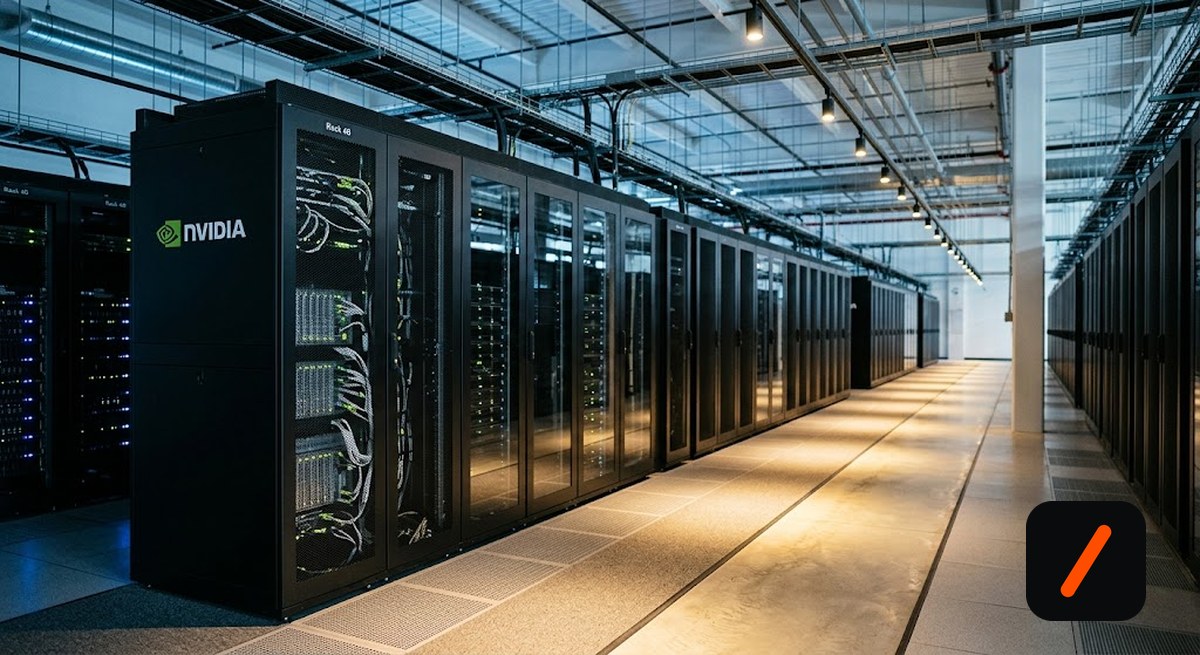
NAVER and NVIDIA announced that Korea's largest internet company will expand its sovereign AI infrastructure on NVIDIA's DSX platform, starting at 55 megawatts of capacity with plans to scale toward the gigawatt range. The buildout will train NAVER's next-generation HyperCLOVA X models and power an AI agent platform launching in Korea in the second half of 2026. The deal is a concrete example of "sovereign AI": a nation keeping the compute, models, and data behind its most strategic technology inside its own borders.
- The scale: starts at 55MW and is designed to grow toward gigawatt-class capacity, a data-center commitment measured in power, not just GPU count.
- The platform: built on NVIDIA DSX, the rack-and-networking reference design for large AI factories.
- The payload: next-generation HyperCLOVA X models plus a Korea-first AI agent platform arriving in H2 2026.
- The theme: sovereign AI is now a hardware race, with countries and national champions buying capacity to avoid dependence on foreign clouds.
What did NAVER and NVIDIA actually announce?
The two companies committed to a phased expansion of NAVER's AI infrastructure built on NVIDIA's DSX platform. DSX is NVIDIA's reference architecture for large AI factories, bundling GPUs, CPUs, NVLink and networking into a repeatable rack-scale design so operators can deploy capacity quickly and predictably. NAVER will begin with 55 megawatts of power dedicated to this system and has laid out a roadmap to scale toward gigawatt capacity over time. The immediate purpose is training and serving NAVER's HyperCLOVA X family, the Korean-language large models it has been developing for years, and standing up a new AI agent platform for the Korean market in the back half of 2026.
RelatedNVIDIA and SK Group Unveil $500B Korea AI Buildout
Why is this called sovereign AI?
Sovereign AI is the idea that a country should own the full stack behind its most important AI, the compute, the models, the data and the operations, rather than renting all of it from foreign cloud providers. For a nation like Korea, HyperCLOVA X is strategic infrastructure: it understands Korean language, culture and context in ways general Western models often do not, and it underpins services millions of citizens use daily. Keeping the training clusters on domestic soil, operated by a national champion, means the government and NAVER retain control over data residency, model behavior and availability, even if geopolitics disrupts access to overseas capacity. The 55MW-to-gigawatt buildout is the physical expression of that policy.
Why does NVIDIA keep winning these deals?
Because sovereign AI has become one of NVIDIA's fastest-growing markets, and DSX is engineered to make it easy to say yes. Governments and national champions from Europe to the Middle East to Asia are buying capacity, and they overwhelmingly standardize on NVIDIA's platform because the software ecosystem, CUDA, the networking, and the reference designs let them move from purchase order to running cluster with less risk. Every sovereign buildout deepens that lock-in. NAVER choosing DSX over building a bespoke system, or waiting for a domestic accelerator to mature, is the same calculation hyperscalers make: time-to-capacity matters more than squeezing the last dollar of efficiency, and NVIDIA sells time-to-capacity.
What it means for the market
The direct beneficiary is NVIDIA (NVDA), whose sovereign-AI pipeline keeps converting national anxiety about AI dependence into multi-year hardware revenue; each gigawatt-class commitment is the kind of demand that supports its data-center growth story. For NAVER, the buildout is a bet that owning the infrastructure behind HyperCLOVA X and a Korean agent platform will defend its home turf against global model providers. The broader signal for investors is that AI capex is going global and governmental: the buyers are no longer just US hyperscalers but sovereign entities with strategic, not purely financial, motives, which makes the demand less cyclical than a normal hardware cycle. This is analysis, not investment advice; watch how many more sovereign DSX deals NVIDIA books this year.
RelatedNvidia's Vera Rubin NVL72 Enters Production, and AI Scale Climbs
What are the risks in a gigawatt plan?
Power and time. A gigawatt of AI capacity is an enormous energy commitment, and securing that much reliable, affordable electricity is now the hardest part of any large buildout, harder in many cases than getting the chips. Grid interconnection, cooling, and the multi-year lead times on data-center construction all stand between the 55MW start and the gigawatt goal. There is also model risk: HyperCLOVA X has to stay competitive with rapidly improving global models for the investment to pay off. Sovereign AI can justify a capability gap on strategic grounds, but not an unlimited one. The buildout only makes sense if NAVER's models and agent platform remain good enough that Korean users and businesses actually choose them.
- The agent platform launch. H2 2026 is the first real proof point; adoption in Korea will tell you whether the compute has a market.
- Power procurement. Watch how NAVER secures electricity for the gigawatt phase; energy, not GPUs, is the true bottleneck.
- More sovereign deals. Each new national DSX commitment reinforces NVIDIA's grip on this market.
- HyperCLOVA X benchmarks. The models must stay competitive with global frontier systems to justify the spend.
Our take
This deal is a clean snapshot of where AI infrastructure is heading. The unit of ambition is now the megawatt, the buyer is increasingly a sovereign entity, and the platform is almost always NVIDIA. NAVER's plan is rational: for a company whose home advantage rests on understanding Korea better than any foreign model can, owning the compute behind that advantage is worth a gigawatt-scale bill. The hard part will not be the chips, it will be the power and the pace of model progress. If NAVER can keep HyperCLOVA X competitive and actually turn 55 megawatts of silicon into an agent platform Koreans use every day, this is a template other nations will copy. If it cannot, it is an expensive monument to sovereignty. Either way, the era of AI measured in gigawatts has clearly arrived.
- OfficialNVIDIA Newsroom DSX platform and sovereign-AI announcements
- ReferenceNAVER HyperCLOVA X NAVER's Korean large-model family
- ContextNVIDIA Data Center reference designs behind large AI factories
Original analysis by GenZTech. Based on NAVER and NVIDIA announcements as of July 2026.