
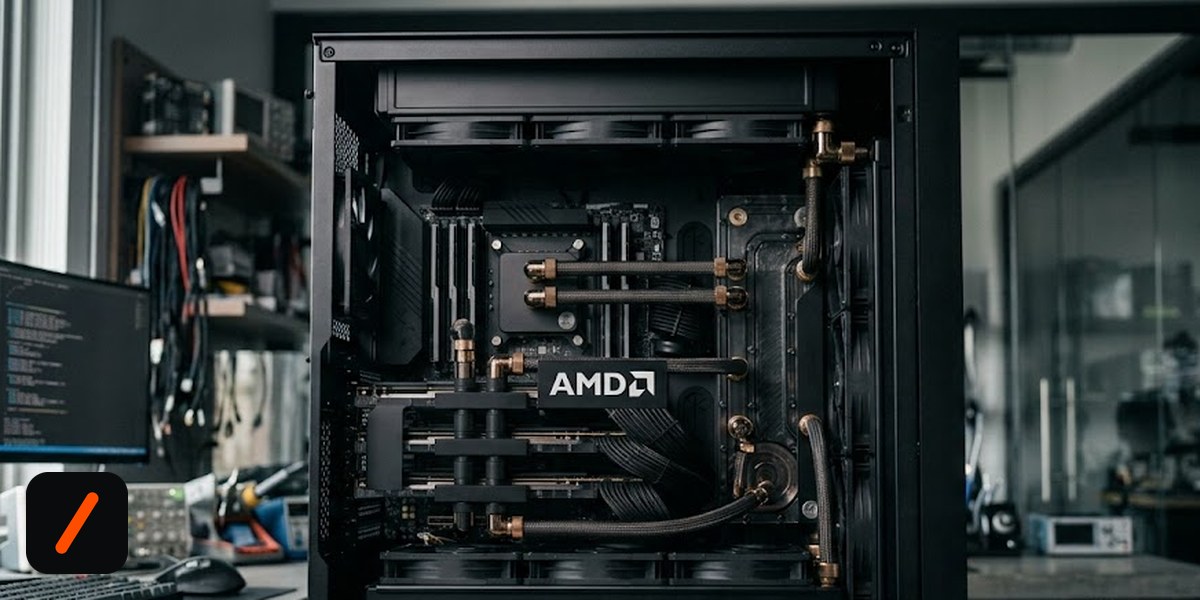
AMD used its IFA 2026 keynote in Berlin today to unveil the Threadripper Halo Station, a liquid-cooled workstation the company is billing as the most powerful in the world, built to run AI models that blow past a trillion parameters without sending a single token to the cloud. Jack Huynh, AMD's SVP and GM of the Computing and Graphics Business Group, introduced it on stage as the centerpiece of a broader "Era of Personal AI" pitch, and the spec sheet backs up the ambition: a 96-core Threadripper PRO CPU, two liquid-cooled Instinct MI350P accelerators with a stated path to four, up to 2TB of system memory, and up to 576GB of HBM3E.
- 96-core AMD Threadripper PRO processor paired with two liquid-cooled Instinct MI350P accelerators, with AMD saying the chassis scales to four.
- Up to 576GB of HBM3E memory plus up to 2TB of system memory, enough headroom to hold a trillion-plus-parameter model without splitting it across machines.
- AMD hasn't published a price. Outlets covering the keynote estimate a fully specced unit lands around $50,000, in line with what dual-MI350P silicon and that much HBM3E currently cost.
- It ships alongside a smaller Ryzen AI Halo line (up to 192GB unified memory, aimed at roughly 300-billion-parameter models), already landing in devices like the Lenovo ThinkCentre X and HP ZBook "Sundance."
What exactly did AMD announce?
The Threadripper Halo Station sits at the top of a two-tier push AMD is calling personal AI: a Ryzen AI Halo line for laptops and small-form desktops, and this Threadripper machine for people who need workstation-class local inference. It's built around the MI350P, the same accelerator family AMD sells into hyperscale AI clusters, just liquid-cooled and crammed into a desktop chassis instead of a rack. AMD's framing, a "new class of workstation designed for AI models exceeding 1 trillion parameters," is a direct answer to where frontier open models have landed this year. The current wave of open releases keeps sitting in the hundreds-of-billions-to-trillion range, past what a single consumer GPU, or even a maxed-out Mac Studio, can hold in memory at full precision.
RelatedApple's A20 Pro Is the First 2nm Smartphone Chip
How does it stack up against Nvidia's DGX Spark and Apple's Mac Studio?
Those two are the closest things the market already had to a "personal AI supercomputer," and the Threadripper Halo Station lands well above both on every axis except price.
| Nvidia DGX Spark | Apple Mac Studio (M3 Ultra) | AMD Threadripper Halo Station | |
|---|---|---|---|
| Fast memory | 128GB unified, 256GB clustering two units | up to 512GB unified | up to 576GB HBM3E |
| System memory | shared with unified pool | shared with unified pool | up to 2TB separate system RAM |
| Local model ceiling | ~200B params, 405B clustered | ~670B-class at 4-bit | 1T+ params |
| Compute | Grace Blackwell superchip | M3 Ultra SoC | 96-core Threadripper PRO + 2x MI350P |
| List price | ~$3,999-4,699 | ~$9,499 at 512GB | unpriced, estimated ~$50,000 |
Why is AMD building a $50,000 desktop machine?
Because the alternative to owning one is renting cloud GPU-hours, and for a lab running trillion-parameter inference constantly, that math flips fast. A single top-tier cloud GPU instance running around the clock for a year already costs more than this workstation's estimated price, before counting data-egress fees, shared-tenancy latency, or the compliance headache of routing proprietary data through a third party's API. AMD is betting that "own the box, keep the data local" becomes the default posture for any organization serious about running its own large model rather than experimenting against someone else's hosted endpoint.
It also gives AMD a showcase for MI350P outside the hyperscaler deals that dominate its AI revenue story. Nvidia's DGX line already proved there's a market for "supercomputer on your desk" positioning, at a fraction of this price and memory. AMD skipping straight to 576GB of HBM3E and a four-accelerator roadmap reads like a pitch to convince developers that AMD silicon, not just Nvidia's, belongs on that desk.
What does this mean for AMD's stock and the broader AI hardware race?
The Threadripper Halo Station itself won't move AMD's (NASDAQ: AMD) revenue in any meaningful way. It's a low-volume, high-margin halo product, the same role the original Threadripper played for CPUs a decade ago. What it signals matters more to investors than what it sells: AMD is extending the MI350 family's reach past data-center contracts into a developer-facing tier, the same playbook Nvidia has run with DGX Spark to keep mindshare with the people who eventually spec out much larger enterprise purchases. The signal for investors is less about this quarter's numbers and more about whether AMD can turn keynote mindshare into design wins the way Nvidia's CUDA ecosystem has for years. Watch whether AMD prices the finished SKU competitively, and whether MI350P availability, already stretched by hyperscaler orders, can support pulling units for a desktop product without tightening supply for AMD's bigger data-center customers.
RelatedNvidia's Vera Rubin NVL72 Enters Production, and AI Scale Climbs
- Earlier in 2026AMD ships Ryzen AI Max+ 395, code-named Strix Halo 128GB LPDDR5x, the first Ryzen AI Halo tier
- Sep 4, 2026IFA Berlin keynote, "Era of Personal AI" Jack Huynh unveils the Threadripper Halo Station and Ryzen AI Max 400
- Sep 4, 2026Partner devices announced Lenovo ThinkCentre X and HP ZBook "Sundance" with Ryzen AI Halo silicon
- TBDThreadripper Halo Station pricing and ship date not yet disclosed by AMD
- Official pricing. The roughly $50,000 figure is an outlet estimate, not an AMD number. The real SKU price decides whether this reads as a niche lab purchase or a genuine mainstream challenger to DGX-class hardware.
- MI350P supply. AMD's data-center MI350 orders are already large; whether desktop units cut into that allocation is worth watching heading into AMD's next earnings call.
- The software stack. ROCm's usability against CUDA has been AMD's long-running weak point for AI workloads, and a $50,000 box is a hard sell if the day-to-day tooling still lags Nvidia's.
- Nvidia's response. A workstation-tier DGX refresh or a price move on DGX Spark would be the clearest sign Nvidia sees this as more than a niche stunt.
Our take
The interesting part of this announcement isn't the hardware. It's the admission baked into it: frontier-scale open models have gotten big enough that "just buy a beefy GPU" stopped being a real answer for local inference months ago, and AMD is now the second major vendor in under a year to build a whole product ladder around that gap. Whether $50,000 buys enough real demand to matter is a separate question from whether the underlying gap is real. It is. A trillion-parameter model needs somewhere to live that isn't someone else's API, and right now the honest list of machines that can hold one on a desk is very short.
What AMD gets right here is scope, not a single flagship. Shipping a full ladder, from a 192GB developer box up through a 576GB workstation, at price points that span an order of magnitude, is a more credible bet on where actual demand sits than one halo SKU would be. Whether AMD's software stack can carry hardware this ambitious is the part that still needs proving, and it's the part an IFA keynote never actually settles.
- OfficialAMD: Powers Next-Generation Agent Computers with Ryzen AI Halo : AMD's own announcement post
- ReferenceTom's Hardware on the Threadripper Halo Station reveal : specs and estimated pricing
- ReferenceThe Cerbat Gem on AMD's IFA 2026 keynote : Jack Huynh quote and Ryzen AI Halo device lineup
- BenchmarkNvidia DGX Spark product page : comparison specs
- BenchmarkTom's Hardware on the Mac Studio M3 Ultra's 512GB configuration : comparison specs
Original analysis by GenZTech. Sources: Tom's Hardware.