
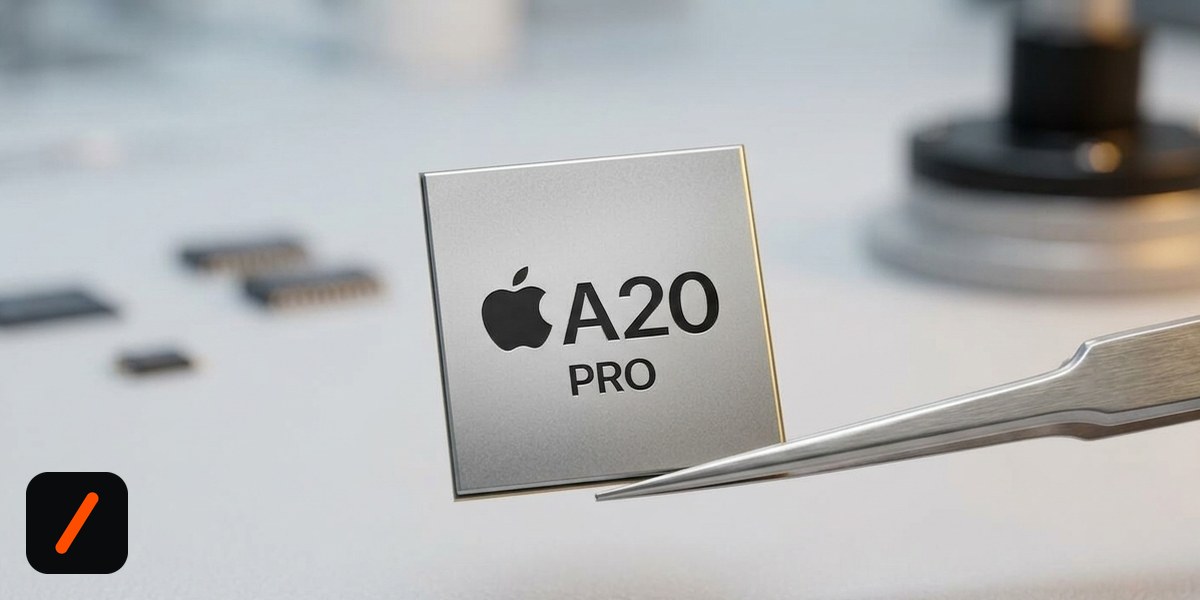
Apple introduced the A20 Pro at its "Surprise and Shine" event this afternoon, and the headline is a manufacturing one: it is the first smartphone chip built on a 2nm process. The chip powers the iPhone 18 Pro and iPhone 18 Pro Max, and almost every claim Apple made about it points at the same job, which is running larger AI models on the phone instead of shipping the work to a server. Apple called it "an exceptional chip that sets a new bar for mobile computing" and said it carries the widest memory interface ever used in an iPhone.
- First phone silicon on a 2nm process, built on what Apple describes as a brand new architecture.
- A 6-core CPU split into two new "super cores" rated up to 20 percent faster, which Apple calls desktop class, plus four new efficiency cores.
- A redesigned 7-core GPU Apple rates at up to 40 percent faster graphics, with neural accelerators that double FP8 throughput.
- An extra Neural Engine takes the total to 32 cores with twice the compute of the previous generation and 8-bit floating point support.
What is actually new inside the A20 Pro?
The CPU is the part that reads most like a Mac announcement. Apple split the six cores into two new super cores and four efficiency cores, described the super cores as desktop class and the fastest in any smartphone, and rated them up to 20 percent quicker than what they replace. That framing matters more than the percentage. Apple has spent years narrowing the gap between the M-series and the A-series, and a phone chip that borrows Mac vocabulary is a phone chip meant for sustained workloads rather than short bursts.
RelatedAMD's Threadripper Halo Station Targets Trillion-Parameter AI
The GPU moved to a 7-core layout with more memory bandwidth, which Apple rates at up to 40 percent faster graphics. Built into it are neural accelerators with double the FP8 performance of the previous generation, and Apple was explicit about what they are for: running large language models locally. The Neural Engine gained an additional engine for 32 cores in total, twice the compute, better efficiency and 8-bit floating point support.
Why does the 2nm process matter?
Process nodes are the least glamorous part of a phone launch and usually the most consequential. Moving from 3nm to 2nm buys some combination of more transistors in the same area, more performance at the same power, or the same performance at lower power. Apple traditionally spends most of that budget on efficiency, which is exactly what shows up in the iPhone 18 Pro's battery ratings of 36 and 45 hours of video playback.
Being first on a node also has a competitive half-life. Apple gets exclusive early capacity, ships a full generation before rival Android silicon reaches the same node, and then loses that edge when Qualcomm and MediaTek catch up. What is different this year is that the node advantage lands on a chip designed around on-device inference, so the efficiency gain is not just battery life, it is how big a model the phone can hold and how long it can run one without throttling.
What does the wider memory interface buy?
Apple noted the A20 Pro ships with the widest memory interface it has ever put in an iPhone, and that line deserves more attention than it got in the room. Local model performance is usually bound by memory bandwidth, not by raw compute. Neural cores sitting idle while they wait for weights is the normal failure mode of on-device inference. Widening the interface is how you keep those cores fed, and it is why Apple also redesigned the physical package so the die sits next to the memory, an approach it borrowed from the M-series.
| A20 Pro | A19 Pro | |
|---|---|---|
| Process | 2nm | 3nm |
| CPU | 6-core: 2 super + 4 efficiency | 6-core |
| GPU | 7-core, up to 40% faster | 6-core |
| Neural Engine | 32 cores, 2x compute, FP8 | 16 cores |
| Packaging | M-series style, die beside memory | Conventional |
| Cooling | Vapor chamber, 3x surface area | Vapor chamber |
What does it mean for the market?
The obvious beneficiary is TSMC, which supplies the 2nm capacity and books Apple as its launch customer at the node. Apple (AAPL) pays a premium for that position and historically converts it into a marketing advantage that lasts until Android flagships arrive on the same process, usually a year later. The read for Qualcomm and MediaTek is not that they lost, it is that they will spend 2027 arguing efficiency parity while Apple argues local model size.
RelatedXiaomi's Xring O3 Chip Hits 5.2M AnTuTu, Cuts Qualcomm Reliance
There is a second-order signal worth tracking. Apple built neural accelerators into the GPU, doubled the Neural Engine, and widened memory all in one generation. Companies do not spend that much die area on inference unless they intend to ship features that need it. If Apple Intelligence stays as thin as it has been, this silicon will look overbuilt. If the next round of Siri features actually runs locally, it will look early.
- Independent benchmarks. Every figure above is Apple's. Geekbench and sustained-load testing usually trim vendor claims, especially GPU numbers measured in short bursts.
- Sustained performance. The vapor chamber with three times the surface area is the real test. Peak scores are easy, holding them through a long game or a long video export is not.
- What actually runs locally. Watch whether Apple ships model sizes that justify a 32-core Neural Engine, or whether the heavy work still goes to Private Cloud Compute.
Our take
Apple's phone silicon has been comfortably ahead for years, so the interesting thing about the A20 Pro is not that it is fast. It is where the transistors went. Two desktop-class cores, a GPU carrying its own neural accelerators, double the Neural Engine and the widest memory bus Apple has shipped in a phone all point at the same goal, and it is not photography or gaming. It is holding a real model in memory and running it without the fans a laptop would need. Whether that turns into features people notice is the open question, and it will be answered by software rather than by another node shrink.
- EventApple: "Surprise and Shine" September 2026 event keynote where the A20 Pro was announced
- ReportingMacRumors: Apple Unveils A20 Pro as First 2nm Smartphone Chip core counts and claimed gains
- ReferenceApple: iPhone 17 Pro tech specs A19 Pro baseline for the comparison
Original analysis by GenZTech Team, based on Apple's September 9, 2026 keynote and MacRumors reporting.