
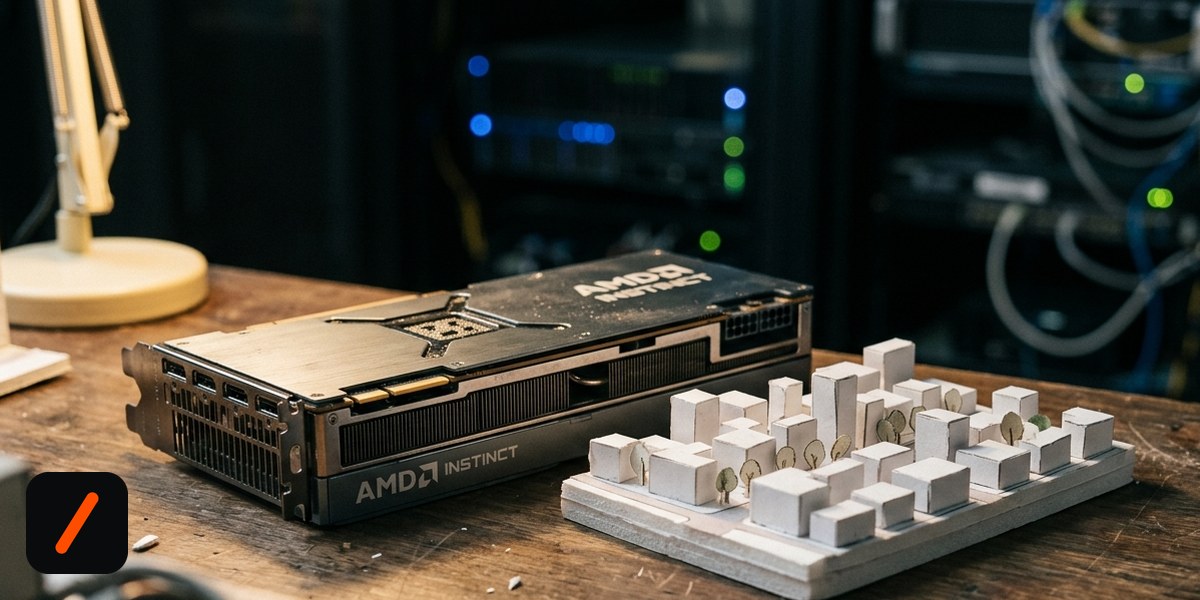
AMD is buying Fei-Fei Li's spatial AI startup World Labs for about $8.2 billion in an all-stock deal, its second-largest acquisition ever behind the $50 billion Xilinx purchase. Li, the Stanford professor who helped build ImageNet and co-founded Google Cloud AI, becomes AMD's executive vice president and chief scientist, reporting directly to CEO Lisa Su.
The deal was announced early Monday and is expected to close by the end of 2026, pending regulatory approval. It lands two years after World Labs' founding and comes at a moment when AMD stock had already climbed 187% this year on the strength of its AI chip business. Investors did not universally love the price tag: AMD shares eased about 4% on the news while Nvidia, the company AMD is explicitly trying to outflank, ticked up roughly 1.8%.
RelatedNvidia's $750B AI Deals Just Spooked Its Own Bondholders
What exactly did AMD buy?
World Labs builds what it calls "world models": AI systems trained to understand and generate coherent 3D environments rather than flat images or text. Its first product, Marble, turns a photo, a sketch or a text prompt into an explorable 3D scene that can be dropped into a game engine, a film pipeline or a robot simulator. That is a different bet than the large language models most labs chase. Instead of predicting the next word, a world model predicts how a physical space behaves when something moves through it, which is exactly the kind of synthetic data that robotics and autonomous-systems companies need and currently struggle to generate at scale.
Li founded World Labs in 2024 with Justin Johnson and Ben Mildenhall, both well-known computer-vision researchers (Johnson from Michigan and Meta, Mildenhall a co-creator of NeRF, the neural radiance field technique underpinning a lot of 3D AI work). Under the deal, Johnson and Mildenhall keep running the World Labs team, now inside AMD, while Li takes the chief scientist seat. AMD says the two companies quietly ran a deep technical partnership for roughly a year before the acquisition, tuning World Labs' training and inference workloads specifically for AMD's Instinct GPUs.
Why would a chipmaker buy an AI research lab instead of just selling it GPUs?
Because whoever builds the frontier models gets to decide what the hardware needs to do next, and AMD has spent two years arguing it should not have to guess. Nvidia's edge over AMD was never just faster silicon; it is Nvidia's own model and simulation stack, Omniverse and the Cosmos world-foundation models, that tells Nvidia's engineers exactly which kernels, memory layouts and interconnects matter before a customer ever asks. AMD buying a model-research team gives it the same feedback loop: World Labs' engineers now sit inside AMD, running real spatial-AI training at scale on AMD's own chips, surfacing bottlenecks that a hardware roadmap built from customer requests alone would miss.
There is also a plainer motive. Training a model that understands physical space, not just pixels, needs enormous, precisely labeled 3D data, and the fastest way to generate that data is to simulate it. Marble already does a version of this for entertainment. Point the same machinery at warehouses, factory floors and city streets and you have a synthetic-data engine for every robotics and autonomous-vehicle company that currently can't collect enough real-world footage. AMD gets first-party access to that pipeline instead of licensing it from a rival's ecosystem.
How does this change the fight with Nvidia?
It's the clearest sign yet that AMD sees robotics and physical-world simulation, not just chatbots, as the next AI battleground, and it is moving to own a piece of the model layer there before Nvidia's version becomes the industry default.
RelatedOpenAI Cuts Off Cursor's Model Access After SpaceX Buyout
| Layer | AMD (after deal) | Nvidia |
|---|---|---|
| Hardware | Instinct MI350/MI400, Helios racks | Blackwell/Rubin GPUs, NVL72 racks |
| Software stack | ROCm | CUDA |
| Spatial/world models | World Labs, Marble | Cosmos world foundation models |
| Simulation platform | Building (post-acquisition) | Omniverse |
| Robotics push | New, via World Labs | Isaac / Jetson robotics stack |
What does it mean for AMD's stock?
The market's first read was skeptical, not celebratory. AMD, trading around $607.87 after the announcement, fell roughly 4% even though the stock is still up 187% year to date, and some analysts flagged the price as steep for a two-year-old lab with no meaningful revenue of its own. Nvidia's modest 1.8% gain the same day reads less like investors betting against AMD's strategy and more like a reminder that Nvidia still owns the safer, cash-generating side of this trade. The signal worth watching isn't the one-day move: it's whether AMD can show, within a few quarters, that World Labs' research is showing up in faster MI-series adoption among robotics and simulation customers, which is the actual thesis being paid for here.
- 2024World Labs founded by Fei-Fei Li, Justin Johnson and Ben Mildenhall
- 2025Deep technical partnership with AMD begins training and inference tuned for Instinct GPUs
- Sep 28, 2026Acquisition announced $8.2B all-stock deal, Li named EVP & chief scientist
- End of 2026Deal expected to close subject to regulatory approval
Who does this actually affect?
Robotics and simulation startups are the most exposed group. Any company that was licensing or planning to license World Labs' models now has to negotiate with a division of AMD instead of an independent lab, and rivals building their own world models, including Nvidia's Cosmos team and smaller players like Genie-style efforts at other labs, just watched their most credible independent competitor get absorbed by a company with a balance sheet and a chip roadmap behind it. Game studios and virtual-production houses using Marble get a more stable, better-funded backer, though also a product now steered by a public semiconductor company's priorities rather than a startup's. And other AI labs building spatial or embodied models should expect this to raise their own acquisition price: if AMD will pay $8.2 billion for a two-year-old world-model lab, the next comparable team is not getting acquired cheap.
- Regulatory review. An all-stock deal this size, from a company that just bought ZT Systems and Silo AI, will draw scrutiny even without direct market overlap with World Labs.
- Whether Marble stays a standalone product. AMD could keep it shipping to outside customers as a showcase, or fold it inward as an internal tool only Instinct customers get privileged access to.
- Nvidia's answer. Expect Nvidia to either accelerate its own Cosmos/Omniverse roadmap or make its own acquisition in the spatial-AI space within two quarters.
- Li's actual mandate. Chief scientist titles can mean anything from hands-on research lead to figurehead. Whether AMD's next GPU generation visibly reflects World Labs' workload needs is the real tell.
Our take
This is AMD paying to stop being a fast follower on the model side of AI, not just the chip side. Xilinx bought AMD custom-silicon expertise; ZT Systems bought it systems and rack integration; World Labs buys it a seat at the table where the next generation of AI workloads actually gets designed. The stock dip says investors want proof before they believe it, and that's fair. An $8.2 billion bet on a pre-revenue research lab is a statement of intent, not a quarter of earnings. But the logic tracks: Nvidia's biggest advantage has always been that it builds the models that stress-test its own chips before anyone else does, and AMD just bought its own version of that advantage rather than waiting to license someone else's.
- OfficialWorld Labs: joining AMD company announcement
- OfficialAMD investor relations release deal terms and rationale
- ReferenceTechCrunch deal value and context
- ReferenceTechTarget on ZT Systems prior AMD acquisition value, for comparison
Original analysis by GenZTech. Source: World Labs.