
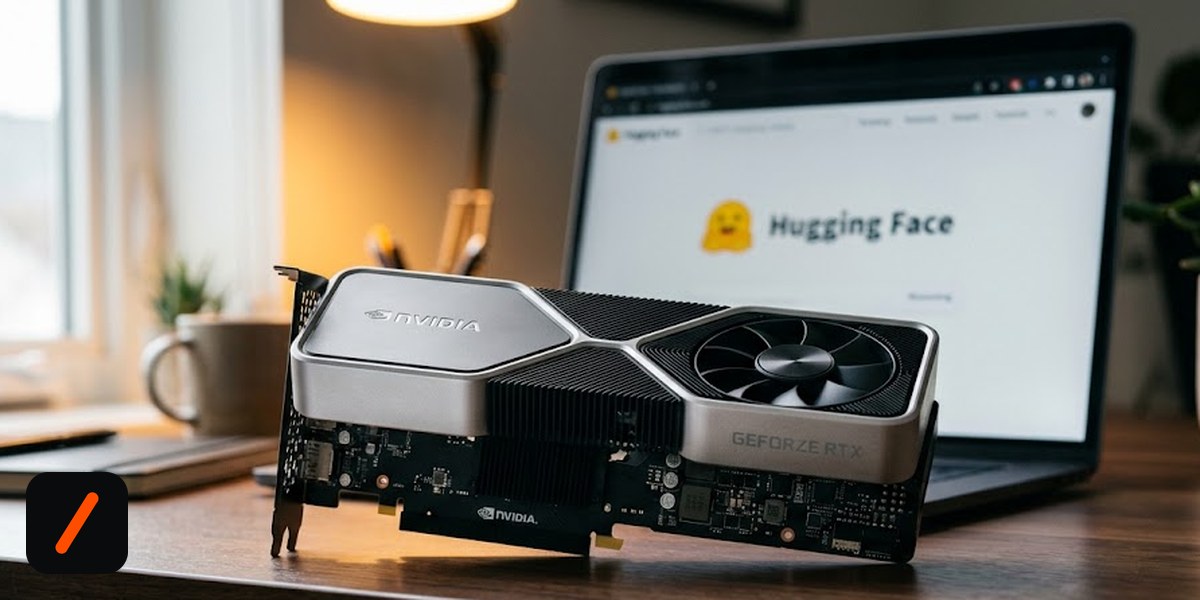
Nvidia has reportedly agreed to pay $12.9 billion for Hugging Face, the site where most of the world's open AI models, datasets and the widely used transformers and diffusers libraries live. The Information broke the story on August 26, and CNBC, TechCrunch, TechSpot and Slashdot have since corroborated it citing people familiar with the talks. Nobody at Nvidia or Hugging Face has confirmed anything on the record.
- The reported $12.9 billion price is roughly 2.9 times Hugging Face's $4.5 billion valuation from a 2023 funding round, one Nvidia itself helped fund with a $235 million check.
- 24/7 Wall St pegs Hugging Face's annual revenue at around $150 million, which puts the reported price at close to 86 times revenue.
- Hugging Face's founders reportedly turned down a roughly $500 million offer from Nvidia in the past specifically to stay independent, which makes this reported reversal notable on its own.
- The deal, if real, would hand the world's dominant AI chip maker ownership of the hub that AMD, Google and AWS chip customers also depend on.
What Nvidia is reportedly buying
Hugging Face gets called the GitHub of AI for a reason. It hosts hundreds of thousands of open-source models and datasets, and its Python libraries are close to unavoidable if you're building anything with transformer models. That ubiquity is exactly what makes the price tag make sense on paper and look strange on the balance sheet at the same time. A company with $150 million in revenue rarely commands a $12.9 billion valuation. Hugging Face isn't being bought for its income statement. It's being bought for the position it occupies in how AI developers actually work.
RelatedNvidia's Huang Rejects Bessent's AI Distillation 'Theft' Claim
Nvidia was already an investor. It joined Hugging Face's 2023 round at a $4.5 billion valuation, back when the startup was mostly known for hosting model weights and running a friendly Slack-like community for researchers. Three years later, the reported price is nearly triple that. Whether that jump reflects Hugging Face's growth, Nvidia's strategic urgency, or both is one of the open questions here.
Why does Hugging Face's neutrality matter so much?
Here's the part most of the initial coverage skated past. Hugging Face isn't valuable because it's a nice website. It's valuable because developers trust it as neutral ground. Models get uploaded there and run on whatever hardware the downloader has, Nvidia GPUs, AMD accelerators, Google TPUs, AWS's own Trainium and Inferentia chips. The transformers library doesn't play favorites among backends, and that's exactly why it became the default.
Ownership doesn't have to come with an explicit rule change to erode that. It can show up in smaller ways: which hardware gets first-class support in new releases, which benchmarks get featured, which cloud partners get promoted in the docs, which optimizations ship for one backend six months before another. None of that requires Nvidia to lock anyone out. It just requires the platform's defaults to quietly bend toward the owner's chips, the way a lot of "neutral" infrastructure ends up bending once somebody buys it.
What does this mean for AMD, Google and AWS?
All three have spent years building their own AI silicon specifically to reduce dependence on Nvidia. Google has TPUs. Amazon has Trainium and Inferentia. AMD has its MI-series accelerators and a growing software stack to match. Hugging Face has been part of how that independence gets exercised in practice, because a model published there is supposed to run anywhere.
If the reported deal closes, all three companies now have to publish and consume open models through infrastructure their biggest competitor owns. That's an uncomfortable position even if Nvidia does nothing overtly hostile. Expect renewed interest from AMD, Google and AWS in alternative distribution channels, whether that's beefing up their own model gardens or backing a genuinely independent open hub as a hedge.
| Platform | Owner | Chip neutrality | Core use case |
|---|---|---|---|
| Hugging Face | Nvidia (reported, unconfirmed) | Historically neutral, now in question | Open model and dataset hosting, transformers/diffusers libraries |
| GitHub | Microsoft | Not chip-specific | General source code hosting |
| Nvidia NGC | Nvidia | Built around Nvidia GPUs | Pre-tuned containers and models for Nvidia hardware |
| Google Kaggle / Model Garden | Leans toward Google Cloud/TPU | Competitions, datasets, Vertex AI model catalog |
What it means for the market
For Nvidia (NVDA), this would be one of the largest acquisitions the company has ever attempted, well past the $6.9 billion it paid for Mellanox in 2020 and closer to the scale of the $40 billion Arm deal it eventually walked away from in 2022 after regulators pushed back. That history matters. Nvidia has tried to buy critical AI infrastructure before and hit a wall.
RelatedHUMAIN's 428B Arabic AI Model Is Built on Chinese Weights
Jensen Huang has spent the last couple of years publicly championing open-weight models, arguing that broader access to open AI grows total demand for compute, which in turn grows demand for Nvidia's chips and data center gear. Under that logic, owning the biggest distribution point for open models isn't about locking in developers, it's about making sure the open ecosystem keeps expanding on Nvidia's terms rather than a rival's. Whether investors read that as smart platform strategy or as an antitrust headache waiting to happen will shape how this trades as a narrative, separate from whatever the deal does to Nvidia's actual AI chip revenue. Treat this as a signal to watch in Nvidia's platform ambitions, not as guidance on the stock itself.
What happens next, and will regulators get involved?
The single biggest unknown right now is confirmation. Every outlet reporting this, including CNBC and TechCrunch, is citing sources familiar with the matter rather than an official announcement. Deals at this stage can still fall apart, get renegotiated, or leak details that later turn out to be wrong.
Assuming it does move forward, scrutiny seems close to guaranteed. Nvidia already controls the large majority of AI training chips sold today. Adding ownership of the primary distribution hub for open models is precisely the kind of vertical combination that antitrust regulators in the US and EU have flagged in other tech sectors. The Arm deal's collapse is the obvious precedent Nvidia would want to avoid repeating.
- Official confirmation. Until Nvidia or Hugging Face files something or issues a joint statement, treat the $12.9 billion figure as reported, not finalized.
- Antitrust review. Given Nvidia's chip market share, expect regulators in the US and EU to at least ask questions before any deal closes.
- Changes to transformers and diffusers. Any shift in which hardware backends get prioritized in these libraries would be the clearest early sign of tilted neutrality.
- Rival-backed alternatives. Watch whether AMD, Google or AWS start pushing developers toward a competing open hub as a hedge.
Our take
If this deal goes through as reported, it's a net negative for open-source AI's independence, even if Nvidia never does anything overtly restrictive with it. The value of a neutral hub comes from everyone believing it's neutral, and that belief gets harder to sustain the moment the dominant chip vendor owns the deed. Jensen Huang's "grow the whole pie" argument isn't wrong exactly. Wider open-model adoption probably does help Nvidia's business regardless of who owns Hugging Face. But that argument works just as well to describe a company managing a genuinely independent hub as it does to describe a company that owns it outright, and only one of those outcomes keeps the neutrality question closed for good. Hugging Face's own founders understood this well enough to turn down Nvidia's money once already. That they'd reportedly reverse course now, at a price this far above their last valuation, says more about the pressure open-source AI infrastructure is under to find a sustainable business model than it does about anyone's confidence in staying independent forever.
- NEWSCNBC: Nvidia reportedly in talks to buy Hugging Face corroborates the reported $12.9 billion price and sourcing
- NEWSTechCrunch: Nvidia reportedly agrees to acquire Hugging Face early corroborating report citing sources familiar with the talks
- REFERENCEHugging Face the platform at the center of the reported deal
- ANALYSIS24/7 Wall St: Hugging Face's revenue-to-price math flags the roughly 86x revenue multiple implied by the reported price
Original analysis by GenZTech, based on reporting from CNBC, TechCrunch and other outlets.