
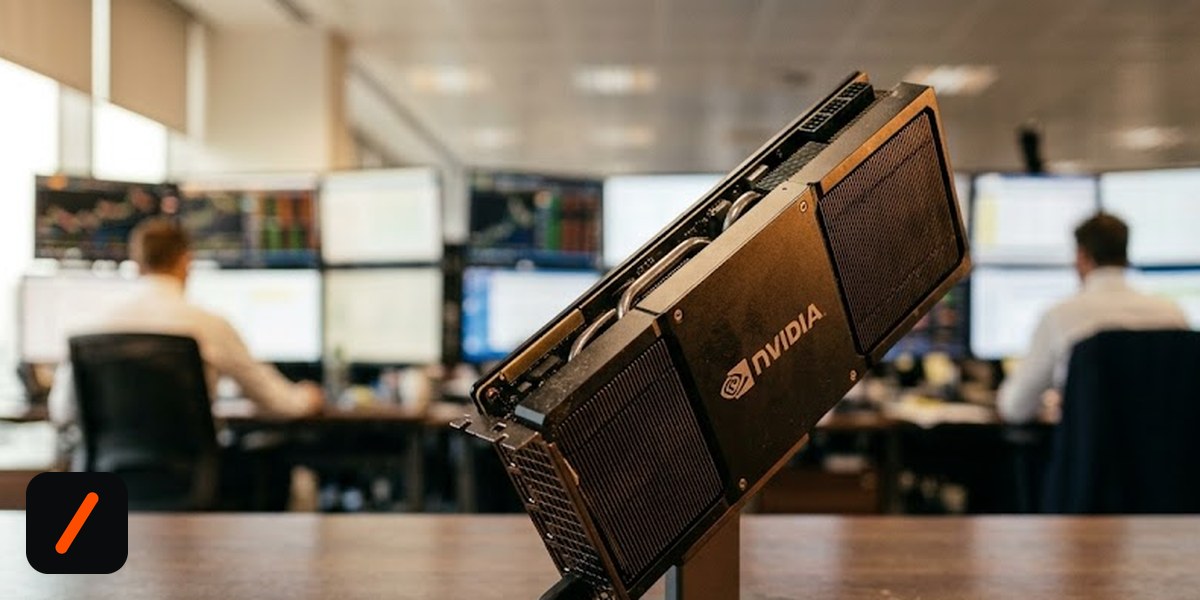
Nvidia is in conversations on more than $750 billion of AI infrastructure deals, and when the number landed on Monday morning the first market to flinch was not the stock market. It was the credit market. The cost of protecting Nvidia's debt against default rose about 0.14 percentage points to roughly 0.82 percentage points a year, the largest intraday jump since the company's five-year swaps started trading actively in November.
That reaction is the actual story. Nvidia buying stakes in its own customers has been argued about for a year. What surfaced over the weekend is different in kind. Bloomberg reported the company is in talks to guarantee as much as $250 billion so that OpenAI can lease computing power from a US data center project. A stake and a guarantee read almost the same in a headline. They behave nothing alike on a balance sheet, and credit desks price that difference for a living.
RelatedOpenAI Is Roughly 70% of Microsoft AI Revenue, Filings Show
What actually landed over the weekend?
Two separate things stacked into one number. Late Friday, Nvidia unveiled an initiative with SK Group, parent of memory maker SK Hynix, that the companies put at more than $500 billion of business with each other. It covers over 2 gigawatts of AI data centers on the Korean Peninsula, with the first facility slated to open next year, plus a $1 billion investment in internet and cloud provider Naver to expand its own Korean capacity. Then on Monday came the report of the OpenAI lease guarantee, worth up to $250 billion, which would rank among the largest financing arrangements Nvidia has ever struck with a buyer of its chips.
Neither piece is small on its own. Together they reset the scale of what Nvidia is willing to underwrite, on top of a year in which the company had already announced upwards of $540 billion of deals before OpenAI entered the frame.
- $500B+ with SK Group, covering 2 gigawatts of Korean AI data centers, first site opening next year.
- Up to $250B guaranteed for OpenAI to lease compute from a US data center project. In talks, not signed.
- 0.82 percentage points is where Nvidia's five-year credit protection closed Monday, up roughly 0.14 in a single session.
- $50.3B was Nvidia's operating cash flow last quarter, which is the number to hold the guarantee against.
Why did the credit market move when the stock story did not?
Because credit and equity are asking different questions. Equity asks how big the AI buildout gets. Credit asks what Nvidia owes if it does not. For most of Nvidia's history the second question was uninteresting: the company carried around $8.5 billion of notes against roughly $50 billion in cash and marketable securities, and there was no reason to buy protection on a balance sheet like that.
That changed recently. On June 15 Nvidia priced $25 billion of senior notes across seven tranches maturing between two and 30 years, at coupons running from about 4.25% on the short end to about 5.6% on the long end. It was the largest bond sale in the company's history, its first since 2021, and it drew $85 billion of orders. A borrower that size gets a liquid credit curve, and a liquid credit curve gets swaps written against it. Nvidia's five-year contracts only started trading actively in November, so Monday's "record" move is a record over a short history. Worth saying plainly rather than dressing it up.
The level still matters more than the record. At 0.82 percentage points, protection on Nvidia is no longer priced like an untouchable balance sheet. And the arithmetic is not hard: a $250 billion guarantee is roughly five quarters of Nvidia's operating cash flow, which ran at $50.3 billion last quarter, concentrated on a single counterparty that does not yet generate anything close to the revenue needed to cover its own compute bill.
How did we get here in six weeks?
- NovemberNvidia's five-year credit default swaps begin trading actively the instrument that moved Monday is barely nine months old
- Jun 15, 2026Nvidia prices $25B of senior notes, its largest ever bond sale seven tranches, 2 to 30 years, $85B of orders, first issue since 2021
- Jul 24, 2026SK Group initiative unveiled late Friday, valued above $500B 2GW+ of Korean data centers, plus $1B into Naver
- Jul 27, 2026Report of a guarantee up to $250B for OpenAI compute leases CDS jumps ~0.14pp to ~0.82pp, the biggest intraday move on record
- 2027First SK Group AI data center facility opens in Korea the point at which the buildout stops being a press release
Is "circular financing" a fair charge?
Jensen Huang has been direct about it. He calls the investments "a small percentage" of the business and says the idea that the arrangement is circular is "ridiculous." He has a real argument. Vendor financing is old and ordinary in capital goods: aircraft makers, turbine makers and telecom equipment vendors have all funded customers for decades. And Nvidia's demand is not hypothetical. Revenue hit a record $81.6 billion last quarter, up 85% year over year, with data center alone at $75.2 billion, up 92%. Against numbers like that, a financed slice genuinely is small.
The objection is not really about the percentage, though. It is about the marginal dollar and the concentration. "Capital is increasingly being used to fund future AI customers," Gary Tan of Allspring Global Investments told Bloomberg. Billy Leung at Global X called it vendor financing that is already under scrutiny. The question skeptics are asking is not whether Nvidia's total revenue is real. It is whether the next increment of growth is being bought, and whether a handful of guarantees now bind Nvidia's fate to two or three counterparties rather than to a broad market of buyers.
| Backer | Beneficiary | Structure | Reported size |
|---|---|---|---|
| Nvidia | OpenAI | Lease guarantee, in talks | Up to $250B |
| Nvidia | SK Group | Joint buildout and purchase commitment | $500B+ |
| Anthropic | Backstopped lease payments at five data centers | ~$35B equivalent | |
| SoftBank | OpenAI | Direct commitment, funded partly by a bridge loan | $65B, plus a $40B bridge |
Read down that table and the pattern is clear enough. Nvidia is not doing anything structurally novel. Google took a similar position behind Anthropic's data center leases. What is novel is the size, and the fact that the largest of these commitments now sits behind the single most compute-hungry company in the industry.
RelatedCognition's SWE-2 Nearly Matches GPT-6 Astra for a Quarter the Price
What does it mean for the market?
The tell going forward is the credit curve, not the share price. Nvidia's equity has been pricing the demand story for two years and does it well. Credit is the only place where the obligations get priced separately from the growth, so a spread that holds above 0.80 is information the stock chart will not give you. This is analysis, not advice, but the exposure map is straightforward: Nvidia itself, SK Hynix and SK Group on the memory and buildout side, SoftBank as OpenAI's other large backer, and the neocloud operators whose own business models lean on lease structures that somebody else guarantees.
The concrete thing to watch is disclosure. A guarantee of this size, if signed, has to surface as a contingent liability in Nvidia's next quarterly filing, with terms attached: is it a full backstop or a first-loss tranche, does it amortize, what triggers it. Those details decide whether 0.82 was an overreaction or an early read.
- Whether the OpenAI guarantee is confirmed, and at what size. $250 billion is the top of a range in a deal that is still described as talks. The signed number is the one that matters.
- The contingent-liability note in the next 10-Q. Structure beats headline. A first-loss tranche and a full backstop are different companies.
- Whether Nvidia's CDS stays above 0.80. A one-day spike is noise. A new floor is a repricing.
- Whether the SK facility opens on schedule next year. Announced gigawatts and energized gigawatts have diverged badly across this cycle.
Our take
The $750 billion figure is the least interesting thing here. It is a sum of two unlike items, one of them not signed, and it will get quoted for a week and then forgotten. The shape of the $250 billion is what deserves attention, because a guarantee converts Nvidia from a seller of chips into a partial underwriter of its customers' ability to pay for them, and that is a different business with a different risk profile.
Huang is right that the financed share of revenue is small today. That is also exactly what you would expect to be true at the start of this pattern rather than at the end of it. The credit market did not decide Nvidia is in trouble on Monday. It decided Nvidia is now a company whose obligations are worth pricing, which after years of a fortress balance sheet is itself the news.
- ReportBloomberg: Nvidia's $750 Billion Deals Revive Fear of AI Circular Financing the deal stack, Huang's response, analyst reaction
- MarketsBloomberg: Nvidia Credit Risk Jumps in Swaps Market on AI Deal Talk the 0.14pp move to 0.82pp and the November start of active trading
- FilingNvidia SEC filings (CIK 0001045810) where a signed guarantee would appear as a contingent liability
- OfficialNvidia investor relations, quarterly results Q1 FY2027 revenue of $81.6B, data center $75.2B, operating cash flow $50.3B
- ReferenceGENZ TECH Funding Tracker running record of confirmed AI rounds and their backers
Original analysis by GenZTech. Reporting on the deal talks and the swaps move from Bloomberg.