
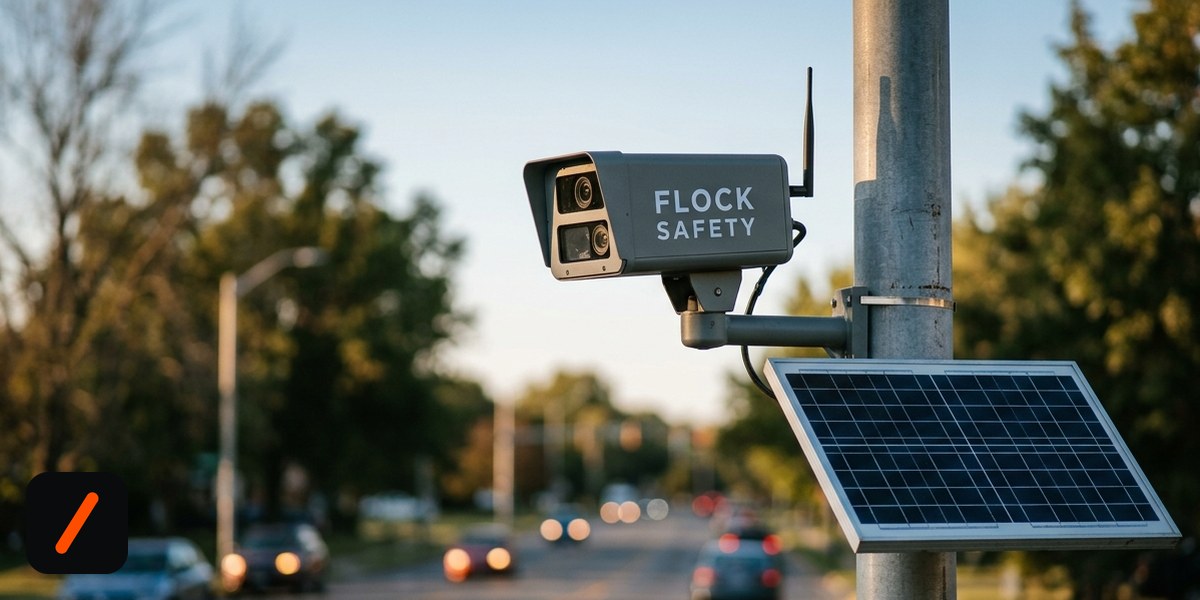
A sheriff's deputy in Lake County, Indiana ran a license plate search across more than 19,000 cameras spanning 1,558 cities and towns nationwide. The box asking why produced exactly one word: "LMAO." That search, and thousands like it, is the centerpiece of a new Electronic Frontier Foundation report published today showing police departments across the country treating a surveillance network built on 120,000-plus cameras as a toy with no one watching how it gets used.
- EFF reviewed Flock Safety audit logs from public records requests covering 2023 through late 2025, finding officers at 30-plus agencies logging over 6,300 searches with "TBD" as the justification.
- Named departments in Ohio, Texas, Indiana, California and a dozen other states entered "LOL," "Hehe," "idk," slurs, and straight keyboard mashing like "asdfga" into fields meant to document a legitimate law enforcement reason.
- Unlike historical cell-site location data, which the Supreme Court's Carpenter ruling requires a warrant to access, an ALPR search needs no judge, no case number, and in most states no specific suspicion at all.
- Flock's own fix, swapping the free-text box for a dropdown of generic categories in late 2025, removes the requirement to write anything specific rather than adding oversight.
What did EFF actually find in the audit logs?
EFF built its report by requesting network audit spreadsheets, the internal logs Flock Safety keeps of every search any agency runs against its camera system, through public records requests to dozens of police departments. Those logs are supposed to include a written reason for each search, since Flock's system and many state laws require officers to document why they're looking up a plate before the search runs. California has required this by law since 2015. What EFF found instead was a written record of how little that requirement actually restrains anyone.
RelatedCities Ditch Flock Cameras, Then Buy Axon's Instead
The Lake County, Indiana search stands out for its scale: one officer, one plate, 19,000-plus cameras, 1,558 cities and towns, logged reason "LMAO." But it's not an outlier so much as the most quotable example of a pattern that repeats across the country. Barberton PD in Ohio and Harris County Sheriff's Office in Texas both logged "LOL." Richmond PD in California wrote "Hehe." Riverside County Sheriff's Department wrote "Haha." Officers in Kankakee County, Illinois and Goshen, Indiana wrote "idk." A Pasco PD officer wrote, in full: "robbery i don't remember the case number leave me alone."
Why does 'TBD' matter more than the jokes?
The jokes are what get quoted, but the volume sits somewhere less funny: over 6,300 searches across 30-plus agencies logged with the literal placeholder "TBD," meaning the officer deferred documenting a reason and, in most of these logs, never came back to fill it in. The Priceville Police Department alone ran 1,954 searches under that placeholder. A "TBD" search isn't a joke entry an officer typed for fun; it's a search that ran, returned someone's location history, and left no record of why it was allowed to happen at all. That's the accountability gap EFF is actually pointing at. The gag entries prove officers know no one is checking. The "TBD" entries prove it at scale.
Button-mashing strings show up constantly too: "HJKNUILH" from a Georgia department, "gyghkkghghjkghjk" from Wisconsin, "mhghjk" from Kentucky State Police. A few entries cross into outright insults, including "WEIRD KID" and "idiot" aimed at whoever's plate got searched. None of these required more effort to type than an actual reason would have. That's the point EFF is making: the friction that's supposed to make an officer pause and articulate cause isn't there, so it doesn't get used even when it costs nothing to use it.
| Access requirement | ALPR / Flock search | Cell-site location history | Wiretap |
|---|---|---|---|
| Legal standard | Agency policy only, varies by state | Warrant, probable cause (Carpenter v. US) | Warrant, probable cause, judge signs order |
| Reason required | Free text, unverified, or dropdown since late 2025 | Sworn affidavit reviewed by a judge | Sworn affidavit, judicial oversight of duration |
| Third-party check | None at search time | Judge before access is granted | Judge before and during interception |
| Data scope per search | Up to 6,474+ camera networks at once | One carrier's location history for named number | One line, time-limited by the order |
Who's affected when a search needs no real reason?
Every driver whose plate crosses a Flock camera is exposed to this gap, not just people under active investigation. Flock's network spans more than 120,000 cameras feeding a searchable history of where a car has been, and a single query can reach across thousands of jurisdictions at once, since agencies routinely share access with neighboring departments and outside networks. A plate search doesn't just return a name; it returns a pattern of movement over time, which is exactly the kind of record the Supreme Court decided in 2018's Carpenter v. United States deserves a warrant when it comes from a cell carrier. ALPR data gets no equivalent protection in most of the country, despite functioning the same way.
People who show up disproportionately in these logs, including undocumented immigrants, people seeking reproductive healthcare across state lines, and protesters, carry the sharpest exposure, since a location history built from casual, undocumented searches can end up in a context far more serious than the "LOL" that triggered it. EFF's October report on a Texas sheriff's plate search tied to an abortion investigation, filed under a "missing person" pretext, is the pattern this new report says is common rather than rare.
What are police departments saying about it?
Responses ranged from acknowledgment to defensiveness. Richmond PD said the officers involved were "counseled." Corona PD said the employee responsible is no longer employed there. Thornton PD said its system now requires defined reason lists and audited searches. Belton PD promised a "thorough investigation." Columbus PD said a 90-day limit in its union contract blocks it from investigating older incidents. Manteca PD pushed back on the framing entirely, arguing a "TBD" entry shouldn't be read as evidence of an illegitimate search. Fishers PD said an officer's "blah" entry reflected frustration with the technology, not indifference to the rules. San Diego County said its reason field is now mandatory with a dropdown menu.
RelatedBorder Patrol Secretly Flags Bank Activity for Traffic Stops
Flock Safety's own response, rolled out in late 2025, replaced the open text box with a menu of pre-set offense categories. It's being sold as a fix. EFF's read is closer to the opposite: a dropdown removes the one thing that made the old system embarrassing when it was misused, the requirement to type something specific enough that "LMAO" would obviously fail it. Pick a plausible-sounding category from a list and the search looks procedurally fine no matter what actually motivated it.
What does the political backdrop look like?
Flock's cameras aren't a fringe product getting quietly rolled back; they're expanding with high-level political cover. President Trump has publicly praised the technology, telling reporters: "I sort of like them because of that, because of law enforcement, but some people don't. They think it's an infringement." That's the tension EFF's report sits inside: a surveillance network growing in scale and political favor, running on an internal audit process this report shows plenty of officers don't take seriously even when their own department requires it.
- 2015California becomes among the first states to require ALPR agencies to document a reason for every search by law.
- 2023–2025Period covered by the Flock audit logs EFF obtained via public records requests.Basis of this report
- May 7, 2025A single documented search reaches 6,474 ALPR networks and 82,413 cameras at once.
- July 2025Lake County, Indiana deputy searches 19,000-plus cameras across 1,558 cities, reason logged: "LMAO."
- Late 2025Flock replaces the free-text reason field with pre-set dropdown categories.
- 2026-09-15EFF publishes "The High Crime of 'LMAO'," naming dozens of agencies.Today
- Whether any state passes a warrant requirement for ALPR searches. Carpenter already set the precedent for cell data; ALPR is the obvious next target for that same argument in court or legislatures.
- Whether the dropdown menu gets treated as reform or as camouflage. Watch whether any independent audit actually checks dropdown selections against real case files.
- More litigation citing misuse patterns like this one as evidence that agency self-policing of ALPR access doesn't work in practice.
- Named agencies' actual discipline outcomes, not just their statements to reporters this week.
Our take
The individual jokes are almost a distraction from what EFF actually proved: an audit trail that exists on paper does nothing if nobody reads it until a nonprofit files a records request years later. A "TBD" search and an "LMAO" search fail the same way, they just fail with different levels of comic value attached. Flock's dropdown fix treats the symptom, forcing text into a plausible shape, rather than the disease, which is that no judge, supervisor, or independent auditor checks a single one of these searches before it runs. Until that changes, the honest description of this system isn't "documented and audited." It's "logged, and read only when someone gets caught."
- ReportEFF: The High Crime of "LMAO" 2026-09-15
- Report404 Media: Cops search thousands of Flock cameras for "LMAO" 2026-09-15
- PrecedentEFF: Texas sheriff's plate search was an abortion investigation 2025-10
- LegalCarpenter v. United States Supreme Court, 2018
Original analysis by GenZTech. Source: Electronic Frontier Foundation.