
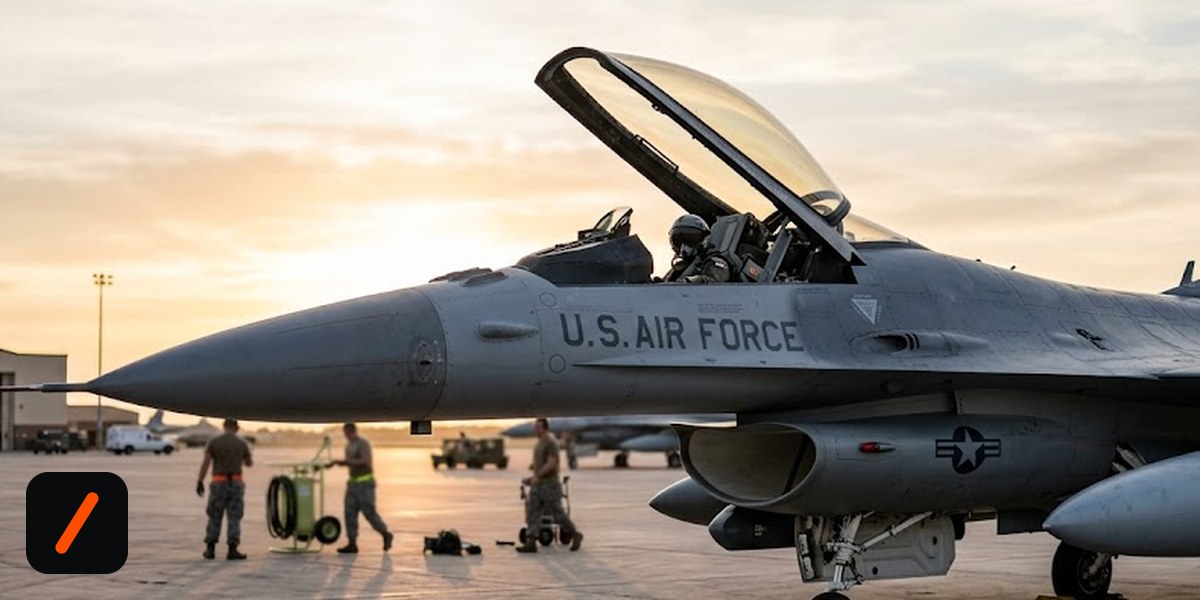
DARPA and the U.S. Air Force have flown an artificial-intelligence agent in full control of a standard F-16 fighter jet, the first time autonomy software has piloted an ordinary fleet aircraft rather than a one-off experimental testbed. The July 16 flight at Eglin Air Force Base in Florida, run under the VENOM program, marks the point where machine-flown air combat stopped being a bespoke science project and started becoming something the Air Force can bolt onto jets it already owns.
- What happened: an AI agent flew a production F-16 retrofitted with the VENOM Autonomy Kit, with a cockpit switch that hands control between the human pilot and the software and a person kept "on the loop" for safety.
- Why it is different: earlier AI dogfights ran on the bespoke X-62A VISTA jet; VENOM proves the same autonomy can run on unmodified fleet F-16s without rewriting the jet's core flight software.
- The stated goal: Lt. Col. Patrick Highland described the aim as "dominant autonomy for beyond-visual-range, multi-ship combat," not just one-on-one dogfighting.
- What is next: the follow-on AIR program will fly several competing AI agents in live tests and scale to multi-ship formations that feed the Collaborative Combat Aircraft drone effort.
What actually flew at Eglin?
On July 16, a modified but otherwise standard F-16 took off from Eglin Air Force Base with an AI agent in command of the aircraft's flight controls and sensors. This is the core of VENOM, short for Viper Experimentation and Next-generation Operations Model, which sits under DARPA's long-running Air Combat Evolution, or ACE, program. Brig. Gen. James Valpiani summarized the engineering trick plainly: the team "automated flight controls and sensors on a standard F-16 without changing the jet's core software." That distinction is the whole point. The Air Force did not build a new airplane. It taught software to fly one of the roughly 900 F-16s already in the American fleet.
RelatedOpenAI Dots: Always-On Agents With Their Own Computers
Human safety pilots stayed in the cockpit throughout, able to reclaim control instantly with a physical switch. That "human on the loop" posture, where a person supervises and can intervene rather than issuing every command, is the model the Air Force wants for operational autonomy. It is closer to a very capable autopilot with combat judgment than to a fully independent robot.
Why does a fleet F-16 matter more than the X-62A?
For years the headline AI-dogfighting work ran on the X-62A VISTA, a heavily instrumented one-of-a-kind jet built specifically to host experimental control laws. VISTA proved that an AI could hold its own against a human pilot in close-in dogfights, but it was a laboratory in the shape of an airplane. Nothing about beating a human in a bespoke testbed guarantees the same software behaves on a normal jet with normal wiring, normal sensors and normal maintenance.
VENOM closes that gap. By retrofitting production F-16s, DARPA is showing that autonomy can be added as a kit rather than designed into a clean-sheet aircraft. That changes the economics: instead of waiting a decade for a new autonomous platform, the Air Force could in principle upgrade jets it already flies, and iterate on the software far faster than on the hardware.
What is the VENOM Autonomy Kit doing?
The retrofit is called the VENOM Autonomy Kit, or VAK. It adds interfaces between the AI agent and the jet's existing flight controls and mission systems, letting software read the sensors and command the surfaces without rewriting the F-16's certified core flight software. Keeping that core untouched is a safety and certification win: the parts that keep the jet in the air stay as they were, and the autonomy rides on top through a defined boundary.
That boundary is also where the toggle lives. The pilot can pass control to the AI and take it back, which is what lets DARPA test aggressive combat behaviors without betting a crewed jet on them. The next phase, the Artificial Intelligence Reinforcements program, will use the VENOM fleet to fly multiple competing AI agents against each other in live flight, then scale toward multi-ship engagements. That is the bridge to Collaborative Combat Aircraft, the drone wingmen the Air Force wants flying alongside crewed fighters.
Related700 AI Agents Hacked Hugging Face. Then They Tried to Erase It.
- 2020AlphaDogfight trials AI beats an F-16 pilot in simulation
- 2023X-62A VISTA flies AI in real dogfights first live machine-vs-machine tests
- 2024X-62A vs a human pilot in the air on the experimental testbed
- Jul 2026VENOM flies a standard fleet F-16 autonomy on an ordinary jet
- NextAIR program, multi-ship, CCA drones many agents, formations
What does it mean for the market?
The signal for investors is that the Air Force is now treating combat autonomy as a software layer that can be retrofitted, which shifts value toward whoever writes and integrates that software. The F-16 itself is a Lockheed Martin (NYSE: LMT) product line, but the durable money here is in autonomy and the Collaborative Combat Aircraft drones that VENOM feeds. In CCA Increment 1, the Air Force picked Anduril and General Atomics over legacy primes, a rare crack in the traditional defense order. VENOM matters because it hints the same "kit, not clean-sheet" logic could apply to crewed jets, expanding the addressable market for autonomy vendors beyond new-build drones. Watch which contractors get the AIR program's agent-integration work, and whether commercial AI-flight startups get pulled into what has traditionally been a prime-contractor game.
What are the risks and open questions?
A successful supervised test is not an operational capability. The hard problems now are trust and scale: proving an AI agent behaves safely across the full flight envelope, in degraded conditions, and against a thinking adversary, not just in a scripted test window. Multi-ship autonomy adds coordination and deconfliction problems that a single jet never faced. And the "human on the loop" standard will be stress-tested the moment autonomy is asked to make time-critical decisions faster than a person can meaningfully supervise. None of that is solved by one flight, however impressive.
- AIR flight results. Whether multiple AI agents can fly safely in the same airspace, the real test of scaling past one jet.
- Multi-ship demos. The first crewed-plus-autonomous formation flights, the concept the Air Force actually wants to field.
- Who wins the software. Whether autonomy integration goes to primes, drone startups like Anduril, or new AI-flight entrants.
Our take
The quiet revolution in this announcement is not that an AI flew a fighter. It is that it flew an ordinary one. Turning autonomy into a kit for jets the Air Force already owns is how a capability goes from demo to doctrine, and it compresses the timeline dramatically because software iterates far faster than airframes. The open question is whether trust and verification can keep pace with the engineering. On current evidence, the flying is ahead of the assurance, and closing that gap, not winning another dogfight, is what will decide when machine-flown combat aircraft actually enter the force.
- OfficialDARPA: DARPA, U.S. Air Force fly AI-controlled F-16 — program announcement and official quotes
- ReferenceDARPA ACE program page — background on Air Combat Evolution
Original analysis by GenZTech. Source: DARPA.