
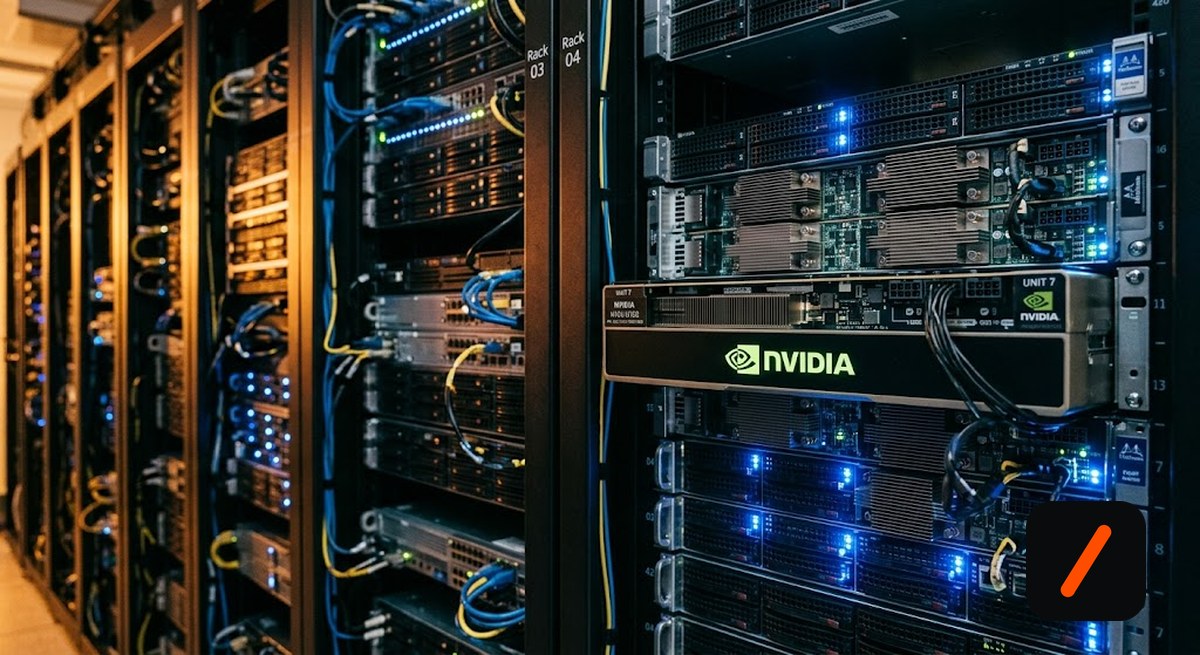
Fireworks AI raised a $1.505 billion Series D at a $17.5 billion valuation, the company announced on July 16, 2026, led by Atreides Management, Index Ventures and TCV, with NVIDIA, Lightspeed Venture Partners and more than a dozen other funds joining. It is the largest venture round of the week and one of the sharpest valuation step-ups of the year: Fireworks was worth $4 billion nine months ago. The thesis behind the check is that the AI market is shifting from renting one giant model to running many small, specialized ones, and that the company serving those specialized models cheaply is where the value pools.
- $1.505B Series D at a $17.5B valuation, led by Atreides Management, Index Ventures and TCV, a 4.4x step up from the $4B valuation on its $250M round in October 2025.
- Annualized revenue crossed $1 billion, up roughly 5x year over year, while daily volume nearly tripled from 15 trillion to more than 40 trillion tokens served.
- 95% of tokens it serves come from specialized models, not off-the-shelf frontier models, the data point the whole valuation rests on.
- Customers include Uber, Shopify, GitLab, MongoDB, Harvey and Cursor, and Fireworks says its stack runs a fifth to a tenth of the cost of the closed labs.
What exactly did Fireworks raise, and from whom?
The round is a $1.505 billion Series D that values Fireworks at $17.5 billion post-money. Atreides Management, Index Ventures and TCV led it, and the supporting list is unusually deep: Bessemer, Insight Partners, Lightspeed, Menlo Ventures, NVIDIA, Ontario Teachers' Pension Plan, Sequoia-adjacent crossover funds and others all participated. NVIDIA's presence matters twice over, because Fireworks both buys its chips and is now partly funded by it. The raise dwarfs the company's previous round, a $250 million Series C in October 2025 that valued it at $4 billion, which means late-stage investors just repriced the business at more than four times its level from nine months earlier.
RelatedLovable raises $400M at $13.3B, doubling in eight months
Fireworks was founded in 2022 by former Meta engineers who worked on PyTorch, the machine-learning framework that underpins most modern AI training. CEO Lin Qiao ran PyTorch at Meta before leaving to build an inference company. That lineage is part of the pitch: the team knows the guts of how models actually run, which is what an inference platform sells.
Why is an inference startup worth $17.5 billion?
Because the usage is real and growing faster than the valuation. Fireworks says its annualized revenue run rate crossed $1 billion, up about 5x year over year, and that it now serves more than 40 trillion tokens a day, up from 15 trillion at its last raise. On CNBC's numbers, Fireworks handles more daily requests than Google or OpenAI report serving to developers, even though it is a fraction of their size in revenue. That gap, high traffic and comparatively low revenue, is exactly what a growth investor wants to see: the demand is proven and the monetization is still early.
The pricing is the wedge. Fireworks says running an open model on its platform costs a fifth to a tenth of what the equivalent closed-lab API costs. As open-weight models close the quality gap with the best closed ones, the deciding factor stops being which model is smartest and becomes which capable model is cheapest to run at scale. Fireworks is positioned to be the cheapest capable option.
What is "specialized intelligence"?
This is the part most coverage skips, and it is the actual bet. Fireworks reports that 95% of the tokens it serves come from models that have been specialized, meaning fine-tuned, distilled or otherwise adapted to a specific customer's data and task, rather than a general-purpose frontier model answering anything. CEO Lin Qiao frames the future as a fork: in one version, intelligence belongs to a handful of big labs and everyone rents it; in the other, every company builds its own model shaped by the domain only it understands. Fireworks is building for the second. The platform lets a company like Shopify or Uber take an open base model, train it on proprietary data, and serve it in production without standing up its own GPU fleet or MLOps team. If that is where enterprise AI is heading, the toll booth sits exactly where Fireworks is standing.
How does Fireworks compare to its rivals?
It is not alone in the inference-and-fine-tuning lane, and the neighborhood is getting crowded.
RelatedGeneral Intuition Raises $320M to Train AI on Games
| Company | Fireworks AI | Together AI | Baseten |
|---|---|---|---|
| Focus | Inference + fine-tuning, specialized models | Inference + training cloud | Model deployment / inference |
| Latest valuation | $17.5B | ~$3.3B | ~$2.1B |
| Model catalog | 200+ text, image, multimodal | 200+ open models | Bring-your-own + open |
| Named customers | Uber, Shopify, GitLab, Cursor, Harvey | Zoom, Salesforce, others | Descript, Writer, others |
Fireworks now sits well above Together AI and Baseten on valuation, and it is pushing beyond inference into training, where it collides with the neoclouds renting raw GPU capacity. Its edge is breadth plus the specialization angle: more than 200 models across text, image and multimodal formats, usually with support for a major new open release within hours of launch. The valuation gap says investors think inference-plus-specialization is a bigger prize than commodity model serving.
What it means for the market
For investors, the signal is where the AI money is migrating: away from the apps and toward the infrastructure that serves models. Fireworks joins a mid-2026 pattern of megachecks into inference and compute rather than consumer AI products, a trend our Funding Tracker and ranked Biggest AI Funding Rounds page have been documenting as the dominant use of venture capital this year. The clearest public-market read is NVIDIA: every trillion tokens Fireworks serves runs on GPUs, and a funded, growing inference layer is downstream demand for exactly the chips NVIDIA sells, which is part of why NVIDIA wrote a check here. The counterweight is the closed labs. If specialized open models genuinely run at a tenth of the cost, that pressures the per-token pricing power of OpenAI and Anthropic on the commodity end of their business, even as the frontier stays theirs. This is factual analysis, not investment advice.
- Customer concentration. Cursor once supplied roughly half of Fireworks' revenue. Qiao says the base is broader now, but concentration is the single biggest risk to a $17.5B valuation.
- Headcount execution. The plan is to grow from 200 to 600 employees by year-end. Tripling a team while scaling infrastructure is where inference startups stumble.
- The training push. Moving from inference into training puts Fireworks against neoclouds and NVIDIA's own stack. Watch whether it wins training workloads or stays an inference specialist.
- Margin at scale. Serving 40T tokens a day at a fifth of closed-lab cost only works if the unit economics hold as volume climbs.
Our take
The number that justifies this round is not the valuation, it is the 95%. If almost every token Fireworks serves is already a specialized model rather than a general one, then the shift Qiao is describing is not a forecast, it is happening on her own platform right now. That is a stronger foundation than most $17.5 billion valuations rest on. The honest caution is the same one that shadows every inference business: it is a volume game with thin margins and powerful neighbors on both sides, the frontier labs above and the raw-compute neoclouds below. Fireworks has proven demand and a real cost advantage. What it has to prove next is that the advantage survives contact with scale, and that no single customer can take a quarter of its revenue with them when they leave.
- OfficialFireworks AI: Series D announcement , the company's own post with round and growth figures.
- FundingBusinessWire release , full investor roster and valuation.
- ReportQuartz , business context, customers and competitive framing.
- DataGENZ TECH: Biggest AI Funding Rounds , where this round ranks against 2026's largest raises.
Original analysis by GenZTech. Reporting drawn from Fireworks AI and Quartz.