
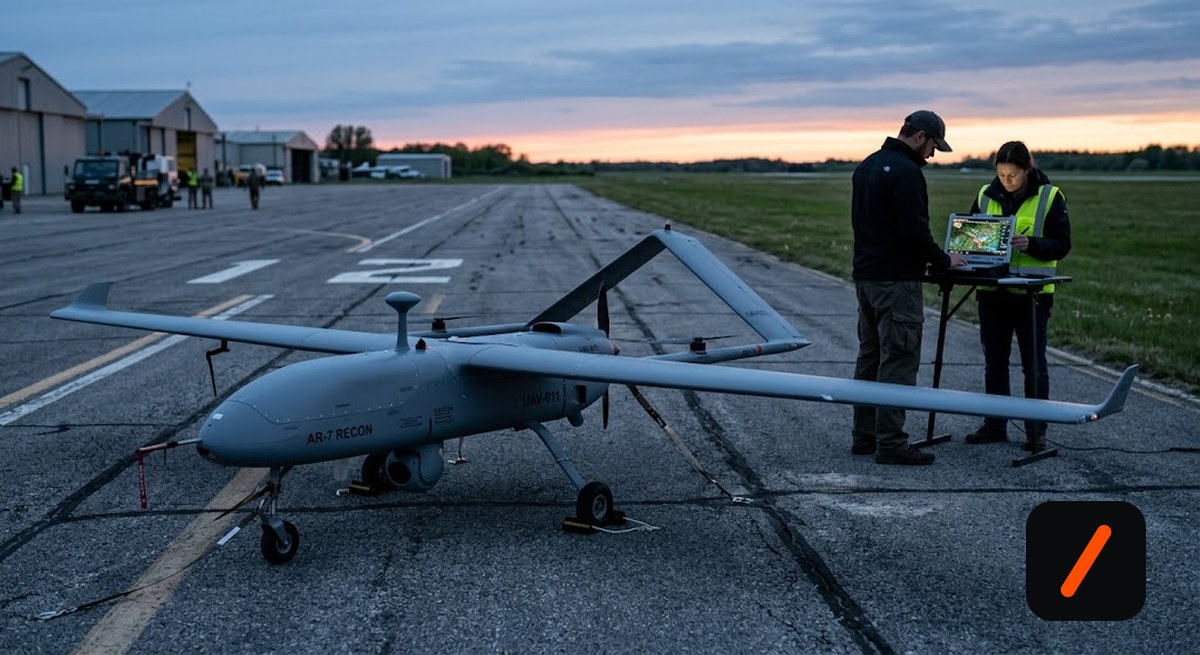
Helsing, the German defense-technology company, has raised a $1.8 billion Series E at an $18 billion valuation to expand its AI-driven battlefield software and autonomous drones. It is one of the largest European defense-tech financings on record, and it arrived on a single day that also saw Quantum Systems close a $1.2 billion Series D, underscoring how much venture capital is now pouring into militarized AI and autonomous systems.
- $1.8B at an $18B valuation. Helsing's Series E ranks among the biggest European defense raises ever and cements its status as the region's flagship defense-AI startup.
- The focus is AI plus autonomy. The money funds battlefield decision software and autonomous drones, the two capabilities modern militaries are buying fastest.
- It was not alone. Quantum Systems raised $1.2B the same day, signaling a broad, not one-off, surge in defense funding.
- Sovereignty is the tailwind. European governments rearming and prioritizing homegrown capability are the demand engine behind these valuations.
What is Helsing, and what does it build?
Helsing is a European defense-technology company that builds AI software for the battlefield: systems that fuse sensor data, help commanders make faster decisions, and increasingly control autonomous platforms like drones. Its pitch is that modern conflict is won by whoever turns raw sensor feeds into actionable decisions fastest, and that this is fundamentally a software problem. The new $1.8 billion, raised at an $18 billion valuation, is meant to scale exactly that: more AI-driven battlefield systems and more autonomous drones, the categories European militaries are procuring most urgently.
RelatedQuantum Systems Raises $1.2B for Defense Drones
Why is this round so large?
Because the demand is structural. European governments are rearming after years of underinvestment, and they increasingly want sovereign capability rather than dependence on foreign suppliers. That combination, rising budgets plus a preference for homegrown technology, turns a company like Helsing into a strategic asset, which is why investors are willing to underwrite an $18 billion valuation. The same forces produced Quantum Systems' $1.2 billion Series D on the same day. When two megadeals land together in the same sector, it signals a durable shift in where capital wants to go, not a single outlier.
How does it fit the 2026 funding landscape?
Defense and robotics have become the hottest venture categories of 2026. Per-deal averages in defense and security now top the tables even as consumer software cools, and globally the robotics sector alone has already raised more this year than in all of 2025. The through-line is "AI for every vertical," and defense is a vertical with deep-pocketed, motivated buyers: governments. For a fuller picture of where the money is flowing, our Funding Tracker and the ranked Biggest AI Funding Rounds page track these deals as they land.
What does it mean for the market?
Helsing is private, so there is no direct ticker, but the read for investors is clear. First, European defense-AI is now a real, well-capitalized category with a flagship worth $18 billion, which pulls talent and follow-on capital toward the space. Second, it validates the thesis behind US peers like Anduril and pressures traditional prime contractors, whose slower software cycles look increasingly exposed to nimble, AI-native challengers. The signal is that software-defined defense is where growth capital expects the next decade of returns, and public-market defense names with credible autonomy and AI stories stand to benefit from that narrative.
RelatedMistral Raises €3B, Europe's Biggest-Ever Tech Funding Round
What could slow the defense-tech boom?
Several things. Defense procurement is notoriously slow and political: winning a $18 billion valuation is not the same as winning multi-year government contracts, and the gap between investor enthusiasm and fielded, paid-for systems can be wide. Budgets that look secure today can shift with elections and geopolitics, and a sudden de-escalation would cool the sector fast. There is also execution risk unique to autonomy and AI in warfare, where reliability, safety, and ethical constraints are not optional niceties but requirements that can slow deployment. And valuations at this level assume years of rapid growth; if any of the flagship names stumble on delivery, the re-rating could reverse as quickly as it arrived. The tailwind is real, but it is not guaranteed to blow at this strength indefinitely.
Our take
The scale here is the story. A $1.8 billion round at an $18 billion valuation would have been unimaginable for a European defense startup a few years ago, and the fact that it landed alongside another billion-dollar-plus raise shows this is a sector re-rating, not a fluke. The tailwind, governments rearming and prioritizing sovereignty, is real and durable. The open questions are execution and ethics: whether Helsing can convert capital into fielded systems at the pace it promises, and how autonomous those systems become. But as a marker of where defense capital is heading, this round is unambiguous.
- OfficialHelsing — Company site
- FundingCrunchbase News — biggest funding rounds
- ReferenceGenZTech — Funding Tracker
Original analysis by GenZTech. Details current as of July 2026. Round details as reported by Crunchbase News.