
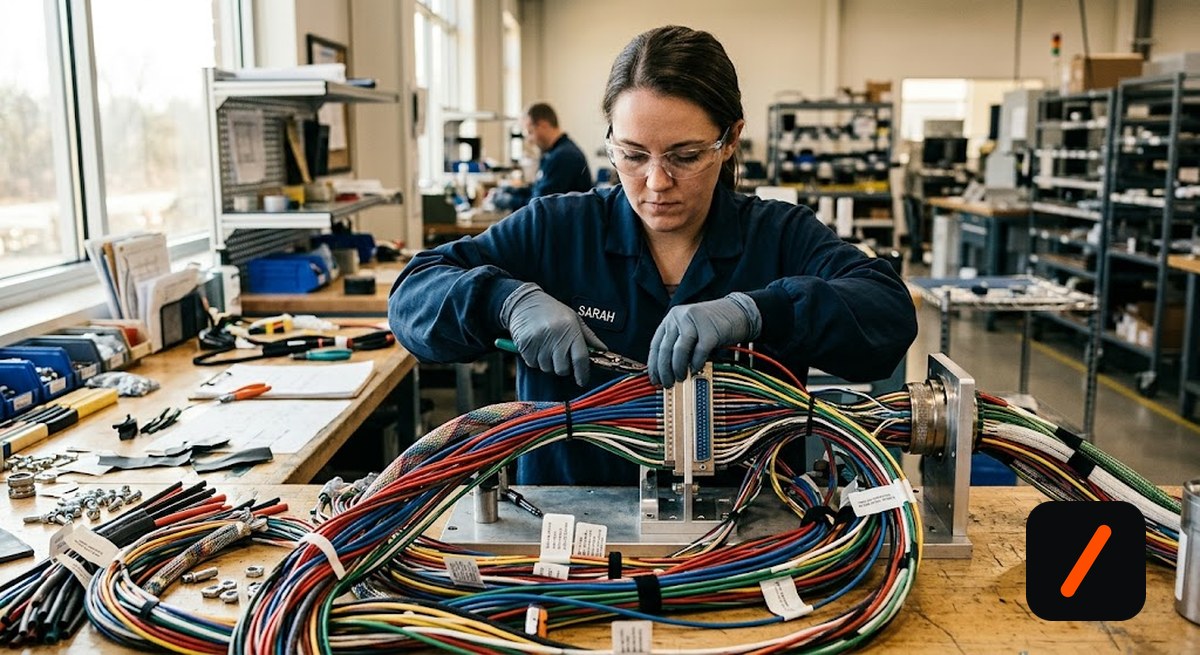
Senra, the wire-harness startup founded by a SpaceX veteran, announced this morning that it has raised a $65 million Series B to drag one of manufacturing's most stubbornly manual crafts into the software era. The round, co-led by Lowercarbon and Interlagos with General Catalyst, Sequoia Capital, Andreessen Horowitz and Founders Fund participating, lands a little over a year after the company's $25 million debut, and it is a bet that the humble bundle of wires inside every rocket, submarine and drone is actually a defense-industrial bottleneck worth fixing.
- Senra's Series B is $65M, co-led by Lowercarbon and Interlagos, with General Catalyst, Sequoia, a16z and Founders Fund in.
- Wire harnesses, the internal cabling in nearly every machine, are still built largely by hand on pegboards; Senra is automating and instrumenting that process.
- Its platform, Amp, turns a harness spec into a "digital twin" that guides technicians step by step, standardizing an error-prone craft.
- The company makes about 1,000 harnesses a month across two factories today and is targeting 10,000 a month in 2027.
What did Senra actually announce today?
Senra said this morning it closed a $65 million Series B, its second raise in roughly a year after a $25 million round in 2025. The company, whose name is "harness" spelled backwards without the h and s, was founded in 2023 by CEO Jordan Black, a former SpaceX engineer, and co-founder Benjamin Shanahan. The pitch is narrow and concrete: wire harnesses, the bundles of wires and connectors that move power and data inside a machine, sit in everything from launch vehicles and satellites to submarines and ground defense systems, yet they are still assembled mostly by hand on physical pegboards using methods that have barely changed since the Cold War. Black's argument, shaped by watching harness delays snarl hardware timelines at SpaceX, is that this manual craft is a national manufacturing chokepoint hiding in plain sight.
RelatedOxmiq Raises $35M to Be the Arm of AI Chips
How does the technology change the work?
Senra's core product is a platform called Amp that standardizes the messy inputs of a harness job and generates what the company describes as a digital twin: a step-by-step, software-guided version of the build that technicians follow, rather than interpreting a static paper drawing. That matters because harness errors are easy to make and expensive to catch late, and a guided, instrumented process makes each build repeatable and auditable. Senra is not trying to remove people from the line; it pairs the software with in-house automation, including a wire-stripping machine small enough to carry onto a plane, and says it operates the only federally certified wire-harness training program. The result it is selling is speed and consistency at defense-grade quality, produced domestically rather than outsourced overseas.
| Attribute | Senra approach | Legacy harness shop |
|---|---|---|
| Build guidance | Software digital twin | Paper spec + pegboard |
| Automation | In-house machines | Mostly hand tools |
| Auditability | Step-by-step, traceable | Manual, hard to trace |
| Location | Domestic, defense-grade | Often outsourced overseas |
| Throughput goal | 10,000/mo by 2027 | Fixed by manual capacity |
Why are top-tier investors backing wire cabling?
Because the timing sits at the intersection of two things venture capital is chasing hard right now: American reindustrialization and defense tech. Modern military and aerospace hardware is getting more electrically complex, not less, which pushes demand for fast, reliable, domestically produced harnesses. Boeing's 2023 Starliner delay, traced in part to flammable wiring tape wrapped around miles of harness, is the kind of story that makes the risk tangible to a program office. Having Lowercarbon and Interlagos co-lead alongside General Catalyst, Sequoia, Andreessen Horowitz and Founders Fund signals that Senra is now viewed as core industrial-base infrastructure, not a niche contract shop. We log rounds like this on our Funding Tracker.
What does it mean for the market?
The signal for investors is that the "picks and shovels of American manufacturing" thesis has moved from slide decks to funded, scaling companies. Senra is private, so there is no ticker to trade, but the read-through is directional: primes and defense integrators that depend on harness supply gain a domestic, higher-throughput option, and legacy manual harness shops face a credible efficiency threat. For anyone watching the defense-industrial buildout, unglamorous component makers that can prove throughput and certification are becoming an investable category rather than an afterthought. The number to watch is not the valuation, which was not disclosed, but whether Senra hits its stated jump from roughly 1,000 to 10,000 harnesses a month.
RelatedGimlet Labs Raises $300M at $3B to Bet Against Nvidia Lock-In
- 2023Senra founded by ex-SpaceX engineer Jordan Black and Benjamin Shanahan
- 2025$25M first round company emerges from stealth to rebuild domestic harness production
- Jul 2026$65M Series B co-led by Lowercarbon and Interlagos, announced today
- 202710,000 harnesses/month target up roughly tenfold from today's two-factory output
What is the risk?
Scaling atoms is harder than scaling code, and Senra's whole promise rests on a tenfold throughput jump in about a year. Standing up factory capacity, hiring and certifying technicians, and holding defense-grade quality while accelerating is exactly where hardware companies stumble. Defense procurement is also slow and relationship-heavy: winning primes as repeat customers takes qualification cycles measured in quarters, not weeks. And the moat is a mix of software plus certification plus physical capacity, so a well-funded incumbent or a rival startup could contest any one layer. The $65 million buys runway to prove the model at volume, but the manual craft it is replacing is entrenched for a reason.
- Throughput proof. Real monthly harness output climbing toward the 10,000 target is the single number that validates the raise.
- Named programs. Disclosed defense or aerospace primes qualifying Senra as a repeat supplier, not a pilot.
- Capacity build. New or expanded factories coming online without quality or certification slippage.
Our take
Senra is a clean example of the most interesting trade in tech right now: taking an unsexy, physical, overlooked process and treating it as a software and automation problem. The framing is strong because the pain is real and the customer, the defense-industrial base, is flush and motivated. But this is a manufacturing company wearing a software company's valuation logic, and manufacturing punishes optimism. The pitch will be validated or broken not by another funding headline but by pallets of certified harnesses leaving the dock on schedule. If Black's team hits the 2027 throughput goal, this looks like early money into critical infrastructure. If the line stalls, it becomes a lesson in how much harder it is to scale a factory than a codebase.
- FundingA SpaceX vet raised $65M to pull wire harnesses out of the Cold War era TechCrunch
- ReferenceGenZTech Funding Tracker running record of rounds
Original analysis by GenZTech. Reporting via TechCrunch.