
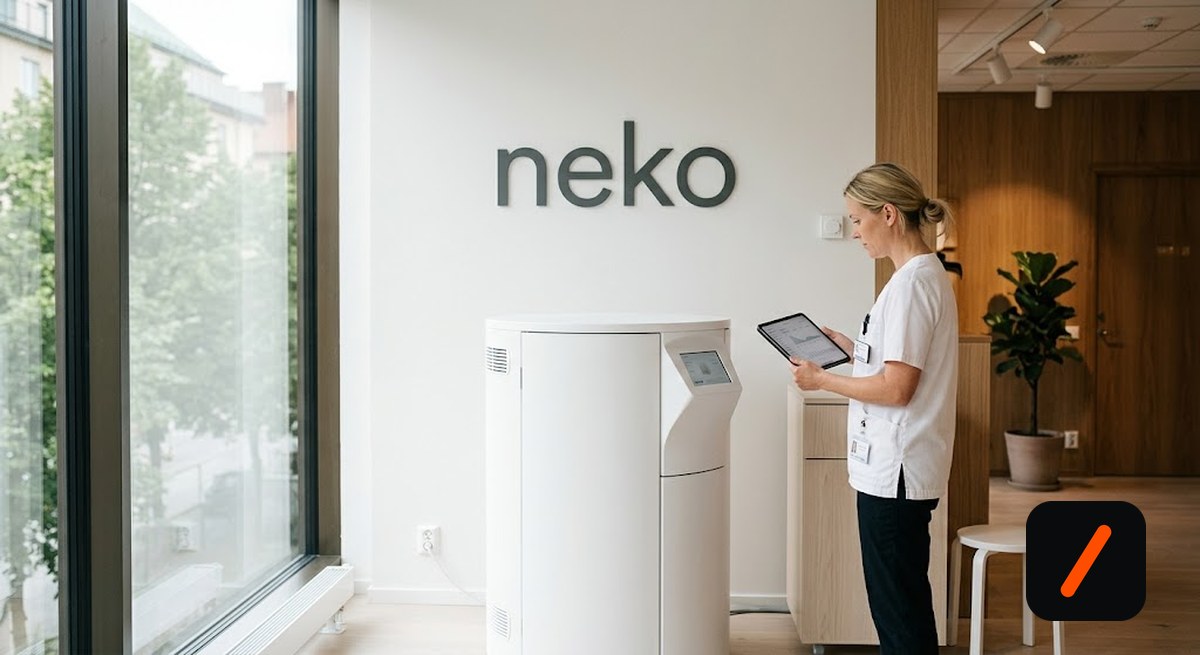
Neko Health, the Swedish preventive-health company founded by Spotify's Daniel Ek and Hjalmar Nilsonne, announced a $700 million Series C on July 15, led by Lightspeed Venture Partners and co-led by O.G. Venture Partners. The round reportedly values the company near $7 billion, roughly four times its $1.7 billion Series B mark from January 2025. That is a big step-up on a company that scans bodies for a living, and the metric that explains it is not the raise: 75% of members book and pre-pay for their next annual scan before they leave their first appointment.
- $700 million Series C led by Lightspeed, co-led by O.G. Venture Partners, with Atomico, General Catalyst and Lakestar returning and Liberty City Ventures, Positive Sum and BDT & MSD joining.
- Valuation lands near $7 billion, about 4x the $1.7B Series B from January 2025, which was itself a $260M round.
- Traction: over 100,000 people scanned, 350,000+ on the waitlist or booked, and a 75% pre-pay rate for the next annual scan at the point of first visit.
- Money goes to US expansion, with first clinics opening in New York and other cities this year. Ek and Nilsonne have not disclosed the split between expansion and R&D.
Who put money in?
Lightspeed led, O.G. Venture Partners co-led, and existing investors Atomico, General Catalyst and Lakestar all returned. New institutional names include Liberty City Ventures, Positive Sum, and BDT & MSD. David Ofer of O.G. Venture Partners joins the board, subject to regulatory approval.
RelatedSnorkel AI Hits $3.5B Valuation in $350M Series E
The individual investor list is the part that got the coverage, and it is a genuinely unusual roster: Mark Zuckerberg and Priscilla Chan, Maria Sharapova, Thierry Henry, Ari Emanuel, Claudia Schiffer and Sir Matthew Vaughn, Danny Meyer, Jimmy Iovine, Tim Ferriss and will.i.am. Zuckerberg and Chan invested as individuals rather than through Meta or a venture fund, which is worth stating plainly since the headline version of this story blurs that.
Read the roster as distribution rather than capital. Neko sells a consumer health product where the binding constraint is trust and awareness, not technology. A cap table full of people whose primary asset is public attention is a marketing strategy that happens to be structured as equity.
What is the actual business?
The Neko Health Scan is a 60-minute, non-invasive, radiation-free assessment that captures millions of health data points, priced at 299 pounds in the UK and 2,750 SEK in Sweden. In June 2026 the company added wearable integration and body composition analysis, and opened a new Stockholm clinic running next-generation devices it calls Derma-2, Echo-2 and Spectrum-2.
The differentiator against US rivals is that Neko builds its own scanning hardware. Prenuvo runs whole-body MRI, which means buying MRI machines at MRI prices and living with MRI throughput. Function Health is blood panels. Neko designing its own devices is what makes a 60-minute scan at 299 pounds possible at all, and it is also what makes the company hard to copy and expensive to scale. Vertical integration is the whole thesis.
What justifies a 4x step-up?
Three numbers. Over 100,000 people have been scanned. More than 350,000 have registered for the waitlist or booked an appointment, which is a 3.5x pipeline against everyone served to date. And 75% of members book and pre-pay for their next annual scan before leaving their first appointment.
That third number is the one to sit with. Pre-paying for a service twelve months out, at the moment you have just experienced it, is about the strongest retention signal a consumer business can produce. It converts a transactional health service into something closer to a subscription with a year of float, and it means the customer acquisition cost amortizes across multiple years rather than a single scan. For a company whose unit economics are dominated by clinic capacity, prepaid annual demand is what lets you plan hardware and staffing against a known load instead of a forecast.
The clinical claim is softer but not nothing: three in four returning members who had previously identified severe or life-threatening conditions are now in good health or have the condition under control. That is company-reported and not a controlled study, and preventive whole-body screening carries a real, contested overdiagnosis debate that this round does not settle.
RelatedWonderful's $550M Series C Doubles Valuation to $5B
| Neko Health | Prenuvo | Function Health | Superpower | |
|---|---|---|---|---|
| Total raised | $960M+ (B + C) | $192M | $298M | $30M Series A |
| Latest valuation | ~$7B | Not disclosed | $2.5B (Nov 2025) | Not disclosed |
| Modality | Own-built scanner | Whole-body MRI | Blood panels | Blood panels |
| Builds own hardware | Yes | No | No | No |
| Scan time | 60 minutes | ~60 minutes | Lab draw | Lab draw |
| Consumer price | 299 GBP / 2,750 SEK | Premium tier | Subscription | Subscription |
| Reported revenue | Not disclosed | ~$250M annual | Not disclosed | Not disclosed |
What does it mean for the valuation?
The signal for investors is that Neko is being priced as a platform while operating as a clinic chain, and those are different businesses with different gravity. Prenuvo, the closest US analogue, has roughly $250 million in annual revenue on $192 million raised. Neko has not disclosed revenue at all, and is valued near $7 billion. The gap between those two facts is the bet: that own-built hardware plus 75% prepaid retention compounds into something with software-like margins once the clinic count is high enough.
The risk is that clinics do not compound like software. Every new city is a lease, a staff, a regulatory posture and a local marketing spend, and the US expansion into New York is where the thesis gets tested against a healthcare market that is far more litigious, more insurance-mediated and more crowded than Sweden or the UK. Watch three things: whether the 75% pre-pay rate survives the transition to US consumers, whether Neko discloses revenue at the next round, and whether the FDA posture on whole-body preventive screening shifts. This is factual analysis, not investment advice. The round is tracked on our Funding Tracker.
- US clinic unit economics. New York is the test. Swedish preventive-health behavior does not automatically port to a US market where screening is insurance-mediated.
- Whether pre-pay holds at 75%. That number is the entire valuation argument. If it drops to 40% in the US, the multiple has no floor.
- Revenue disclosure. Neko has raised nearly $1B without publishing a revenue figure. At $7B, the next round will not have that option.
- Regulatory posture on whole-body screening. The overdiagnosis critique is real and unresolved, and a US regulator taking a view would reprice the entire category.
Our take
The 75% pre-pay rate is the most interesting number in this round and almost nobody led with it. Preventive health has a well-known demand problem: people intend to get screened and then do not, which is why the category has historically been a marketing business wearing a medical coat. Capturing the renewal at the moment of peak intent, before the customer walks out the door, is a genuine product insight, and it turns an annual cold-start problem into a book of prepaid demand you can plan clinics against.
The 4x step-up is harder to defend. Neko is being valued like a platform and it runs clinics, and clinics scale linearly with capital and real estate. Prenuvo doing $250 million on $192 million raised is the sober comparison, and Neko has not published revenue at all. The celebrity cap table reads as clever distribution and also as a company that knows its constraint is trust rather than technology. Both things are true. The US expansion will settle which one matters more, and New York is an unforgiving place to find out.
- OfficialNeko Health: raises $700m Series C ahead of US launch the company's own announcement, investor list and traction figures
- FundingGenZTech Funding Tracker running record of confirmed rounds
- FundingBiggest AI Funding Rounds ranked by confirmed round size
Original analysis by GenZTech. Round detail from Neko Health's press announcement. Valuation is reported rather than company-confirmed; traction figures are company-reported. Not investment advice.