
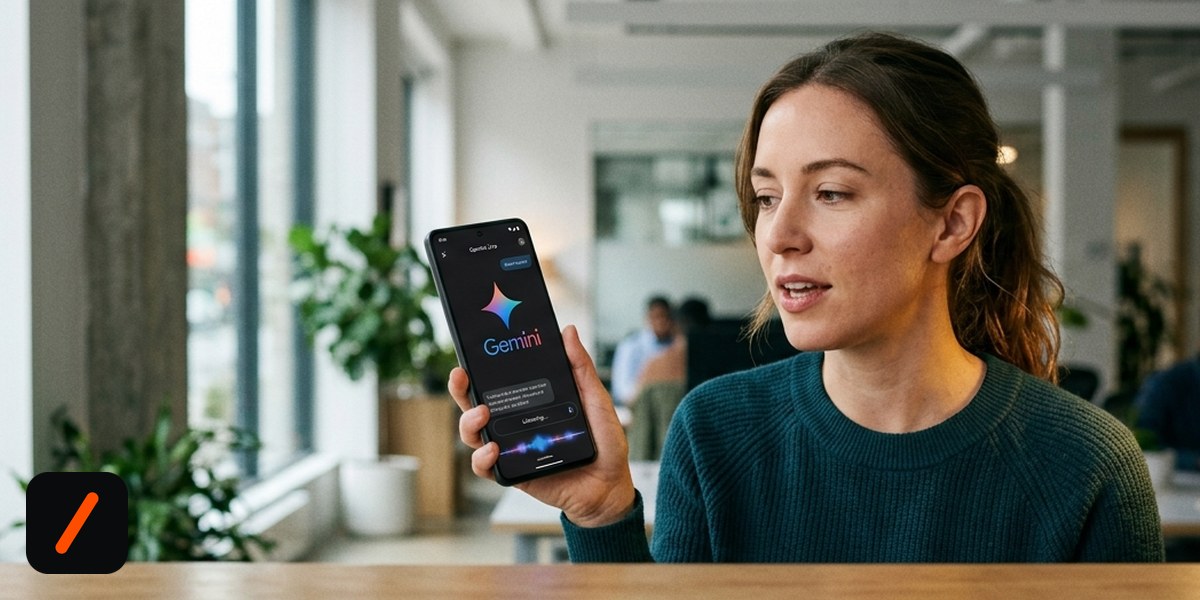
Google released two voice models on September 15, 2026: Gemini 3.8 Live and Gemini 3.8 Live Extended Thinking. The headline is a first place finish on the Artificial Analysis Speech to Speech Index, 82.6 points. That is not the interesting part. The interesting part is how Extended Thinking gets there: it talks while it thinks, quietly solving the worst habit of reasoning voice models, the dead air while the model works something out.
- Gemini 3.8 Live Extended Thinking scores 82.6 on the Artificial Analysis Speech to Speech Index, the top spot, edging OpenAI's GPT-Live-1 (Astra) at 81.5 by 1.1 points.
- Extended Thinking speaks an acknowledgement like "Let me check that..." while it reasons and runs tool calls in the background, so the conversation never stalls.
- Grok Voice Think Fast 2.0 High scores close behind at 81.3, with roughly half Google's latency: 0.70s versus 1.35s.
- Both new models support 97 languages with mid-conversation switching, live now in the Gemini API, AI Studio, Search Live and the Gemini Live app.
What did Google actually release?
Two audio-to-audio models, announced on Google's blog: Gemini 3.8 Live and Gemini 3.8 Live Extended Thinking, API model IDs gemini-3.8-live and gemini-3.8-live-extended-thinking, replacing gemini-3.1-flash-live-preview as Google's flagship Live models. Both take 16-bit PCM audio at 16kHz in, return 16-bit PCM at 24kHz out, support near real-time visual grounding at up to one frame per second (JPEG), and watermark every clip with SynthID. Developers get them today through the Gemini API and Google AI Studio. Enterprise access is a private preview inside Gemini Enterprise, with a version planned for Gemini Enterprise for Customer Experience and Google Workspace. Consumers get the standard model through Search Live and the Gemini Live app, while Extended Thinking goes to Pro and Ultra subscribers in Workspace and more broadly in Gmail and Keep. Launch partners include Agora, LangChain, LiveKit, Pipecat and Vercel, with testimonials from Salesforce, ServiceNow, Genspark and Lenskart.
RelatedGrok 4.6 Ties GPT-5.6 Sol but Loses the Terminal
How does a model talk while it's still thinking?
Every speech-to-speech model faces the same tradeoff: answer instantly and stay shallow, or pause to reason and let silence stretch out while the user wonders if the call dropped. Extended Thinking sidesteps the choice. The moment it hears a prompt that needs real work, it emits a short verbal cue, something like "Let me check that...", then reasons and calls tools in parallel with that acknowledgement. The user hears a voice respond immediately, the model keeps working behind it, and the full answer lands once the background work finishes. Both models can run tools without interrupting the exchange, but Extended Thinking is the one built to narrate its own thinking instead of leaving a gap.
How good is it, really?
On Google's own numbers, Extended Thinking posts a tau-Voice agentic task completion rate of 68.6%, a Sierra tau-Voice-banking score of 35.1%, and 97.7% on Big Bench Audio. The standard Gemini 3.8 Live, without the reasoning-while-speaking behavior, ranks second on Speech Agent Arena. The number that matters for comparison shopping is the independent one: the Artificial Analysis Speech to Speech Index, a composite of speech reasoning, agentic performance, arena preference and task success. Extended Thinking's 82.6 puts it in first place, ahead of OpenAI's GPT-Live-1 running as Astra at 81.5, and SpaceXAI's Grok Voice Think Fast 2.0 High at 81.3. Worth being precise: 1.1 points is not a blowout, it is the kind of gap a good leaderboard cycle closes in weeks, the same dynamic we track on our own coding model leaderboard.
| Gemini 3.8 Live ET | GPT-Live-1 Astra | Grok Voice TF 2.0 High | |
|---|---|---|---|
| Index score | 82.6 | 81.5 | 81.3 |
| Latency | 1.35s | 1.34s | 0.70s |
| Languages | 97 | n/a | n/a |
What does a real voice AI call actually cost?
Pricing on the Gemini API is the same for both 3.8 Live models, paid tier, per 1M tokens. Input runs $0.75 for text and $3.00 for audio, which is $0.005 per minute of audio in. Image and video input is $1.00 per 1M tokens, about $0.002 per minute. Output is pricier: $4.50 for text, $12.00 for audio, roughly $0.018 per minute, and thinking tokens bill as output too. There is a free tier for testing, and grounding with Google Search adds 5,000 free requests a month shared across the Gemini 3.x family, then $14 per 1,000 after that.
Run the arithmetic: a ten minute, two way call where the model speaks half the time costs roughly ten minutes of audio input at $0.005 plus five minutes of audio output at $0.018, about $0.14 for the audio alone, before thinking tokens or search grounding. Cheap enough to put behind a support line or a tutoring app without a finance team blinking. That is the point.
RelatedGemini 3.8 Flash Model Card Leaks Ahead of Google Launch
What does this mean for the market?
The signal for investors and operators: voice agents are turning into a commodity API priced by the minute, the way text generation did two years earlier. For Alphabet, a first place index score plus aggressive per-minute pricing is a land grab, getting developers onto gemini-3.8-live before they standardize elsewhere. For OpenAI, GPT-Live-1 Astra sitting 1.1 points behind means the gap is competitive, not decisive, and the next release cycle likely resets the order. The group with the real problem is the voice-agent middleware layer, startups wrapping a foundation model's speech API with call routing, scripts and analytics. When the model itself acknowledges prompts, runs tools in the background and holds a natural conversation, a chunk of what that middleware sold becomes a checkbox in a system prompt. Contact-center incumbents bundling compliance and CRM integration still have a moat. Thin wrappers around a single model's Live API do not.
- The next Artificial Analysis refresh. A 1.1-point lead over GPT-Live-1 Astra is thin enough that the ranking could flip within a quarter.
- Grok's latency edge. 0.70s versus Google's 1.35s is a real user-facing difference for anything that feels like a live phone call.
- Gemini Enterprise for Customer Experience. Once that ships, contact-center vendors will know exactly how much of their stack Google intends to absorb.
- Actual pricing at scale. The $0.14 per ten-minute call estimate assumes light tool use and no search grounding; real deployments will show the true blended cost.
Our take
The reasoning-while-speaking trick is the more durable idea here, not the leaderboard position. Silence has always been the tell that gives away a voice bot, the beat where a human would say "um" and the model just goes quiet because it is busy calling an API. Teaching the model to narrate that gap instead of hiding it is a small interface decision with an outsized effect on whether a voice agent feels usable on a real phone call. The benchmark score will get matched fast, given how close GPT-Live-1 and Grok Voice already are. The verbal-acknowledgement pattern is the part worth copying regardless of who leads next quarter.
- OfficialGoogle: Gemini 3.8 Live and Gemini 3.8 Live Extended Thinking launch announcement, September 15, 2026
- BenchmarkArtificial Analysis Speech to Speech Index independent leaderboard used for the model comparison
- ReferenceGemini API pricing per-token and per-minute rates for both Live models
- ReferenceGemini API models documentation model IDs and capabilities
Original analysis by GenZTech. Primary source: Google Gemini 3.8 Live announcement.