
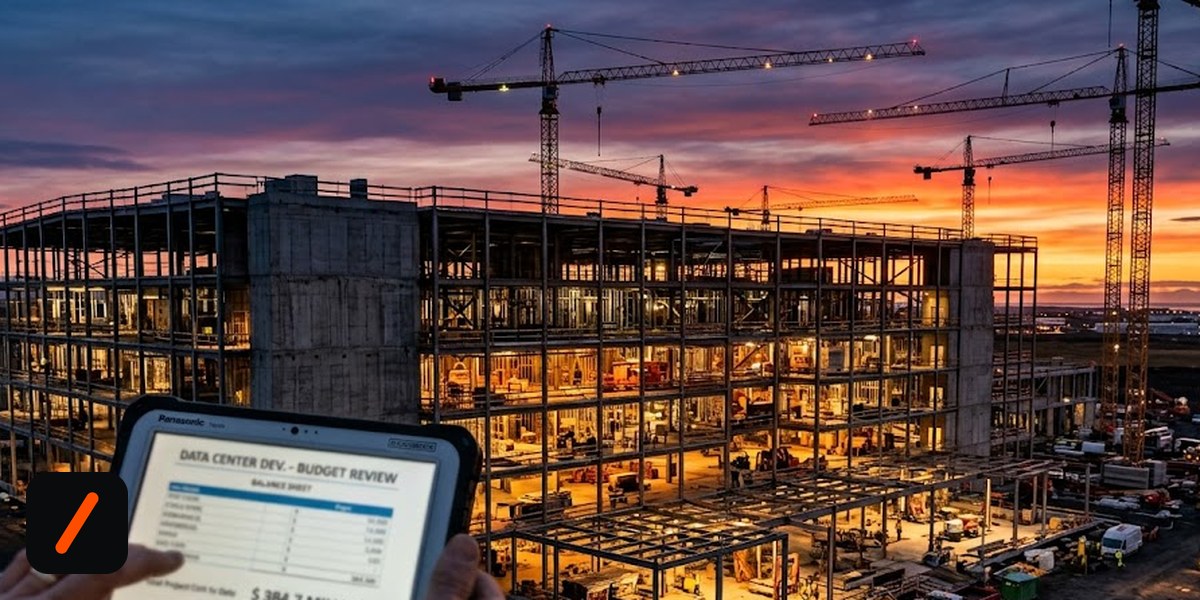
Meta's Hyperion data center in Louisiana runs through a special-purpose vehicle that raised roughly $27 billion in loans from Pimco, BlackRock, and Apollo, plus $3 billion in equity from Blue Owl, for total exposure near $46 billion. None of it shows up on Meta's own balance sheet. Meta isn't unusual. Across the five biggest AI spenders, reporting now puts off-balance-sheet AI infrastructure debt at roughly $1.65 trillion, more than the $1.35 trillion those same companies carry on their books. Outstanding AI datacenter debt overall is estimated at $500 to $750 billion, against roughly $120 billion in annual compute demand and close to 190 gigawatts of planned capacity. That gap between demand and planned supply is the number that launched the "subprime AI datacenter" comparison in the first place.
We asked people who work in datacenter finance, structured credit, and cloud capacity planning whether that comparison holds up, and where the actual risk sits if it doesn't play out the way the headline implies. Their answers converge on a real, checkable warning sign, just not the one the CDO comparison points at.
RelatedBig Tech's $1T AI lease bill isn't on the books
Does the SPV Structure Actually Resemble a 2008 CDO?
Srinivas Chippagiri, a senior technical staff member at Salesforce with fifteen years in cloud infrastructure and multi-tenant systems, says the comparison misidentifies what made 2008 dangerous in the first place. "A pre-2008 CDO was dangerous because the underlying asset could go to zero, and the tranching hid correlated risk behind a AAA label," he said. "An AI-datacenter SPV is backed by a physical asset with a real salvage floor: power interconnects, cooling, shell, and GPUs that hold residual value as long as someone wants compute. That's not subprime, the collateral doesn't vanish." That distinction matters more than it sounds like it should. A defaulted subprime mortgage on a house nobody wants to buy is a very different asset than a defaulted loan against a data center that a dozen other hyperscalers would still want to lease.
Where Chippagiri says the analogy does bite is in a place the tranching debate skips past entirely. "Where the analogy does bite is the same place it bit in 2008, which is the quality of the revenue underwriting," he said. "If the debt is sized against take-or-pay contracts from a single hyperscaler, or against a demand curve that assumes today's training intensity holds for a decade, then you've re-created the real 2008 problem, which was never the tranching. It was correlated, over-optimistic assumptions about the cash flow underneath. SPVs and off-balance-sheet treatment aren't the risk. The risk is what utilization assumption the whole stack is priced on." Meta's Hyperion deal is underwritten against a single, enormous, long-duration bet on Meta's own future compute needs. Whether that counts as diversified revenue or concentrated exposure to one company's forecast is exactly the question Chippagiri says the CDO framing obscures.
Is the Demand-Versus-Capacity Gap as Bad as the Headline Number?
The $120 billion-against-190-gigawatts figure treats the AI buildout as one undifferentiated pool, and Chippagiri says that's where the number stops being useful. "The mismatch is real but it's not uniform, and that's the part the headline number flattens," he said. "'Planned' includes a large tail of announced-but-unfinanced projects that will never energize, gated by grid interconnection queues and power delivery. What I actually see is a bifurcation: contracted, high-utilization capacity tied to real inference and training workloads that is genuinely tight, sitting next to speculative buildout chasing the same scarce power. The former is not overbuilt. The latter is where the air is." That reframes the risk from a single systemic overbuild into two separate markets wearing the same "AI datacenter" label, one of which is running close to capacity and one of which may never get built at all.
Who Actually Absorbs the Loss If Utilization Falls Short?
Chippagiri's answer is structural, and it's the whole reason SPVs exist in this market in the first place. "It flows to whoever holds the demand risk, and that is deliberately not the hyperscalers in most of these structures, and that's the whole point of moving it into an SPV," he said. "The hyperscaler signs the offtake or walks; its exposure is capped at the contract. If utilization disappoints, they don't get a 2008-style cliff, they get the slower version: impaired returns and stranded assets on a fifteen-year horizon. That's a real risk. It just isn't a subprime one, and calling it subprime makes people watch for the wrong failure mode."
Dr. Matt Hasan, an economist and AI strategist with four decades advising on technology and capital investment decisions, agrees the risk has been distributed rather than eliminated, and traces where it actually lands. "SPVs don't concern me nearly as much as the assumptions underpinning them," he said. "If projected AI demand falls materially below expectations, leverage simply amplifies the consequences of optimistic forecasts. The biggest question isn't who financed the assets. It's whether the industry is collectively overestimating future utilization." His list of who feels it is longer than "the lender." "If utilization disappoints, the pain won't stop with hyperscalers," he said. "It will flow through the entire capital stack, including infrastructure funds, private credit, pension capital, insurers, and equipment financing partners."
RelatedMicrosoft and Oracle Are Betting the House on AI Data Centers
Abdelali El Khadmaoui, founder and chief research analyst at TMS AI Wealth Intelligence, points at exactly the link in that chain that's already showing strain, and it's a claim we could check rather than take on faith. "The greater concern is liquidity. Private credit exposure to AI infrastructure has expanded rapidly, while many semi-liquid funds offer periodic redemptions despite holding long-duration, illiquid loans," he said. "In research published through the Private Credit Redemption Monitor at TMS AI Wealth Intelligence, we've observed several flagship private credit funds reaching their redemption caps despite relatively stable market conditions. If market sentiment deteriorates, redemption pressure could become a more immediate risk than borrower defaults." That's not a hypothetical: mega-cap private credit funds took in roughly $20.8 billion in redemption requests in the first quarter of 2026 alone, and as of early July several major credit interval funds, including vehicles run by Blue Owl and Cliffwater, were still holding redemption limits in place. El Khadmaoui's warning isn't waiting on a downturn to prove itself. The redemption pressure he's describing is already on the books.
- $1.65 trillion. Off-balance-sheet AI infrastructure debt across the five largest AI spenders, more than the $1.35 trillion they carry on-balance-sheet.
- ~$46 billion. Total exposure on Meta's Hyperion SPV alone, $27B in loans plus $3B in equity, none of it on Meta's own balance sheet.
- $500 to $750 billion. Estimated total outstanding AI datacenter debt, against roughly $120 billion in annual compute demand.
- $20.8 billion. Redemption requests at mega-cap private credit funds in Q1 2026 alone, the strain El Khadmaoui flagged before it became a headline number.
Our Take
Every source we asked pushed back on "subprime" as the operative word, and their reasoning holds up: the collateral behind these SPVs is real, salvageable infrastructure, not a house nobody wants, and the loss, if it comes, is structured to land as slow-bleed impairment rather than a 2008-style cliff at the hyperscalers who benefit from the buildout. But agreeing the label is wrong isn't the same as agreeing there's no risk. Chippagiri's revenue-underwriting question, Hasan's utilization-overestimation question, and El Khadmaoui's liquidity question are three ways of asking the same thing: not whether the debt is dangerous in the way 2008 was, but whether anyone financing this buildout actually tested the demand assumption it's priced on. The redemption caps El Khadmaoui pointed to are the first place that test is already failing, quietly, in funds most people financing this boom aren't watching closely enough.
- ReferenceOracle, Meta, xAI, CoreWeave move $120B of AI debt off books using Wall Street SPVs — on the scale of off-balance-sheet AI infrastructure financing.
- ReferenceAlternatives Watch: Private credit's growing pains continue — on redemption limits at major private credit interval funds.
- BackgroundGENZ TECH's Funding Tracker — ongoing tracking of AI infrastructure and compute funding rounds.
Quotes gathered directly by GENZ TECH from sources who volunteered to comment on this story, with full attribution as agreed with each. Figures current as of late July 2026.