
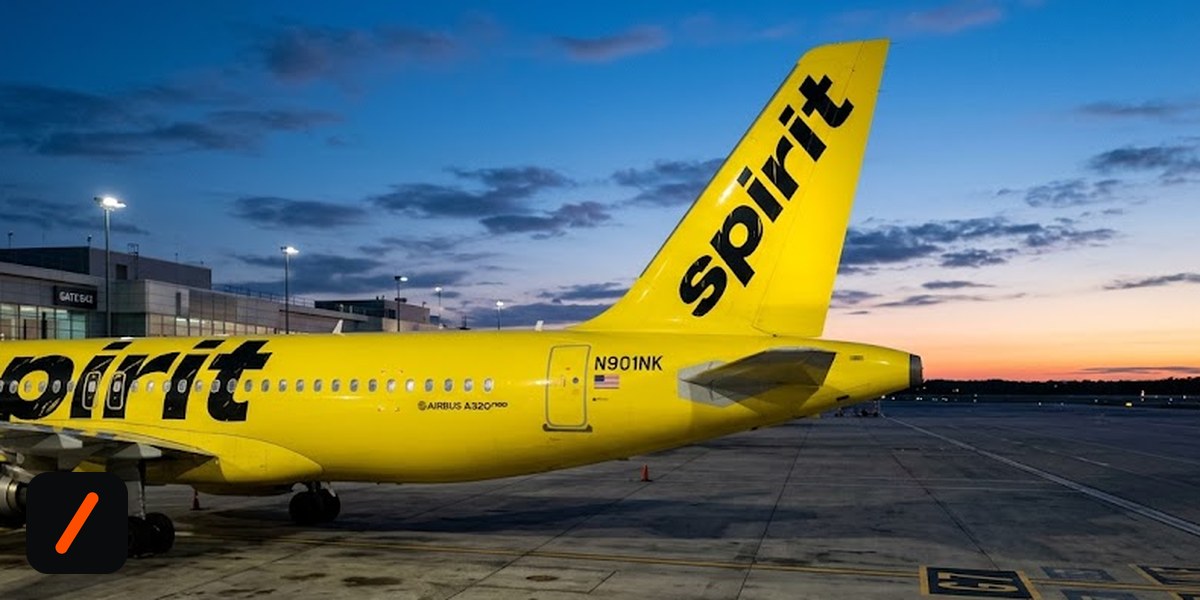
A dead airline just became a data vendor. Spirit Airlines went through Chapter 11, and a bankruptcy court auctioned off its digital filing cabinet: roughly 100 million emails, about 500 million Teams chats, spreadsheets, HR files, financial records. Google won it for $10 million.
- Google agreed to pay $10 million in a bankruptcy auction for Spirit Airlines' internal business data, first reported by Axios on August 17 and confirmed by CNN Business, The Register and Bloomberg Law.
- The corpus covers about 100 million emails and about 500 million Microsoft Teams chats, plus calendars, spreadsheets, marketing materials, HR records, project documents, audits and presentations.
- Excluded: the roughly 97.5 million passenger profiles Spirit kept and the 50.2 million records from its Free Spirit loyalty program. That data stays out of the sale.
- A federal judge still has to approve it. If the deal collapses, the next bidder was Mercor, an AI hiring platform, at $7.5 million.
What exactly did Google buy?
Not a curated dataset. It's the ordinary internal output of running an airline for years: emails between departments, Teams threads about scheduling and vendors, spreadsheets, HR paperwork, financial audits, marketing decks. Nobody wrote any of it thinking a search company would eventually own it. Run the arithmetic and the number gets small fast. Ten million dollars across roughly 100 million emails plus 500 million Teams chats works out to about 1.7 cents per document, or roughly $10 per 600 records. Spreadsheets and presentations don't map onto that math cleanly, so call it a rough estimate. Still, it was priced as bulk exhaust, not a premium dataset licensed line by line.
RelatedSalesforce Global Outage Disrupts Amazon, Walmart, Toyota
Is deidentified the same as anonymous?
Google agreed the data will be deidentified, and agreed not to try to re-identify anyone in it. That's a meaningful commitment for the passenger and loyalty records, structured tables where a name sits in a labeled field you can strip cleanly. Those records, notably, aren't even part of this sale. The harder case is what is being sold. Emails and chats are free text. A name doesn't live in a "name" column, it lives in "hey Sarah, can you resend the Q3 numbers," in the sign-off, in the CC line. Stripping that out of 600 million messages without gutting the content is a much harder problem than deidentifying a passenger table, and it gets far less scrutiny than the part everyone already understands.
The bankruptcy loophole nobody priced in
Here's the mechanism most coverage skipped past. A company's internal communications were never collected with resale in mind. Bankruptcy changes the legal frame entirely: a trustee's job is to maximize value for creditors out of whatever the estate owns, and an airline's inbox counts as an asset the same way its aircraft leases do. No employee at Spirit consented to their Teams messages becoming AI training material, because that question never came up in the normal course of business. It came up only because the company failed, and failure routes the data through insolvency court instead of any negotiation with the people who wrote it. That's a legal channel, not a privacy channel, and a genuinely new way to acquire a corpus that could never have been licensed directly.
Who actually gets touched by this
The immediate group is thousands of former Spirit employees whose day-to-day correspondence is now headed into a commercial AI system. None of them were customers in the way that triggers a privacy policy about passenger data. They were people doing their jobs on a company email account, the category of data with the weakest protection here. The wider group is everyone else. This deal sets a template: if your employer goes bankrupt, its internal chat logs and email archive become an auctionable estate asset, with no separate opt-out for the people who wrote them. That's a property of Chapter 11 itself, and this is just the first time it's played out at this scale with an AI buyer on the other end.
What it means for the market
The signal isn't that Google bought data, it's the price. Alphabet (GOOGL) can afford essentially any licensing deal it wants, and it chose a bankruptcy auction over a negotiated content-licensing agreement, the kind that runs into much larger sums once a publisher sits across the table with leverage. Ten million dollars for hundreds of millions of records only works because a bankruptcy estate has none. It wasn't a fluke price either: Mercor, an AI hiring platform, bid $7.5 million for the same corpus, meaning two AI-adjacent buyers independently valued it. The signal for investors is whether this becomes a repeatable pattern, since every company that fails from here on is a potential seller of exactly this kind of corpus.
RelatedCloudflare Cuts DNS Cache Memory 56%, Frees 100TB Fleet-Wide
What happens next
The deal isn't final. A federal bankruptcy judge has to approve the sale, and that's a real gate, not a formality baked into the price already. If the judge rejects it, Mercor's $7.5 million bid becomes the fallback, putting the corpus with a hiring platform instead of an AI giant. Watch the approval hearing, and whether the deidentification process gets any independent scrutiny before the data changes hands.
| Bankruptcy auction | Publisher licensing | Web scraping | Platform UGC | |
|---|---|---|---|---|
| Consent | None, runs through insolvency law | Negotiated with the rights holder | None, pulled from the open web | Buried in the terms of service |
| Legal exposure | Low, judge-cleared | Low, contract-backed | High, active lawsuits | Medium, depends on ToS wording |
| Data quality | High, real correspondence | High, edited and checked | Mixed, noisy | Mixed, informal |
| Price signal | $10M, set at auction | Negotiated, usually confidential | Effectively free | Bundled into platform ownership |
| Who gets asked | Nobody who wrote it | The publisher, not the writer | Nobody | Users, once, years earlier |
- The approval hearing. A rejection hands the corpus to Mercor at $7.5 million instead of Google.
- How deidentification actually gets done. Structured passenger data is easy to strip. Free-text messages are not, and no method has been published.
- Other AI labs showing up at bankruptcy auctions. Mercor's competing bid means this wasn't a one-buyer market.
- Alphabet's (GOOGL) data-acquisition pattern. Buying an estate's records is a cheaper channel than licensing content from a willing publisher.
Our take
The passenger exclusion is real and it matters. Spirit's customers are not having their travel history handed to Google. But the privacy story here was never really about passengers, it's about the roughly 100 million emails and 500 million chat messages that ordinary employees wrote without imagining they'd end up as training material. A structured database is comparatively easy to scrub. A decade of internal conversation is not, and "deidentified" is doing a lot of quiet work in that sentence. What bothers us more is the channel this confirms is open: bankruptcy court, not a licensing negotiation, is now a viable route to a business's internal correspondence. Spirit is the first case at this scale. It won't be the last.
- ReportingGoogle wins bankruptcy auction for Spirit Airlines data, Axios , first report
- ReportingCNN Business: Google buys Spirit Airlines' business data , confirms deal terms
- LegalBloomberg Law: Google aims to boost AI with purchase of Spirit Airlines data , bankruptcy process context
- CoverageThe Register: Google buys crashed airline Spirit's data at auction, because AI , auction detail
Original analysis by GenZTech. Source: Axios