
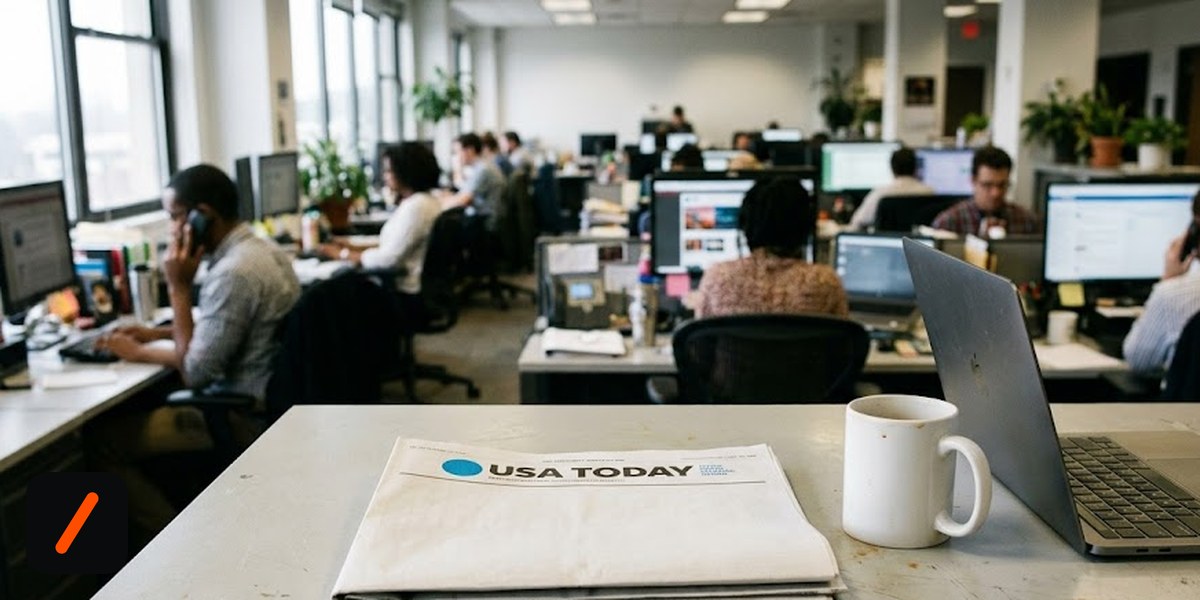
USA Today Co., the largest newspaper chain in the United States, told investors on Thursday morning's second quarter earnings call that it has hired Palantir to analyze the data it collects from its readers. Chairman and CEO Mike Reed framed it as a monetization play: link first party data across the company's titles, turn anonymous visitors into identified accounts, then decide in real time which ad, which subscription price and which affiliate link each reader is most likely to convert on. The reason it is happening now sat a few slides earlier in the same deck. Average monthly unique visitors dropped from 180 million in the first quarter to 158 million in the second.
- Reed announced the Palantir partnership on the Q2 2026 call held Thursday, August 6. Neither the contract value nor its length was disclosed.
- Average monthly uniques fell 22 million in one quarter, and are down 29 million from the 187 million the company reported a year ago when it still traded as Gannett.
- Digital advertising revenue fell 9.2% quarter over quarter to $79.8 million. CFO Trisha Gosser attributed roughly a third of that decline to search.
- The company holds 1,442,000 paid digital subscribers, 16% fewer than a year ago, but has pushed average revenue per user up 34.4% to $10.47.
What exactly did USA Today Co. sign?
Very little of the contract is public. No value, no term, no named Palantir product. What Reed described is a data unification and prediction layer sitting on top of everything the company already collects across USA TODAY, the Arizona Republic, the Detroit Free Press and the rest of the roughly 200 US titles, plus Newsquest in the UK. Spokesperson Lark-Marie Anton called it "a unified intelligence layer" meant to "drive growth across subscriptions, advertising, and e-commerce."
RelatedYouTube Doubles Watch-Hour Bar for New Partner Creators
The buy-versus-build logic is the honest part of the pitch. "What may take us a considerable amount of time to build internally, we can do in a matter of weeks or months with Palantir," Reed told investors, in remarks reported by Poynter. That is a company with shrinking revenue choosing not to staff a data platform team, which is a rational call and also a lasting dependency.
Reed was careful on ownership: "All of our data remains our data. It's our data. The actions and the intelligence that we utilize takes place on our platform." Worth noting what that sentence does and does not promise. It addresses who owns the records. It says nothing about what gets inferred from them, how long the inferences live, or who inside a newsroom can see a reader's predicted willingness to pay.
Why does a newspaper chain need Palantir at all?
Because the traffic that used to arrive for free is gone, and the money that replaced it is smaller and harder to earn. Gosser told analysts the 9.2% quarterly drop in digital advertising came from three roughly equal causes: search, the loss of a programmatic partner, and a platform policy change that hit a sponsored link partner. Only one of those is a normal business setback. The search line is structural.
| Metric | Q2 2026 | Direction |
|---|---|---|
| Total revenue | $536.3M | down 8.3% year over year |
| Net income | $9.1M | positive, second straight quarter |
| Digital advertising | $79.8M | down 9.2% from $87.9M in Q1 |
| Digital-only subscriptions | $45.6M | up 6.8% year over year |
| Paid digital subscribers | 1,442,000 | down 16% year over year |
| ARPU | $10.47 | up 34.4% |
| Avg monthly uniques | 158M | down from 180M in Q1 |
Read the subscription rows together and the strategy is already visible without any AI. Fewer subscribers, each paying substantially more. That is what a company does when it has decided it cannot win volume back, so it charges the remaining loyalists closer to what they are individually worth. Palantir's job is to work out what each of those numbers should be, per reader, per session.
What does a "unified intelligence layer" actually do?
Strip the phrasing and it is an identity graph feeding a decision engine. Every signal a visitor leaves, articles read, device, referral source, newsletter opens, past purchases, gets stitched to one profile. The system then predicts three things at request time: which ad will earn the most, what subscription price this person would accept, and which commerce link they would click. Reed also said the partnership automates affiliate link matching that staff previously did by hand, which is the least glamorous and probably most immediately profitable piece of it.
Who should be uneasy about this?
Readers first, and not for the reason people usually reach for. Dynamic subscription pricing means two people can see different prices for the same journalism based on a model's guess about their wallet and their attachment to a local paper. That is legal, common in travel and retail, and genuinely uncomfortable when the product is the local record of a city council meeting.
The vendor matters too, whether or not it should. Palantir holds a $30 million no-bid contract with ICE for a deportation prioritization system, along with Department of Defense work, and its co-founder and chairman Peter Thiel secretly funded the lawsuit that destroyed Gawker. None of that is evidence about how a media analytics deployment will behave. It is, however, the exact context a newsroom's own reporters will be asked about, and the company has not said which internal walls separate audience prediction from editorial decisions.
RelatedGoogle Paid $10M for Spirit Airlines' Emails and Chats
- Q3 2025187 million average monthly uniques reported as Gannett
- Q1 2026180 million uniques, digital ads at $87.9M the slide before the drop
- Aug 6, 2026Q2 results and the Palantir partnership 158M uniques, $536.3M revenue
- 9 to 15 monthsReed's stated window for a Google content deal "definitely there's a line of sight there"
What it means for the market
For Palantir (PLTR), the interesting part is not the size of this contract, which is likely small next to its government book. It is the reference customer. Consumer media is a new logo type, and every publisher watching its search referrals evaporate now has a name to call. Watch whether a second and third newspaper group sign in the next two quarters; one deal is a pilot, three is a vertical.
For USA Today Co. itself, the signal for investors is the gap between the two halves of this quarter. Costs are down about 8% year over year, free cash flow is around $20 million and rising, and net income has been positive two quarters running. That is a functioning turnaround on the expense side. The revenue side is still falling 8.3% a year, and no amount of yield optimization fixes an audience shrinking by 22 million people a quarter. The Palantir layer raises revenue per reader. It does not produce readers.
- The Google talks. Reed put a 9 to 15 month window on a licensing deal. That number, not the Palantir one, decides whether the traffic loss gets paid for.
- Price discrimination showing up. If two readers start seeing different subscription offers for the same title, the model is live and someone will screenshot it.
- An editorial firewall statement. The company has not published one. Its absence will be the story the first time a reporter covers Palantir.
- The uniques line in Q3. Another double digit drop makes 2026 the year the chain stopped being a mass audience business.
Our take
This is what the end of the search referral era looks like in practice, and it is less dramatic than the arguments about it. A publisher that lost 29 million monthly visitors in a year is not going to win them back by writing better headlines. So it stops chasing reach and starts extracting more from the people who still show up, which requires knowing those people far more precisely than it currently does. Hiring Palantir is the shortest path to that, and it is also an admission that the audience is now a resource to be mined rather than a public to be grown.
The uncomfortable part is not the software. It is that the incentive now points at knowing the reader better than the reader knows the newsroom. A local paper that can predict your maximum acceptable price has learned something about you that it will never publish, and it learned it from your reading.
- OfficialUSA TODAY Co. announces second quarter results — the August 6 earnings release
- OfficialUSA TODAY Co. investor relations — filings and call materials
- ReportPoynter: the Palantir partnership — Reed's remarks from the call
- ReportNieman Lab: the search traffic context — audience decline alongside the deal
Original analysis by GenZTech. Earnings call remarks first reported by Poynter.