
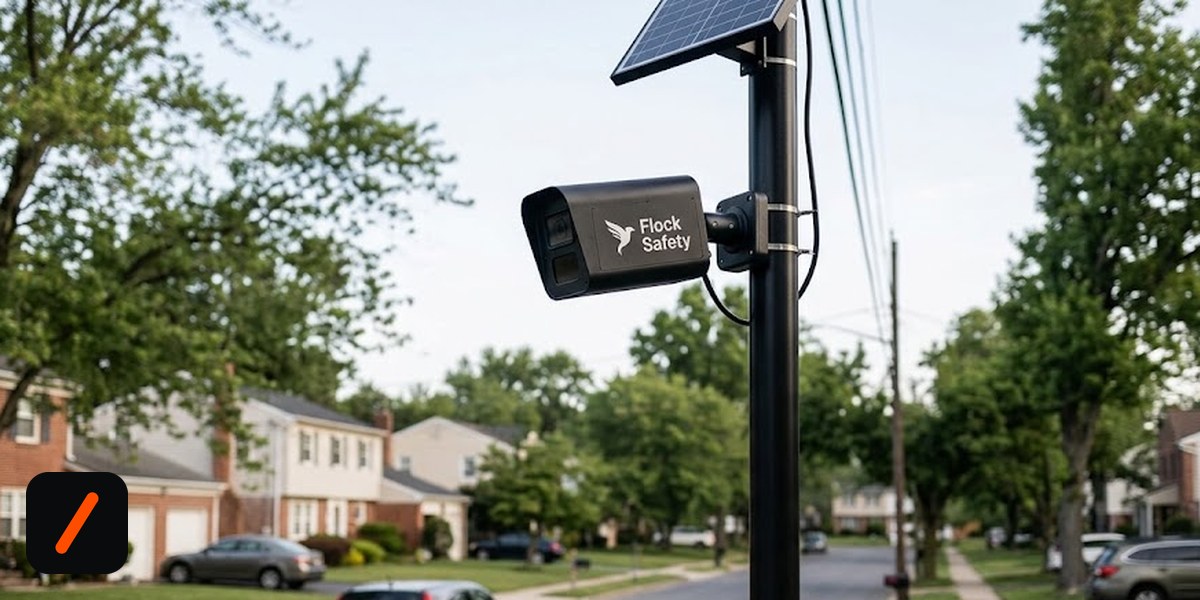
At least seven state fusion centers and FBI headquarters have been tracking the Instagram and TikTok accounts of people organizing against Flock Safety's license plate cameras, according to law enforcement bulletins published this morning by 404 Media. The documents were obtained through public records requests, carry a "Law Enforcement Sensitive" marking, name specific accounts, tally how many cities had signed up for a national protest week, and instruct officers to increase patrols around the cameras. That protest week began today.
- Bulletins came from the Colorado Information Analysis Center, the Wisconsin Statewide Intelligence Center, three Florida fusion centers, the New Jersey State Police, the New Mexico All Source Intelligence Center, and FBI headquarters.
- Instagram accounts including "Nomark.Project" and "Thepatrioticgoy" were named directly in the documents.
- One Wisconsin bulletin told officers to increase patrols around license plate readers during the protest week and to report all ALPR vandalism, disruption, or sabotage.
- The DeFlock National Week of Action runs August 16 to 22, with more than 400 events registered across nearly every state as of August 13.
What do the bulletins actually say?
The through-line across the documents is property damage. Analysts flag what one bulletin calls "extensive and ongoing chatter on social media" about methods to physically destroy Flock cameras, and they build a case around a handful of concrete incidents: seven instances of camera damage documented in Florida, and a June 25 traffic stop in which officers recovered a device described as something that could be used to identify the locations of Flock cameras.
RelatedRFC 10023 puts a for-sale sign in your domain’s DNS
Around that core, the bulletins do something broader. They list 11 Florida cities that had signed up for the week of action. They name individual social accounts. They pull screenshots and engagement counts from posts that are, by definition, already visible to anyone with the app installed. A reader of these documents learns roughly as much about who is organizing a city council appearance as about who is cutting down a pole.
That mix is the whole story. Vandalism against a camera network is a real thing for police to track. The bulletins do not stop there, and nothing in the documents draws a line between the two.
Why does monitoring public posts still matter?
The reflexive answer is that a public post carries no expectation of privacy, so reading one costs nothing. Legally that is close to right, and it is exactly why this kind of collection sits outside most oversight: no warrant, no judge, no notice to the person whose account got written into a federal-facing intelligence product.
The practical answer is different. Fusion centers were built after 2001 to move terrorism-related tips between agencies, and their output lands in front of patrol officers as a threat picture. When an account that posts about open records requests appears inside that product alongside a device seizure and seven acts of vandalism, the framing does work that the underlying facts do not. An officer skimming a bulletin is not being asked to distinguish an organizer from a saboteur. They are being handed both under one heading.
There is also a chilling-effect question that does not require anyone to break a law. Learning that your handle sits in a document marked Law Enforcement Sensitive is, for most people, a reason to post less.
Where do the bulletins and the organizers part ways?
DeFlock's creator says the project has never called for disabling cameras or covering license plates. The project is a crowdsourced map showing where ALPR cameras are installed, which is a transparency argument, not a sabotage manual. The gap between the two descriptions is wide enough to matter.
| As described in the bulletins | As described by organizers | |
|---|---|---|
| Core activity | Chatter about destroying cameras | Info sessions, council meetings, records requests |
| The map | A locating tool, tied to a seized device | A transparency project showing camera placement |
| Stated goal | Disruption of ALPR infrastructure | Cameras removed through local political process |
| Evidence cited | 7 damage incidents, 1 traffic stop, social posts | 400+ registered events, roughly 22,000 participants |
| Police directive | Increase patrols, report sabotage | None sought |
Ed Vogel, a DeFlock member, put the scale of the week plainly: "Even if one person stands on a corner with a sign, that's an event." Reported plans include community information sessions, city council attendance, open records requests, and a North Carolina event billed as "Popsicles for Privacy." None of that is what a threat bulletin is designed to describe.
How did the backlash get this big?
Flock spent several years installing cameras through city contracts that rarely drew a public fight. The reversal has been quick, and it has been driven less by privacy abstractions than by specific documented misuse: stalking cases, and data sharing with federal immigration enforcement.
RelatedEU Kids Act: No Social Media Under 13, No Accounts Under 15
- Feb 2026Reports of Americans physically destroying Flock cameras the first sign the backlash had left the council chamber
- Summer 2026Fusion centers circulate ALPR bulletins to local agencies the documents published today
- Aug 6, 2026Cities begin swapping Flock contracts for rival vendors procurement starts moving
- Aug 10, 2026Camera damage reported across 23 states no longer a regional story
- Aug 13, 2026Flock announces platform changes amid the backlash the company responds publicly
- Aug 16-22National Week of Action against ALPRs 400+ events, the week the bulletins anticipated
Who should be paying attention this week?
Anyone who has posted about ALPRs under their own handle has the most direct interest, and the practical takeaway is unglamorous: assume a public account is read as a public account, by more parties than the follower count suggests.
City officials are the second group. Most Flock deployments were approved as routine procurement, and the councils that approved them are now the venue where the week of action is aimed. A council member who signed a contract in 2023 is about to field questions about a surveillance program they may have understood as a camera purchase.
Flock itself is the third. The company is privately held, so there is no ticker to watch, but the signal for anyone tracking the sector is contract churn rather than sentiment. Cities have already begun moving deals to rival vendors, and the August 13 platform changes read as a company responding to renewal risk. Watch which contracts get renewed this autumn, not which hashtags trend this week.
- More records requests. These bulletins surfaced through public records law, and the week of action explicitly trains people to file them. Expect more documents, from more states.
- A named-account challenge. Individuals identified in the bulletins now have documentary evidence they were listed. That is the kind of record that supports a civil liberties complaint.
- Contract renewals as the real scoreboard. Council votes this autumn will say more about Flock's position than any protest turnout figure.
- Fusion center guidance. Whether any of the seven centers revises how it distinguishes organizing from sabotage will indicate if this coverage landed internally.
Our take
The defensible part of these bulletins is small and real. Cameras are being cut down in nearly two dozen states, and telling officers about it is ordinary police work. The indefensible part is the packaging. Once you place an Instagram handle that promotes a city council meeting inside the same document as a device seizure, you have built a threat product that cannot tell the difference, and you have handed it to people making split-second decisions on a street corner.
What makes this worth reading closely is that it inverts the usual surveillance argument. The debate over Flock has been about cameras watching drivers. These documents show the same apparatus turning to watch the people objecting to the cameras, using nothing more exotic than a public Instagram feed. That is not a technical escalation. It is a much older pattern, running on cheaper infrastructure.
- Records404 Media: The Government Is Monitoring Anti-Flock TikTok and Instagram Accounts the bulletins, obtained via public records requests
- OrganizersAtlanta Press Collective: Organizers launch week of action against ALPRs event counts and organizer quotes
- CompanyWashington Post: Flock announces changes amid backlash the August 13 platform changes
- ContextGenZTech: Cities swap Flock ALPR contracts for Axon cameras our earlier reporting on procurement churn
Original analysis by GenZTech, built from law enforcement bulletins released under public records law and reporting published by 404 Media on August 16, 2026.