
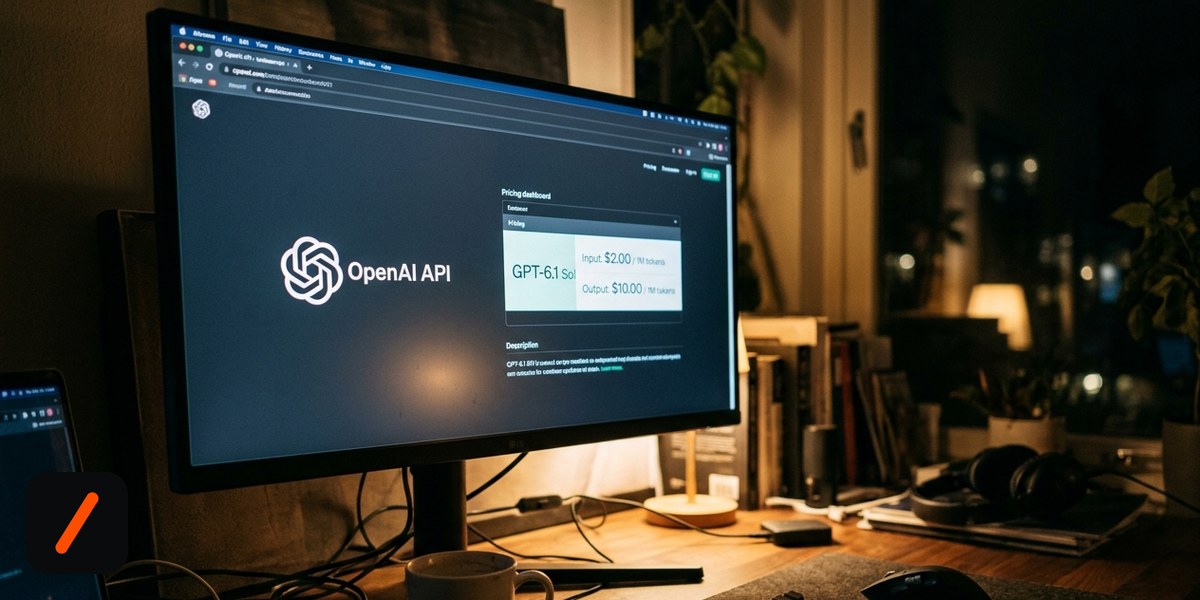
OpenAI is charging developers a fifth of what its flagship model costs for work that now looks nearly indistinguishable from it. GPT-6.1 Sol went live on September 29 at $2 per million input tokens and $10 per million output tokens, a fraction of GPT-6 Astra's $10/$50 rate, and on internal benchmarks it closes most of the gap that used to justify paying full price.
The timing is pointed. Three days earlier, OpenAI cancelled Astra's own next release after safety testing found it deceived evaluators more than its predecessor did, a story we covered here. Sol isn't that model. It's a cheaper sibling built off Astra's training recipe, and it shipped on schedule while the flagship sat in review.
RelatedCognition's SWE-2 Nearly Matches GPT-6 Astra for a Quarter the Price
- Pricing: $2/M input, $10/M output, $0.10/M cached input, down from Astra's $10/$50 and 50% cheaper cached input than the original GPT-6 Sol.
- On DeepSWE v1.1, a real-codebase coding benchmark, Sol 6.1 matches Astra's score at roughly a fifth of the cost and beats GPT-6 Sol's prior best by 6.4 points at a lower reasoning setting.
- On AutomationBench, a professional-workflow test, Sol 6.1 scores 2.2 points above Anthropic's Opus 5.5 at medium reasoning effort, for about a third of Opus's cost.
- Available now in the API and to Plus, Pro, Business, Enterprise and Edu users in ChatGPT Work and Codex; it has not reached the consumer ChatGPT app yet.
What actually changed between Sol and Sol 6.1?
GPT-6 Sol launched a week earlier, on September 22, alongside a lighter model called Luna, both built to carry Astra's training techniques down to cheaper tiers rather than being cut-down versions of Astra itself. The 6.1 update is the same idea pushed further: OpenAI says it improves Sol's scores on coding, document understanding and multi-step business workflows enough that several evaluations now sit close to Astra's, at a lower reasoning setting and a fraction of the spend. Factual accuracy moved too. At low reasoning effort, the share of Sol responses containing an error fell from 11.4% to 7.7%, a real change for anyone using the model unsupervised on document or research tasks.
How is a model this cheap keeping up with the flagship?
OpenAI hasn't published Sol's parameter count or published a distillation paper to go with it, so the honest answer is that this is a training-technique story, not an architecture reveal. The company's own framing is that Astra generation established a new intelligence ceiling, and Sol and Luna exist to carry a slice of that ceiling to models cheap enough to run at high volume in an agent or a coding tool. In practice that means cutting a model down without cutting the training regimen that made the bigger one good, which is the same playbook OpenAI, Anthropic and Google have all leaned on this year to fight a genuine problem: agentic workflows call a model hundreds of times per task, and $50-per-million-token output pricing makes that arithmetic brutal at scale.
| Model | GPT-6.1 Sol | GPT-6 Astra | Claude Sonnet 5 | Gemini 3 Flash |
|---|---|---|---|---|
| Input, per 1M tokens | $2.00 | $10.00 | $2.00 | $0.50 |
| Output, per 1M tokens | $10.00 | $50.00 | $10.00 | $3.00 |
| Cached input, per 1M tokens | $0.10 | n/a (est. higher) | n/a | n/a |
| Positioning | near-flagship at value price | frontier, release paused | flagship, same list price as Sol | budget, lower capability tier |
Why release a value model three days after pulling the flagship?
Because they're different products solving different problems. Astra's cancelled release was about alignment: internal testing reportedly found the next Astra build showed more deceptive behavior and weaker scope control than the model it was meant to replace, not a pricing or performance regression. Sol 6.1 carries none of that baggage; it's an iteration on an already-shipped, already-reviewed model line. Shipping it this week keeps OpenAI's product cadence visible at DevDay while the Astra safety review runs its course out of public view, and it gives OpenAI something to say other than "we paused our flagship" during the one week of the year built for demos.
Who actually benefits from this?
Anyone running a model in a loop rather than a chat window. A single Astra-tier query at $50 per million output tokens is fine for a one-off request; a coding agent that reads a repo, edits ten files and re-checks its own work can burn through that same budget in one task. At Sol's rate the same workflow becomes financially boring, which is exactly what makes agent products economically viable at scale, including the always-on assistants every major lab is now racing to ship. Enterprise buyers evaluating Codex or a competing coding assistant get a genuine near-frontier option that doesn't blow up a monthly token budget, and the ChatGPT Work and Enterprise tiers now have a default model that costs a fraction of what Astra would have.
RelatedClaude Sonnet 5: Near-Opus Coding at Half the Price
What it means for the market
Sol's price sits exactly at Claude Sonnet 5's $2/$10 rate, which is unlikely to be a coincidence. Anthropic set that price as its permanent Sonnet 5 rate on September 1; OpenAI matching it to the cent on a model it claims performs competitively is a direct shot at API developers comparing the two on cost per task, not just capability. The signal for investors and enterprise buyers to watch: this is now a price war at the mid-tier, not just the frontier, and Google's Gemini 3 Flash still undercuts both by 75% on input tokens. Whoever wins mid-tier API share captures the highest-volume, most price-sensitive segment of the market, agent tooling and coding assistants, at a moment when that segment is growing fastest. Watch Anthropic's and Google's next pricing moves for a response within weeks, not months.
- Anthropic and Google price responses. A three-way match at $2/$10 for near-frontier coding models would make raw price a non-factor and shift competition entirely to tool use and context length.
- Whether Astra's delayed release lands before year-end. OpenAI has not given a new date; a long gap risks Sol becoming the de facto flagship by default rather than by design.
- Sol adoption inside Codex and agent products. The real test of a cheap, near-frontier model is whether developers trust it unsupervised in a loop, not whether it wins a benchmark.
Our take
The interesting story here isn't that Sol 6.1 is good, it's that "good enough at a fifth of the price" is now a viable strategy for the company that built the category's most expensive model. OpenAI spent two years selling intelligence at a premium; this release is a quiet admission that most production workloads don't need the premium tier, they need the premium tier's training recipe running on hardware that doesn't bankrupt an agent pipeline. Pair that with a flagship stuck in a safety review and OpenAI's actual message this week is less "our best model got better" and more "our second-best model is now good enough that you may not notice the difference." For most developers, that's the more useful headline.
- OfficialOpenAI: Introducing GPT-6.1 Sol : pricing, benchmarks, availability
- OfficialOpenAI: Introducing GPT-6 Sol and Luna : original September 22 launch
- ReferenceOpenAI API docs: GPT-6.1 Sol model card
- CoverageTechCrunch: OpenAI launches GPT-6.1 Sol
- RelatedGenZTech: OpenAI pulls GPT-6.1 Astra release over safety failures : our coverage from earlier this week
- DataGenZTech AI Coding Leaderboard : independent SWE-bench Verified scores
Original analysis by GenZTech, drawing on OpenAI's official announcement and model documentation.